
Product Category Rules (PCR) for Lounge Chairs and Lounge Tables
|
|
|
- Jørgen Aagaard
- 10 år siden
- Visninger:
Transkript
1 Product Category Rules (PCR) for Lounge Chairs and Lounge Tables The Danish Programme for Environmental Product Declarations MVD-DK Læs mere om ordningen på
2 Appendix 1 Typical materials for lounge furniture (tables & chairs) This Appendix is only in Danish. Typiske materialer, som indgår i lounge borde og stole: Aluminium Stål Glas Plastmaterialer (fx. PP, PA6, PA6GF30, PU(R)-skum, PET, ABS, EPDM (gummi)) Træ, træplader Tekstiler af bomuld, uld eller syntetisk Evt. kompositmaterialer A 1.1 Livsfaser Undtagen brugsfasen er alle livscyklusfaser medtaget, se afsnit A Aluminium Til lounge møbler anvendes aluminium typisk i trykstøbt form, f.eks. til fodkryds af lounge stole og til beslag, eller stangmateriale, f.eks. til lounge borde. Aluminium handles typisk via grossister og ikke direkte fra værk. Aluminium fremstilles af mineralet bauxit, som findes i jordskorpen og udvindes i åbne miner i tropiske og subtropiske egne. Bauxit bearbejdes (vaskes, screenes og tørres). Den bearbejdede bauxit raffineres dernæst til aluminiumoxid (Al 2 O 3 ) typisk ved Bayer processen, hvor bauxit knuses og males under tilsætning af varm kautisk soda (natriumhydroxid). 3

3 Slammet tørres og aluminiumoxiden udkrystalliseres og afvandes ved calcinering med kalksten. Fremstilling af aluminiumoxid sker oftest i nærheden af bauxit bruddet. Rent aluminium udfældes dernæst fra aluminiumoxiden ved elektrolyse, hvor smeltet aluminiumoxid opløses i en saltopløsning af fluoridsalte (hovedsageligt kryolit Na 3 AlF 6 ). Denne udfældning af aluminium er meget energikrævende og udføres derfor først og fremmest i lande med god og billig adgang til elektricitet, som fremstilles ved hjælp af vandkraft. Som input til miljøvurderingen af aluminium fra råstofudvinding til og med produktion og forarbejdning af primært aluminium er anvendt følgende kilder: Integrated Pollution Prevention and Control (IPPC), Reference Document on Best Available Techniques (BREF) in the Non Ferrous Metals Industries, December 2001, EUROPEAN COMMISSION, Environmental Profile Report for the European Aluminium Industry, Life Cycle Inventory data for aluminium production and transformation processes in Europe, April 2008, European Aluminium Association, EAA. Life Cycle Assessment of Aluminium, Inventory data for the worldwide primary Aluminium Industry, March 2003, International Aluminium Institute. Genanvendelse I LCA systemudvidelse. A. Schmidt. Miljønyt 81/2006, udgivet af Miljøstyrelsen, Miljøprofiler for aluminium i et livscyklusperspektiv, E. Hansen et al. Miljøprojekt 478/1999, udgivet af Miljøstyrelsen, Alternativer til blyinddækning J. Maag et al, Miljøprojekt nr. 593, 2000, udgivet af Miljøstyrelsen, De væsentligste miljøpåvirkninger ved fremstilling af aluminium omfatter emissioner til luft samt et relativt stort energiforbrug, som bl.a. er afhængigt af mulighederne for varmegenvinding mv. Nedenfor er listet de væsentligste miljøpåvirkninger inden for fremstilling af aluminium jf. IPPC s BREF: 4
4 Aluminium (Al) og dets legeringer Emission af SO 2 og støv Emission af fluorider (herunder HF) Emission af metalforbindelser Emission af CO og CO 2, PAH, flygtige organiske forbindelser VOC, drivhusgasser (PFC'er og CO 2 ) Dioxindannelse ved anvendelsen af sekundære råmaterialer Emission af chlorider og chlorbrinte Restprodukter i form af bauxitreststoffer, brugt digelbeklædning (SPL), filterstøv og saltslagge Spildevand med olie og ammoniak Energiforbrug Alle ovenstående parametre og flere til er med i dataopgørelsen fra EEA, på nær dioxin, PFC s og clorider. Ved brug af grunddata fra EEA 2008, og ved beregning i UMIP, er de væsentligste emissioner, affald og ressourcer vurderet til at udgøre følgende for primæraluminium i Europa: Emissioner til luft Carbondioxid, CO 2 Svovldioxid, SO 2 Kvælstofoxider, NOx Methan, CH 4 Hydrogencarboner, HC NMVOC, non-methane volatile organic compounds (incl. PAH) Fluorider, F - Ressourceforbrug Råolie Naturgas Stenkul Brunkul Aluminium
5 De væsentligste emissioner, affald og ressourcer fra råstofudvinding til og med fremstilling af aluminium (inkl. påvirkninger fra energiproduktion), der som minimum skal oplyses i en MVD, er: Emissioner til luft Carbondioxid, CO 2 Svovldioxid, SO 2 Kvælstofoxider, NOx Methan, CH 4 Hydrogencarboner, HC NMVOC, non-methane volatile organic compounds (incl. PAH) Flygtige organiske forbindelser VOC, Fluorider, F - herunder HF Hydrogenchlorid, HCL Støv Ressourceforbrug Råolie Naturgas Stenkul Brunkul Aluminium Deponi Volumenaffald (SPL) Slagge og aske A Stål Stål kan typisk indgå i lounge møblers stel. Stål fremstilles ud fra jernmalm, som findes i jordskorpen som iltforbindelser af jern. Jernmalm bliver udvundet i åbne brud og i egentlige miner, hvorefter Jern udvindes ved smeltning af malmen i højovne. Jernet kan tilsættes forskellige legeringsmaterialer og forskellig overfladebehandling alt efter anvendelsesformål. Som input til miljøvurderingen af stål fra råstofudvinding til og med produktion af stål, fremstilling af stålprofiler og valsning til plader er anvendt følgende kilder: 6
6 Integrated Pollution Prevention and Control (IPPC), Best Available Techniques Document on the Production of Iron and Steel, December 2001, EUROPEAN COMMISSION, Data leveret af International Iron and Steel Institute, IISI, til Miljøstyrelsens opdateringsprojekt Arbejdsrapport fra Miljøstyrelsen, 6/2004. (IISIs data er almindeligt anerkendt som branchedata.) Miljøprojekt 561/2000, Brancheanalyse af miljømæssige forhold i træ- og møbelindustrien. Product-specific requirements, Steel Products, PSR 2002:1, The Swedish Environmental Management Council, Version 1.1, Data for primærstål gælder den almindeligt anvendte Blast Furnace Integrated Route, som er fremstilling af råjern (ca. 4,3 % kulstof, eutektisk) i højovn med efterfølgende afbrænding af overskydende kulstofindhold i ovn med oxygenindblæsning - en såkaldt Basic Oxygen Furnace (BOF). Produktet fra BOF er råstål (0,2 1 % kulstof), der kan varm- og koldvalses til plader og stænger. Afbrændingen af overskydende kulstof udvikler varme, og processen kræver derfor køling. Dette sker ved tilsætning af stålskrot, såkaldt køleskrot, til BOFen. Derfor er stålet ikke 100 % primær. Der tilsættes op til 30 % køleskrot, der typisk er meget lav værdigt, f.eks. stålaffald fra affaldsforbrænding. Data er leveret på terminal form fra referencen, data for elektricitetsscenarier er derfor integreret og typen er angivet i processernes navne, f.eks. European eller Global. Til brug for kraftigere gods, samt systemudvidelse med undgået produktion er leveret: European Heavy Plate Global Rebar/Wire Rod Til brug for emballage og andre tyndplade-produkter er leveret: European Cold-rolled Coil European Tinplate (fortinnet Cold Rolled, anvendes til konservedåser) (Reference: Edward Price, manager of Life Cycle Assessment, [email protected])
7 Ved brug af grunddata for stål Global Rebar, fra International Iron and Steel Institute, 2000, og ved beregning i UMIP, er de væsentligste miljøpåvirkninger vurderet til at udgøre følgende parameter for stål globalt: De væsentligste emissioner, affald og ressourcer fra råstofudvinding til og med fremstilling af stål (inkl. påvirkninger fra energiproduktion), der som minimum skal oplyses i en MVD, er: Emissioner til luft Carbondioxid, CO 2 Carbonmonoxid, CO Svovldioxid, SO 2 Kvælstofoxider, NOx Methan, CH 4 NMVOC, non-methane volatile organic compounds Tungmetaller (Cd, Cr, Hg, Pb, Zn) Emission til vand Tungmetaller (Cd, Cr, Ni, Pb, Zn) Affald efter endt behandling til deponi Mineralsk affald Uspecifikt volumenaffald Ressourceforbrug Jern Stenkul Råolie A Glas Glas er et materiale der ofte bruges til lounge borde. Glasset kaldes for floatglas pga. produktionsmetoden. Floatglas Floatglas videreforarbejdes typisk til: Termoruder, lamineret glas, hærdet glas, belagt lavemissivt glas, solbeskyttelsesglas, emaljeret glas, brandbeskyttelsesglas, støbeharpiks-lamineret glas. 8
8 Floatglas fremstilles ved, at råstofferne blandes til glasmenge, som derefter påfyldes smelteovnen og smeltes ved en temperatur på ca grader C. Det flydende glas ledes derefter ind på et float-bad af flydende tin. På det smeltede tin "floater" glasmassen som et endeløst bånd og bliver langsomt kølet ned til stuetemperatur i en køletunnel og til sidst tilskåret Som input til miljøvurdering af floatglas fra råstofudvinding til og med produktion af glas er anvendt følgende kilder: Integrated Pollution Prevention and Control (IPPC), Reference Document on Best Available Techniques in the Glass Industry, December 2001 EUROPEAN COMMISSION (BAT -Glass Industry, 2001 EU). Integrated Pollution Prevention and Control (IPPC), Reference Document on Best Available Techniques in the Glass Manufacturing Industry, December 2001 EUROPEAN COMMISSION. Pilkington glas. De typiske råvarer til floatglasproduktion er følgende, hvoraf sand, soda og dolomite tilsammen udgør ca. 95% af råvaremængden (Pilkington): Sand (kvartssand) Soda (natriumcarbonat, Na 2 CO 3 ) Dolomitkalk (Mineral CaMg(CO 3 ) 2 ) Kalksten (CaCO 3 ) Gips Jernoxid Nedenfor er listet de væsentligste miljøpåvirkninger inden for fremstilling af Floatglas jf. BAT Glass Industry, 2001 EU. Floatglas Emission af SO 2 (Fra oxodation af brændsel i smelteprocessen og svovl fra råvarer) Emission af støv (Fra proces og råvarehåndtering) Emission af kvælstof, NOx, (Oxidation af kvælstof fra brændsel i smelte- og tørreprocessen) Emission af fluorider, HF, (I råvarer fx. hvis fluorspar anvendes, frigives ved smelten) Emission af hydrogenchlorid, HCL, (Urenheder i råvarer frigives ved smelten)
9 Emission af hydrogensulfid, H 2 S (Urenheder i råvarer eller brændsel) Emission af tungmetaller (Fra håndtering af råvarer (farvestoffer og urenhed i råvarer) og fra processer) Emission af kuldioxid, CO 2 (Fra forbrænding/smelte af råvarer fx. fra soda og limestone) Emission af kulmonoxid, CO (Fra forbrænding/smelte) Spildevand med olie, tungmetaller og svært nedbrydelige organiske stoffer (relateret til Chemical Oxygen Demand, COD) Energiforbrug Af ovenstående parametre er HCl, HF, H 2 S og tungmetaller ikke med i dataopgørelsen fra Pilkington. Ved brug af grunddata fra Pilkington, og ved beregning i UMIP, er de væsentligste emissioner, affald og ressourcer fra råstofudvinding til og med floatprocessen vurderet til at udgøre: Emissioner til luft: Carbondioxid, CO 2 Svovldioxid, SO 2 Kvælstofoxider, NOx Partikler NMVOC, non-methane volatile organic compounds (incl. PAH) fra energiproduktion Ressourceforbrug: Naturgas Råolie Energiforbruget til glasfremstillingen er stort og de afledte miljøpåvirkninger fra energiproduktionen er således af væsentlig betydning for glas s miljøbelastning. Emissioner til vand fra glasproduktionen er generelt lave, men der kan forekomme tungmetaludledning. Vand anvendes primært til køling og rengøring. Af emissioner til luft er især CO 2 fra selve floatglasprocessen af betydning. Blandt miljøpåvirkningerne fra udvinding og fremstilling af råvarer til floatglasproduktionen er bidragene fra Soda og sand vurderet væsentligst: 10
10 De væsentligste emissioner, affald og ressourcer fra råstofudvinding til og med fremstilling af floatglas (inkl. påvirkninger fra energiproduktion), der som minimum skal oplyses i en MVD, er: Emissioner til luft: Carbondioxid, CO 2 Svovldioxid, SO 2 Kvælstofoxider, NOx Partikler, PM CO og NMVOC, non-methane volatile organic compounds (incl. PAH) fra energiproduktion Ressourceforbrug: Naturgas Råolie Kul og uran (afhængigt af energikilde) Affald til deponi: (Afhænger af energiproduktionen) A Plastmaterialer (f.eks. PP, PE, PA6, PU skum og PET/polyester) Som input til miljøvurderingen af de forskellige plasttyper og polyester fra råstofudvinding til og med produktion produktets råmaterialer er set på følgende kilder: SPINE LCI dataset: Production of EPDM, 2001, Prepared for Ecolab by Annika Olsson, IVL Swedish Environmental Research Institute. Polyethylene Terephthalate (PET), Low Density Polyethylene (LDPE), Polypropylene (PP), Polybutadiene, Eco-profiles of the European Plastics Industry, I Boustead, March Integrated Pollution Prevention and Control Reference Document on, Best Available Techniques in the Production of Polymers, Dated October 2006, EUROPEAN COMMISSION. IDEMAT 2001 databasen
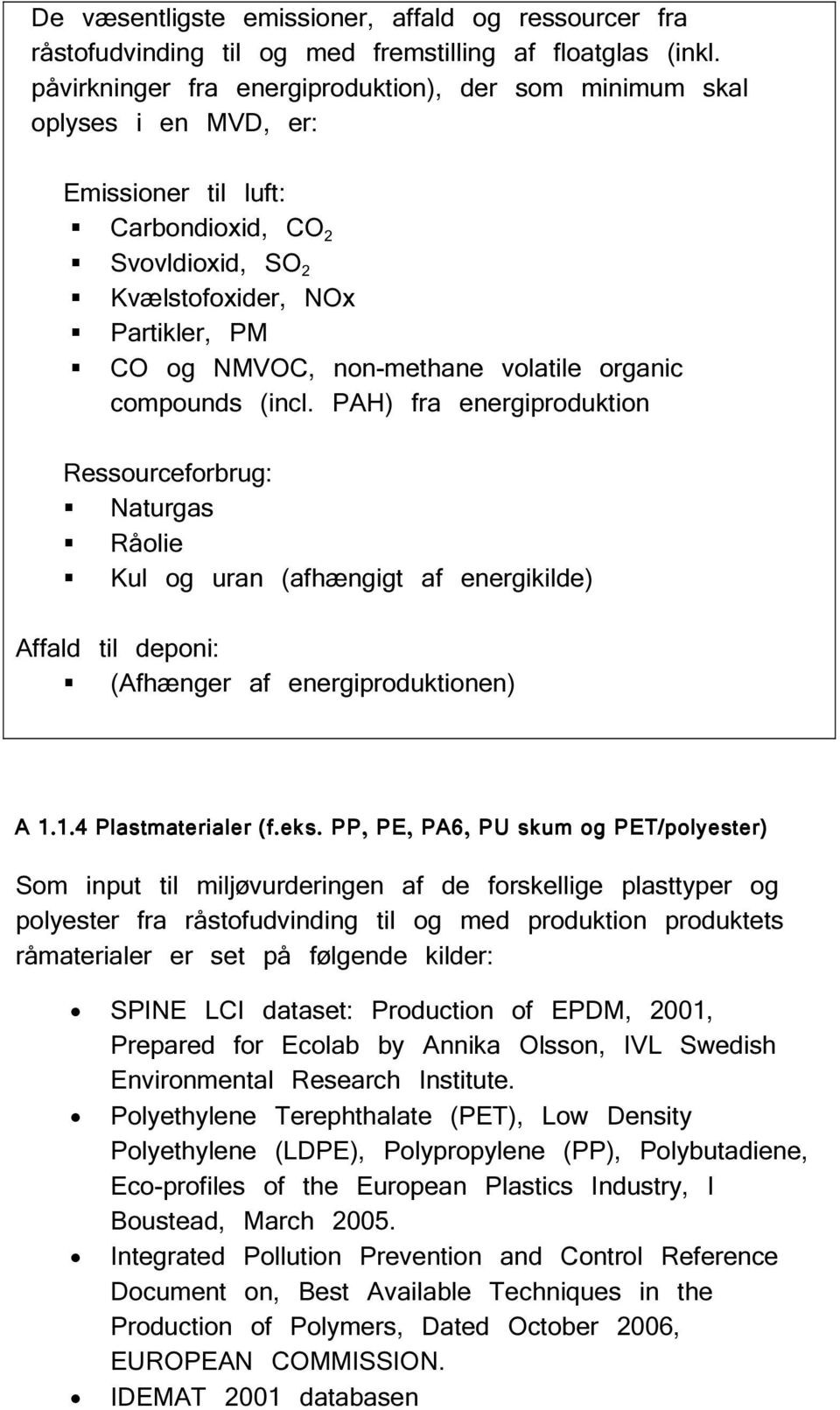
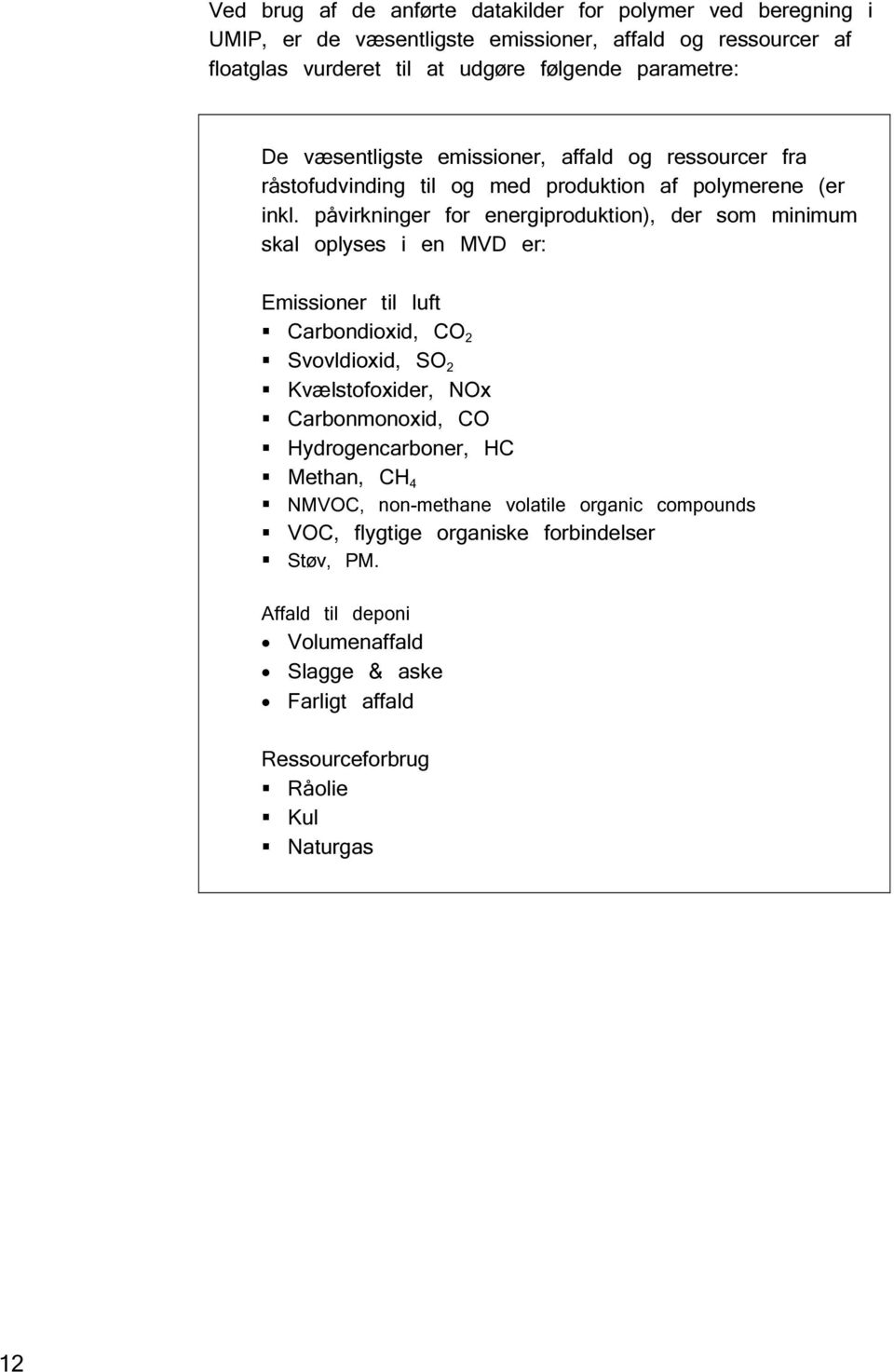
11 Ved brug af de anførte datakilder for polymer ved beregning i UMIP, er de væsentligste emissioner, affald og ressourcer af floatglas vurderet til at udgøre følgende parametre: De væsentligste emissioner, affald og ressourcer fra råstofudvinding til og med produktion af polymerene (er inkl. påvirkninger for energiproduktion), der som minimum skal oplyses i en MVD er: Emissioner til luft Carbondioxid, CO 2 Svovldioxid, SO 2 Kvælstofoxider, NOx Carbonmonoxid, CO Hydrogencarboner, HC Methan, CH 4 NMVOC, non-methane volatile organic compounds VOC, flygtige organiske forbindelser Støv, PM. Affald til deponi Volumenaffald Slagge & aske Farligt affald Ressourceforbrug Råolie Kul Naturgas 12
12 A Træ Træ indgår typisk i lounge møbler i massiv form, f.eks. i stellet/rammen eller i plader, f.eks. som bordplade. Der anvendes løvtræ og nåletræ i massivdelene og diverse blandinger i finér-, MDF- og spånplader. Som grundlag til miljøvurderingen af træ fra råstofudvinding til og med produktion af træ som massivmateriale og halvfabrikat er anvendt følgende kilder: Miljøprojekt nr. 561, 2000, Brancheanalyse af miljømæssige forhold i træ- og møbelindustrien, C.J. Kofoed et al., Trätck et al. 1997, Nordic Wood, Miljödeklaration av träindustriens produkter, Huvudrapport Junckers Miljøredegørelse 2008 Norske Skog, Annual report 2008 Ecoinvent v2.0 database, 2007 De væsentligste miljøpåvirkningerne ved skovdrift og skovning af træ kommer fra brændstofforbruget, f.eks. emissioner til luft fra benzin forbrændt i motorsav og bilmotor samt diesel forbrændt i en traktormotor. For behandlingen af træ på savværkerne er næringssalte i spildelvand og affald fundet mest betydende, idet energibehov i stor udstrækning dækkes af træfyring. De væsentligste miljøpåvirkninger ved forarbejdning af træ er relateret til dækning af det energibehov til processerne, og for overfladebehandling er det emission af VOC og energi til tørring som er betydende. Ved brug af grunddata for nåletræ fra Svensk skovproduktion 1998, opsavning og tørring på svensk savværk, 1996, og ved brug af effektfaktorer, normalisering og vægtning jf. UMIP 2003, er de væsentligste emissioner, affald og ressourceforbrug vurderet til at udgøre følgende for træ:

13 De væsentligste emissioner, affald og ressourcer fra råstofudvinding til og med afkortning af træ til salgbare effekter (er inkl. påvirkninger for energiproduktion og drivmiddel), der som minimum skal oplyses i en MVD er: Emissioner til luft Carbondioxid, CO 2 Svovldioxid, SO 2 Kvælstofoxider, NOx Carbonmonoxid, CO Hydrogencarboner, HC NMVOC, non-methane volatile organic compounds VOC, flygtige organiske forbindelser Emissioner til vand Kvælstof, N Fosfor, F Affald efter endt behandling, til deponi Farligt affald Volumenaffald Slagge & aske Ressourceforbrug Råolie Træ (afh. af træsort) Kul (hvis kulbaseret el og varme anvendes) Naturgas (hvis gasbaseret el og varme anvendes) 14

14 A Tekstil af bomuld og uld Tekstiler indgår typisk i lounge møbler som betræk af lounge stole. De væsentlige miljøpåvirkninger fra syntetiske tekstiler, som polyester, er nævnt sammen med andre plastmaterialer i afsnit A Tekstilerne bomuld og uld er derimod naturbaserede materialer. Generelt kan farvestoffer være problematiske mht. tekstilers miljøegenskaber og biocider mht. naturbaserede tekstiler. Mht. bomuld er der produktionsmæssige valg, som producenten har indflydelse på, f.eks. forbundet med: økologiske materialer valg af blødgøringsproces ingen tilsætning af ægthedsforbedrer ikke toksiske reaktivfarvestoffer. Ifølge UMIPTEX-rapporten stammer, f.eks. 98% af det totale økotoksicitets-potentiale i den undersøgte bomulds T-shirt livscyklus fra materialerne. Fordelingen mellem de vigtigste fibertyper i tekstilindustrien er [BAT Tex 2003]: - bomuld 45% - polyester 14% - viscose 12% - uld 8% - acryl 4% - silke 2% - andre 15% (I alt 100 %) Som input til miljøvurderingen af uld og bomuld fra fårhold/dyrkning til og med produktion af betræktekstiler er anvendt følgende kilder: Arbejdsrapport 3, 2006, UMIPTEX - Miljøvurdering af tekstiler, S.E. Laursen et al., 2006 Working report 10, 2002, Danish experience. Best Available Techniques - BAT - in the clothing and textile industry Integrated Pollution Prevention and Control (IPPC) Reference Document on Best Available Techniques for the Textiles Industry (BATtex) July 2003
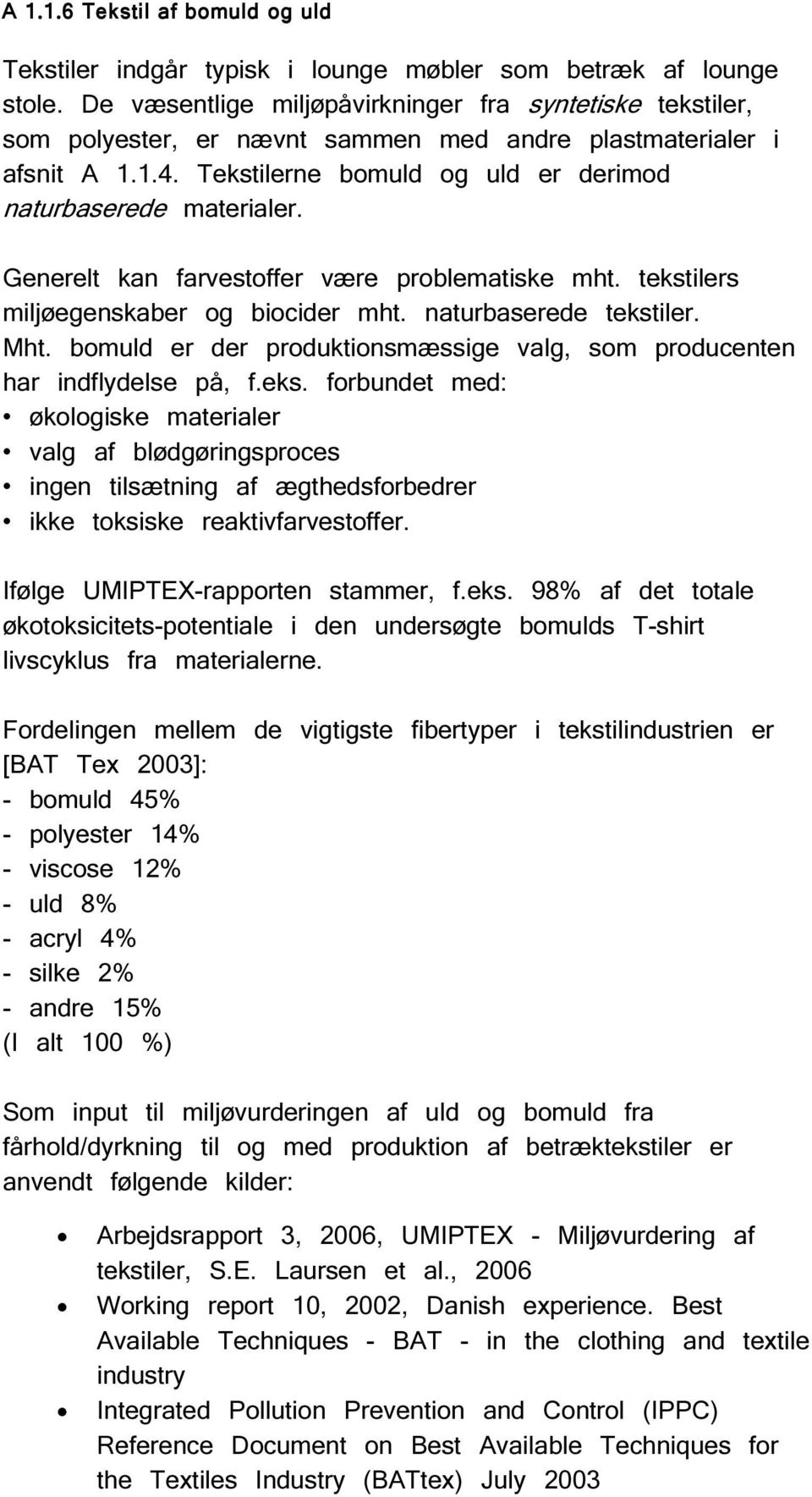
15 Ecoinvent v2.0 database, 2007 De væsentligste emissioner, affald og ressourcer fra fårhold/dyrkning til og med produktion af garn til betræktekstiler (inkl. påvirkninger for energiproduktion og drivmiddel), der som minimum skal oplyses i en MVD er: Emissioner til luft Carbondioxid, CO 2 Metan, CH 4 Lattergas, N 2 O Svovldioxid, SO 2 Kvælstofoxider, NO x Ammoniak, NH 3 NMVOC, non-methane volatile organic compounds Carbonmonoxid, CO Affald til deponi Volumenaffald Ressourcforbrug Råolie Naturgas (hvis gasbaseret el og varme anvendes) Stenkul (hvis kulbaseret el og varme anvendes) Anbefalinger mht. den bedste tilgængelige teknologi vedr. tekstil fibre er nævnt i tabellen forneden, direkte fra kilden [BATtex 2003] 16
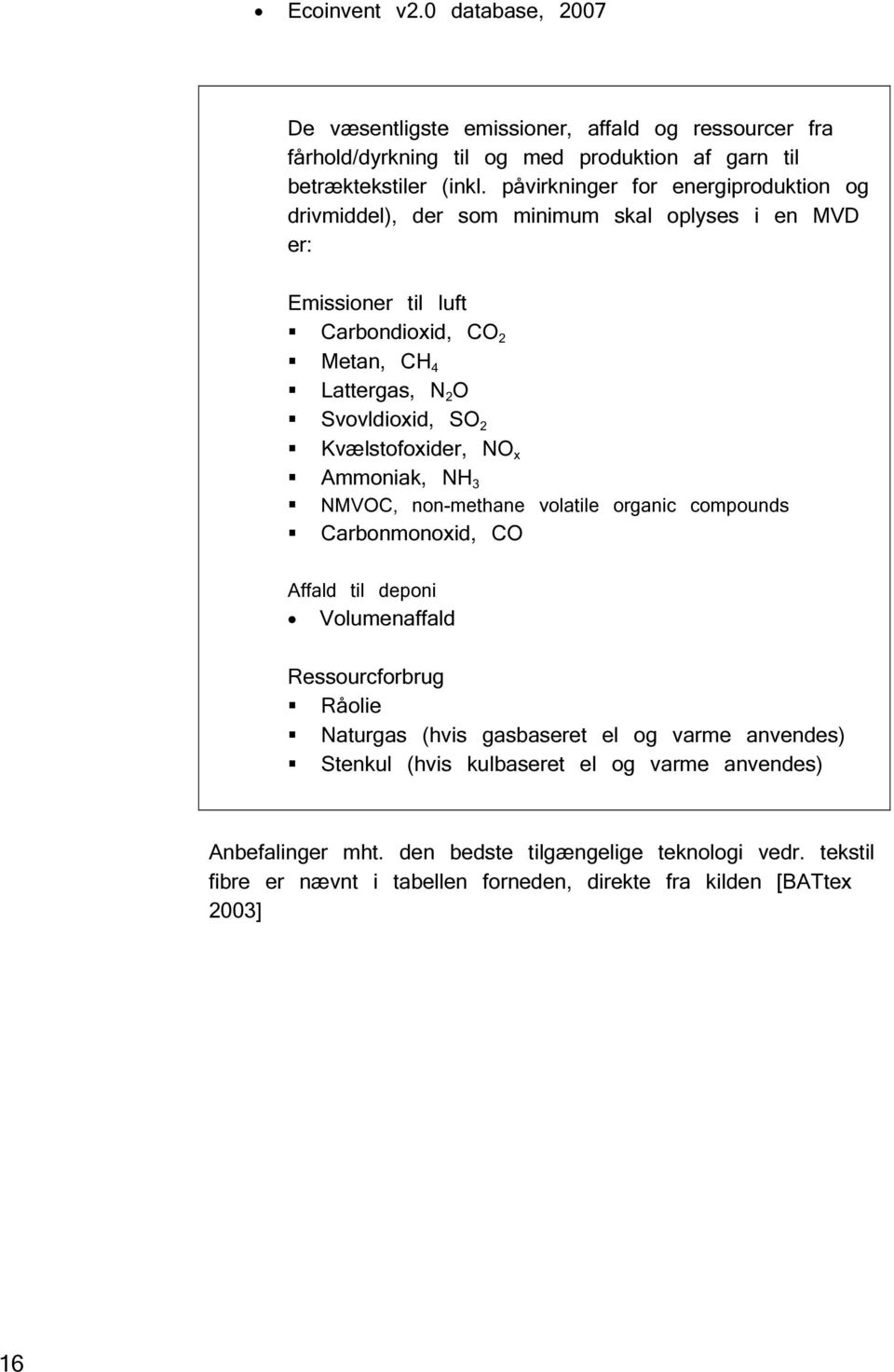
16 [BATtex 2003], side 448

17 Contents PREFACE 2 1 INTRODUCTION 4 2 DEFINITION OF THE PRODUCT CATEGORY PRODUCER OR ORGANISATION THE EPD SHALL BE VALID FOR PRODUCT DESCRIPTION CONTENTS DECLARATION THE FUNCTIONAL UNIT MINIMUM REQUIREMENTS FOR SYSTEM DELIMITATION Life cycle stages Processes in system expansion Dealing with environmental loads of common processes Data types and sources EMISSIONS, RESOURCES, ENERGY DATA, WASTE AND ENVIRONMENTAL IMPACTS TO BE DECLARED IN THE EPD OTHER ENVIRONMENTAL INFORMATION 28 3 VERIFICATION 30 4 EPD TEMPLATE 31 5 REFERENCES 32 APPENDIX 1 - TYPICAL MATERIALS 1 APPENDIX 2 FLOW CHARTS FOR TYPICAL PROCESSES RELEVANT FOR LOUNGE FURNITURE 1 1
18 Preface This document describes the Product Category Rules (PCR) for lounge chairs and lounge tables. The PCR shall be followed when developing Environmental Product Declarations (EPDs, also referred to as "Type III environmental declarations") for lounge chairs and lounge tables that are to be registered under the Danish programme for EPDs, called "MVD-DK". The Product Category Rules have been developed in the period from October 2006 to September 2009 by a PCR group representing the following organisations: Fritz Hansen A/S Aluminium Danmark Sapa Profiler A/S Steelcase Europe IPU This Product Category Rule document is reviewed by a panel consisting of: Kim Christiansen, DS (panelformand) Heidi B. Bugge, Miljømærkning Danmark Jette Lindgaard, Kvadrat A/S The Product Category Rules are verified and approved on December 8 th, 2009 and are valid until December 7 th, 2014, i.e. 5 years, under the condition that no major changes occur in the described life cycles of the product category or in the programme instructions for MVD-DK. Background literature can be found in the section "References". 2
19 3

20 1 Introduction An Environmental Product Declaration (EPD) is a quantitative documentation of the environmental properties of a product. An EPD comprises product life cycle based environmental data but can also comprise other information that is not based on the product life cycle. An EPD shall be objective and neutral. It must not comprise subjective assertions as, for instance, that the product has a good environmental profile, and it must not comprise comparisons with environmental profiles of other products. An EPD can be used for various purposes. A major purpose is that an EPD shall enable business-to-business (B2B) customers, product developers, purchasers/buyers and others to compare environmental profiles of alternative products within the same product category. The EPD shall support purchase decisions and shall therefore as far as possible show the environmental consequences of demanding and using the particular product. Furthermore, EPDs for furniture, incl. e.g. lounge chairs and lounge tables, can be used in environmental assessments of buildings in B2B communication. The Product Category Rules (PCR) in this document specify what is to be taken into account in Environmental Product Declarations (EPDs) for products within the product category lounge chairs and lounge tables. The PCR also indicate as far as possible the way in which calculations shall be performed. In this way, the Product Category Rules are meant to ensure that EPDs for different products in the product category are prepared on similar grounds and thus facilitate comparability of EPDs within the product category. The Product Category Rules comprise the following: A definition of the product category Requirements for product description and what features are to be mentioned in the EPD A definition of the functional unit (reference unit) Minimum requirements for the system scope which have to be included in the EPD, incl. life cycle stages, processes, and inputs & outputs 4
21 An expression of the type of data and data sources to be used and how the data should be collected as well as an indication of the calculation procedure for inventory data An indication of the processes which shall or may be included in system expansion An indication of how common processes for several products (co-products) are to be distributed (allocated) An indication of those emissions, resources, energy data, waste and potential environmental impacts that have to be included in the EPD An indication of substances and materials which are to be included in the contents declaration An indication of additional environmental information that may be included in the EPD For preparing an EPD under MVD-DK, the programme's EPD template shall be used. The EPD template is available through the programme secretariat at Danish Standards (DS). The rules in this PCR document are among other things based on existing ISO conforming Life Cycle Assessments (LCAs) for typical products and for related materials in the product group. Some of the LCAs are confidential but have been available for the review panel. Background materials can be found in the list of references. Two other EPD programmes have issued PCR for related product categories: i) The Swedish EPD programme "The international EPD system" has a PCR document for "Furniture; Other transportable goods" [IEPD 2009], and another one (as draft version) for "Seats" [ILV 2008]. ii) The Norwegian EPD programme "EPD-Norge" has a PCR document called "Seating solution" [NPCR003] and one called "Table" [NPCR05]. These PCR are in several aspects not conforming to the programme instructions for MVD-DK, e.g. regarding packaging and product disposal issues, regarding the required impact assessment methods, and regarding the in MVD-DK required LCA approach of assessing environmental consequences (consequential LCA). These PCR can therefore not be transferred directly to MVD-DK. 5
22 2 Definition of the product category 2.0 About the product category The product category is called: "Lounge chairs and lounge tables for indoor use". In this PCR, the product category covers tables and seating furniture for use in indoor lounge environments, such as reception areas, waiting rooms, foyers, and hotel lobbies. This PCR does not cover lounge furniture used for storage purposes. Lounge chairs and tables are designed for the primary functions of enabling relaxation and short-term task applications in private, public or business spaces. Lounge furniture thus may offer relaxed seating, little desk space and enhanced comfort in less formal, usually quiet environments. Lounge chairs and tables can be considered to offer product functionalities that build a bridge between on the one hand primarily office work-focused applications and on the other hand primarily private home-related applications. Lounge tables typically consist of 1. a table top and 2. a frame, including one or several legs (maybe incl. a foot plate or foot cross). Lounge chairs typically consist of 1. a seat - with or without a back - and 2. a frame, including one or several legs (maybe incl. a foot plate or foot cross). 6
23 Lounge chairs are produced in a great variety with and without features such as back support (this back support can be integrated with the seat in one piece) arm rests, wheels, gliders, cushioning, and upholstery In this PCR the term "lounge chairs" covers chairs to be used by one person at a time, thus including armchairs, guest chairs, chaise lounges and ottomans but excluding sofas and other seating for several persons at a time. Lounge tables in this PCR, in turn, may be used by several persons at a time, e.g. for short meetings. Due to their typical application for non-task work, lounge tables and chairs typically have neither mechanisms, nor motors or electronics, e.g. for adjustments of height, angle or the like. Products with grid power consumption and electronics are not included in this PCR as they show a different environmental profile from those without such features. Design and construction of lounge chairs and lounge tables can vary widely. Some examples for lounge chairs and lounge tables are shown below. Below: Examples of lounge chairs Below: Examples of lounge tables Lounge tables in glass and steel An upholstered lounge chair 7
24 A chaise longue in stainless steel and Another lounge table in glass and steel wicker An upholstered lounge chair A lounge table in (probably) surface-coated fibre board with a foot leg and plate in steel Secondary functions of lounge furniture are: to facilitate informal meetings to facilitate individual, short-term task work to facilitate creative discussions through providing informal, flexible surroundings This PCR is applicable for non-electricity-consuming, indoor lounge chairs and lounge tables primarily made of - steel (profiles, plates, tops; all may be chrome-plated or lacquered) - aluminium (profiles, plates, tops) - glass (plates or tops) - plastics, such as: o Polypropylene (PP) o Polyamide 6 (PA6) o glass fibre-/glass ball-reinforced PA6 (e.g. PA6GF30) o PU foam - wooden bars & boards (massive wood, soft or hard) 8
25 - wood-based boards (particle boards, veneer. May be surface-coated, e.g. with melamine) - textile fabrics (natural or synthetic) In the current first version, this PCR does not cover lounge chairs and lounge tables that - are made of leather - are made for outdoor use. Leather is excluded since leather types, qualities and treatments vary a lot and lead to accordingly varying environmental exchanges as well as to varying product life times. And for some products ageing of the leather may be intentional, for others it may not at all be intended. Outdoor application is excluded as it would set requirements on design options, material types, surface treatments, etc. especially regarding temperature, sunlight, humidity, etc. during the use stage which are very different from those for indoor use, leading to very different life cycle characteristics. However, in order to cover the full market spectrum of lounge chairs and lounge tables, leather, outdoor use and possible other issues are recommended included in a revised version of these PCR. 2.1 Producer or organisation the EPD shall be valid for The producer or organisation that the Environmental Product Declaration (EPD) shall be valid for, shall be stated under the heading "Producer". Here, the producer's or organisation's name as well as contact information incl. address, telephone number and, if applicable, website address have to be stated. 2.2 Product description The product shall be identified in the main heading of the EPD and it shall be described under the heading "Product". To be mentioned here are: The product's type, name, model/ identification no. The product's size and weight in final, assembled state (overall height, width, and depth in millimetres plus product weight in kilograms) The product s transport weight, i.e. the sum of product weight and total weight of transport packaging 9
26 The product itself, including in particular its primary function. A picture or sketch of the product. Regarding potential impacts caused by transporting the product, packaging volume can be of importance. Therefore, a statement on transport size/volume (height, width, and depth in millimetres) may be mentioned. This can be of special interest, if the product can be disassembled or needs to be assembled before first use. If the below-mentioned criteria hold true, the respective technical features and issues shall be stated in the EPD: - If the furniture can be equipped with additional features: A statement on which features are available in the particular product described in the EPD (e.g. arm rests, different upholsteries, etc.) - If the furniture consists of several materials: A statement whether or not the product can be disassembled and, if yes, how to separate the materials (disassemblability) - A statement on recyclability of the materials (preferably as percentage of the product s transport weight, i.e. of the product weight including the weight of all transport packaging) 2.3 Contents declaration Lounge furniture can be made of several materials. Table tops produced in industrial production volumes are usually made of glass, wood (incl. fibre board, plywood, etc.), metals, plastics, or stone. Table frames are usually made of steel, aluminium, or wood. Other materials do occur, as well as combinations of different materials (hybrids/composites). All these materials may be coated or in some way be surface-treated for colouring and/or surface protection. The seat of lounge chairs usually consists of steel, wood, plastics, aluminium, or natural materials (e.g. braid/basketwork). If the seat is upholstered, the upholstery will usually consist of PU foam and textile from natural and/or synthetic fibres. 10
27 If a seat shell is used, it usually consists of form-pressed plywood (incl. potentially several intermediate layers), injection moulded plastics or form-shaped composite materials. Seat frames are usually made of wood, aluminium, or steel all possibly surface-treated. Also here, other materials do occur as well as combinations of different materials. Packaging is typically but not at all limited to PE foil (i.e. polyethylene) and a cardboard box, fixed with glue, tape, and/or metal clips. The total weight of the packaged final product i.e. the transport weight shall be stated in the EPD, as well as weight percentages of the materials that represent at least 95% of the total weight. Material contents and combinations in the product shall be declared as specified in Table 1, where components, their materials, and surface treatments are listed. If cushioning and upholstery is used, it shall also be stated which substances are used to produce the cushion and, if applicable, which origin the upholstery fabrics have. If there are components in the lounge furniture that are not mentioned in Table 1, this table shall be edited in order to include them. Components mentioned in Table 1 that are not part of the product can be omitted by removing the respective row from Table 1. The geographical location of the life cycle stages raw materials extraction and production shall be stated in the contents declaration table. If the raw materials supplier is not known e.g. due to purchase at a wholesaler or trader the country of the materials trader s location shall be mentioned, e.g. materials trader in Germany. Packaging is important in order to make sure that the lounge furniture reaches a dealer and/or customer/consumer without any transportation damages. However, packaging doesn't have to be specified in more detail, if the related potential impact falls under cut-off criteria mentioned in the Programme Instructions [Bendtsen et al. 2009]. Any hazardous substances occurring with more than 1%wt shall be mentioned according to the general chemicals rules in Denmark. 11
28 Consequently, if weight percentages of materials and ancillary substances such as PVC, pigments, glue, heavy metals, brominated flame retardants, coulouring agents and PUR (polyurethane) foam are above 1%wt, they shall be mentioned too. Table 1. A generic example for a contents declaration of a lounge furniture produced in Denmark. To be modified so that it reflects the product at hand, either a lounge chair or a lounge table Component Material, substance, or fabric Surface treatment (if applicable) Amount pr. functional unit Geographic location of the marginal kg weight -% supplier Total weight of Table "nn.." not applicable x 100 Denmark the lounge furniture incl. packaging or Chair "mm.." Frame Example: Steel tube Example: chrome-plated x x Nordic steel market, supplier in Germany Shell or table top Example: Injection moulded PA6GF30 seat shell or Round flat glass (float glass) none x x European plastics market, supplier in Denmark or European flat glass market, supplier in Denmark Cushion Example: PU foam not applicable x x European plastics market, supplier in Denmark Upholstery Example: Textile fabric (e.g. polyester) not applicable x x European fabrics market, supplier in Denmark Screws, nuts, bolts Example: Steel Example: galvanised x < 5 Nordic steel market, supplier in Denmark Soft feet, spacers Example: EPDM rubber not applicable x < 5 European plastics market Packaging Example: Card board not applicable x x European card board market Other Example: glue not applicable <
29 2.4 The functional unit As mentioned earlier, lounge chairs and lounge tables are designed for the primary function of enabling relaxation and/or short-term task applications in private, public or business spaces. Regarding lounge chairs, this primary function refers to use by one person at a time. Regarding lounge tables, the primary function can refer to one or more persons at a time. In order to allow for comparing environmental impacts of different lounge chairs or lounge tables based on their functionality, the term "functional unit (FU)" is used as a reference unit. In compliance with the Programme Instructions for MVD-DK, the functional unit shall be defined based on the primary function as this is what the customer intends to acquire when purchasing the product, see p.33 [Bendtsen et al. 2009]. The primary function corresponds with primary properties, also called "obligatory properties". Based on the PCR group's professional experience, the typical lifetime of lounge furniture on the professional market is set to 10 years. For any lounge chair in the context of this PCR, the functional unit is defined as "Provision of 1 lounge seating for 10 years" For any lounge table in the context of this PCR, the functional unit is defined as "Provision of 1m 2 lounge table surface for 10 years" As described in the Programme Instructions, all EPDs within a product category shall be based on the same functional unit, and system delimitation shall be made in the same and unambiguous way for all products in the category. In order to enable sound comparisons, certain obligatory properties and positioning properties need to be stated in the EPD through further detailing the functional unit. Obligatory properties must be fulfilled by the product and by any product 13
30 that is to be compared, while positioning properties may be fulfilled by the compared product (for details, see the Programme Instructions [Bendtsen et al. 2009]). The lifetime of the different components of lounge chairs and lounge tables can vary depending on, for instance, how resistant the furniture is against wear and tear. The Programme Instructions distinguish between two types of lifetime as potential reference: a) the technical lifetime, i.e. the physically possible lifetime under normal use. b) the technological lifetime, i.e. the expected lifetime until the product gets replaced due to aesthetical, fashion or similar reasons, although the product may still be technically fully functioning. It is usually the technological lifetime that determines at what point in time lounge chairs or tables reach their disposal stage. It is more likely that a lounge table gets disposed of because it has become out of fashion rather than because it is physically worn out so that it cannot be used any more. As an exception from the above rule, for design icons and iconic design furniture the appropriate lifetime may well be the technical lifetime, and this may be extremely long, e.g. 100 years or more (e.g. for iconic chairs, that simply aren't being disposed of and would get repaired if broken). However, as EPDs are to be used especially in business-tobusiness relation, i.e. on the professional market, the technological lifetime is to be stated and used as reference lifetime. There are no specific rules as to how any lifetimes are to be determined. Usually, the guarantee period of the producer gives a useful indication. Regarding lounge chairs, the following functional unit and related properties and requirements must be specified in the EPD in order to ensure comparability between different products in the product category: The functional unit to be used: "Provision of a seating for one person for 10 years" (if relevant; this refers to 2 hours a day and a person weighing up to 100 kg) 14
31 Lifetime to be applied: Shortest technological lifetime for typical use in the professional market. Obligatory properties (i.e. have to be fulfilled by any product in the category): Comfortable, primarily short-term seating in lounge areas; Examples of positioning properties (i.e. may be fulfilled by any product in the category and may be stated) - Features of stability, load and balance, e.g. option for rotating and/or tilting - Upholstery & cushioning - Existence of arm rests, and, if applicable: arm rest adjustability (1-, 2- or 3-dimensional) - Adaptability/replaceability of features (e.g. of upholstery) - Existence of castors - Low overall weight Availability in different colours/configurations Regarding lounge tables, the following functional unit and related properties and requirements must be specified in the EPD in order to ensure comparability between different products in the product category: The functional unit to be used: "Provision of 1 m 2 table surface for 10 years" (if relevant; this refers to 2 hours a day) Lifetime to be applied: Shortest technological lifetime for typical use in the professional market. Obligatory properties (i.e. have to be fulfilled by any product in the category): Primarily short-term desk space in lounge areas; Examples of positioning properties (i.e. may be fulfilled by any product in the category and may be stated) - Features of stability, load and balance, e.g. if one-legged: option for rotating - Possibility of height adjustment - Low overall weight Availability in different colours/configurations Lounge chairs and tables also offer a number of secondary functions, such as that they may create a relaxed atmosphere and thus enable a less formal way of collaborating or working, and thus may e.g. support creative thinking in work places. However, such secondary functions are relatively difficult to specify and quantify and are therefore not relevant to be stated in the EPD. 15
32 The product lifetime and the functional unit stated in the EPD shall enable the customer to compare products with different characteristics. In order to enable comparisons, all EPDs based on this PCR shall state impacts for the same, general functional unit. At the same time, a factor shall be stated in the EPD that relates the functional-unit-based product impacts to the impacts from one actual product. This is because the general functional unit may for instance be fulfilled by half a table of a certain type and 1.3 tables of a different type. An example with two lounge tables that are to be compared: Lounge table A has a surface area of 0.5 m 2 and a lifetime of 10 years Lounge table B has a surface area of 0.4 m 2 and a lifetime of 15 years These two alternatives can be compared by their functionality measured in "m 2 of surface area * years". The general functional unit for lounge tables given in Table 3 is: "1m 2 of surface area for 10 years", equalling "10 m 2 surface area * years". Lounge table A with 0.5 m 2 * 10 years thus equals 5 m 2 surface area * years, i.e. it takes 2 products to fulfil the general functional unit from Table 3, leading to a conversion factor of 2 that is to be stated in the EPD of lounge table A. Lounge table B with 0.4 m 2 * 15 years equals 6 m 2 surface area*years, i.e. it takes 1.67 products to fulfil the functional unit from Table 3, leading to a conversion factor of 1.67 that is to be stated in the EPD of lounge table B. The factor which is needed to relate one product in the EPD to the general functional unit shall be specified in the EPD. 2.5 Minimum requirements for system delimitation Life cycle stages The EPD shall present an overview of all processes within the entire life cycle of the lounge chair or lounge table. In 16
33 particular, an EPD for a lounge chair or lounge table has to include data for the following life cycle stages: Materials stage comprising all processes of raw materials extraction and production of semi-manufactured goods, i.e. the cradle-to-factory gate processes Transport stage comprising all major distribution and transport processes throughout the entire life cycle, especially from suppliers to the manufacturer and from the manufacturer to the customer Production stage comprising all processes at the manufacturer's site End-of-life stage comprising disposal processes such as dismantling, recycling, incineration, landfill and, if applicable, credit for avoided production of primary energy and of materials The use stage does not have to be included since the impacts from this stage are negligible, even in extreme scenarios for use of cleaning agents, (see Appendix 2). It shall be clearly stated in the EPD, exactly which stages are covered. The below conditions apply within the different life cycle stages: Materials stage All materials and semi-manufactured goods (such as steel tube) as described in Section 2.3 and Table 1 have to be included in the EPD. Potential processes (e.g. surface treatments) related to those materials or semi-manufactured goods have to be included in this stage as well. Transport of raw materials/ ingredients to suppliers shall also be included here. Transport stage Transport processes from suppliers to the furniture manufacturer as well as transport processes from the furniture manufacturer to the dealer and/or further on to the customer shall be included in the EPD since their contribution often is not insignificant, compare [G3 2006, G5 2006, Miljøprojekter nr. 376 &571]. Usually, the dealer location is known while the customer location is not. Usually, dealers are located with a relatively short distance to a customer. Therefore, if the end customer is not known, the distance to the dealer is to be stated. However, if the end customer is known, the distance to the end customer s location is to be stated. Other transport 17
34 processes shall be ascribed to either the materials stage or the end-of-life stage. The lounge table or lounge chair will usually be sold in many different countries, making it difficult to calculate a distance from manufacturer to an average dealer/customer. The transport distance from manufacturer to dealer/customer shall therefore be calculated as the weighted average distance of the transport distances to the capitals of the major markets/countries where the product is sold or, for new products, assumed to be sold (80% of the products or more). Distances to locations with high sales share thus obtain a higher weight relative to distances to locations with lower sales shares. Unless known specifically (and then to be stated in the EPD), the modelled means of transportation for distribution from manufacturers to dealers/customers shall be heavy trucks i.e. neither train, nor ship, nor light lorries. Production stage All production processes from materials or semi-manufactured goods to the final product, ready for shipping, have to be included in the EPD under this stage. Also potential overhead consumption, i.e. heating, lighting, air-conditioning, etc. is to be stated here. Use stage The use stage does not have to be included in the EPD, since it most often leads to insignificant contributions. According to product LCAs e.g. two LCAs performed on a lounge chair and lounge table of a Danish manufacturer [G3 2006; G5 2006], the use stages have no significant influence on the life cycle impacts of those product types, This is the case, even if values for consumption of polish, textile shampoo and similar cleaning products as well as vacuum cleaning applied during the use stage are estimated relatively high. LCAs on office furniture products, e.g. [SC , Gamage et al. 2008], and furniture products in general support the same conclusion regarding the use stage. For lounge chairs and lounge tables with typical use patterns and life times, potential impacts from product use can therefore be omitted in an EPD. If they are not omitted, they shall be stated as a separate stage and not as part of any of the other stages mentioned in section of this PCR. 18
35 This is in accordance with the Program Instructions for MVD-DK [Bendtsen et al. 2009], Tables 7 & 8, p. 40/41. End-of-life stage For EPDs of lounge chairs and lounge tables that are assumed disposed of in Denmark, the following disposal ways are to be used: For materials easily separable from the product - i.e. in a few moments, by the end-user, and without using special tools: Steel, aluminium and other metals are disposed to recycling Glass is disposed to recycling Plastics and rubber (all non-pvc) are disposed to incineration with energy recovery. For materials not easily separable from the product: Landfilling or incineration may be assumed depending on the standards in the location of disposal Disposal information on furniture in general is supplied by e.g. Waste Centre Denmark [Affaldsinfo.dk] For disposal in European countries, data on disposal options and shares may be found through the tool "Wastebase" of the European Topic Centre on Sustainable Consumption and Production [ETCSCP]. Furthermore, see the Programme instructions for MVD-DK. Transport processes from the customer to a disposal facility shall be included in this stage. Disposal of lounge furniture is generally assumed 10 years in the future - and can be even longer away in time. As it is difficult to predict the relevant (marginal) disposal technologies in the future, those technologies applicable at the time of preparing the EPD and 5 years on have to be used as grounds for the EPD. Specific substances harmful to environment and human health As far as substances are used that are listed on the Danish EPA s List of Effects on specific, environment or health damaging substances, 2009 these have to be mentioned with the name of the substance or in a dedicated row on the 19
36 emission table in the EPD (see Section 2.6) called Substances on the List of Effects. Earlier it was for instance paints, lacquers and glues that included these hazardous substances. Over the years the industry has phased out or substantially reduced emissions of a number of these substances, e.g. biocides and VOCs due to a European and Danish law 1. Also, powder lacquering is used widely in Europe now instead of e.g. solvent-based lacquering. Figure 1 below shows the overall life cycle stages to be included in the EPD, namely materials stage, production stage, transport stage, and end-of-life stage. Figure 1.The four life cycle stages which shall be included in the EPD. The flow charts in Appendix 2 illustrate typical chains of processes for lounge chairs and lounge tables. 1 The Danish VOC-bekendtgørelse nr. 350 of 29th May 2002 that emerged from EU Directive 13/1999 and VOC-produktbekendtgørelsen nr of 27th October 2005, that emerged from EU Directive 2004/42/EF. And The European Parliament s &Council s Directive 98/8/EF on marketing of biocide containing products 20
37 2.5.2 Processes in system expansion Those products/services that should be displaced (in the sense of "made unnecessary") by co-products/co-services of the assessed product shall be subtracted from the system. Examples for typical secondary products are given in Table 4, including data references. Table 2. Secondary products and data references in system expansion Secondary product Displaced product Data source for displaced product Geographical location/area Heat production in case of disposal through incineration (e.g. of plastics, wood, textiles) Depends on the heat supply in the respective country and on local conditions See Table 7 See Table 7 Electricity production in Depends on the See Table 7 Europe case of disposal electricity supply through incineration in the respective (e.g. of plastics, wood, country and textiles) possibly on local conditions Aluminium disposed to Primary aluminium See Table 6 Global re-smelting (recycling) bars Plastics (e.g. PP, PE) Primary plastics See Table 6 Europe disposed to recycling granulate/resin. Glass disposed to remelting Primary glass (and partly secondary) See Table 6 See Table 6 Steel disposed to remelting Primary steel See Table 6 Global Secondary products that are not mentioned in Table 4 shall be briefly described, and for the displaced products, data types and data sources for each life cycle stage shall be used as stated in the Programme instructions for MVD-DK, section 9.4 in [Bendtsen et al. 2009]. 21
38 2.5.3 Dealing with environmental loads of common processes System expansion should be preferred over allocation. If it is not possible to use the system expansion method, allocation based on e.g. weight or volume can be applied. Therefore, mention briefly those secondary services or common processes (co-processes) which are not calculated as displaced under system expansion and apply the following rules for allocation: Recycling of materials: Allocate according to the allocation model in the Programme instructions for MVD-DK, [Bendtsen et al. 2009]. Co-production/co-processes: Allocate according to the allocation model in the Programme instructions for MVD-DK, [Bendtsen et al. 2009] Data types and sources It is intended to establish a database with data to be used for EPDs under MVD-DK. In the meantime, the general rule is, that the practitioner preparing the EPD shall use appropriate data found in existing sources. As an initial guidance, for the typical materials in the product category, the data given in Table 3 can be used - unless there are specific data from any marginal supplier(s) the manufacturer definitely would purchase at within the 5 years of validity of the EPD. For disposal processes, data as given in Table 4 can be used, and for electricity and heat the data in Table 5. If there, during preparation of the EPD, should be access to more recent data than those given in Tables 3-5 and, if those data are representative for the processes and materials of the product in question, those data may be used instead. Whenever different data sources are used, it is pointed out that those different sources can include diverse ways of allocation, system delimitation, etc. All data and sources have to be mentioned in the EPD background report. Table 3. Data for materials 22
39 Material Data source Geographical location/area Primary aluminium and its processing Primary plastics, synthetic textiles Flat glass. E.g. from Swedish producer Other flat glass Primary steel Soft wood (foresting & harvesting) Soft wood (cutting & drying) Pine wood (foresting & harvesting) (continued) Pine wood(cutting & drying) Wood (massive) Wood particle board Wool Cotton Rubber Life Cycle Inventory data for aluminium production and transformation processes in Europe, Environmental Profile Report for the European Aluminium Industry, April 2008 Data from PlasticsEurope (formerly: APME) 2005 or newer, if available from Pilkington Sweden, 2008 possibly: Data from Ecoinvent [EI] "Flat glass uncoated, at plant/rer U" International Iron and Steel Institute, Tel: +32(0) , UMIP, MT120 UMIP, MT123 Pine log (44% water content) European Platform on LCA Timber pine (40% water content) European Platform on LCA possibly: Data from Ecoinvent database e.g. Sawn timber, softwood, raw, plant-debarked, u=70%, at plant/rer U" possibly: Data from Ecoinvent Particle board, indoor use, at plant/rer U" possibly: Data from Ecoinvent Wool, sheep, at farm/us U" possibly: Data from Ecoinvent Textile, woven cotton, at plant/glo U possibly: Data from Ecoinvent EPDM rubber, "Synthetic rubber, at plant/rer U" Europe Europe Sweden Western Europe Europe Sweden Sweden Germany Germany Europe Europe United States Global Western Europe For data search in general, the following sources may be helpful: International Reference Life Cycle Data System [ILCD 2009] Ecoinvent [EI] 23
40 Table 4. Data references for disposal Disposal process Data source Geographical location/area Waste incineration, construction steel Waste incineration, Glass Waste incineration, stainless steel Incineration of cast iron and low-allow construction steel. Waste incineration, copper Waste incineration, zinc Incineration of aluminium with thickness between 0.05 mm and 0.25 mm Table 6. continued Incineration of aluminium with thickness over 0.25 mm Waste incineration, cardboard UMIP, DKTEK-MGR-B2017 DK Ref. year 2000* UMIP, DKTEK-MGR-B2014, Ref. year DK 2000*. UMIP, DKTEK-MGR-B2015 DK Ref. year DKTEK-MGR-B2018 DK Ref. year 2000*. DKTEK-MGR-B2019 DK Ref. year 2000*. DKTEK-MGR-B2020 DK Ref. year 2000*. DKTEK-MGR-B2022 DK Ref. year 2000*. DKTEK-MGR-B2023 DK Ref. year 2000*. DKTEK-MGR-B2011 DK Ref. year 2000*. (continued) Re-melting of steel IPU-MSH-B0009 Global Rebar EAF* Re-melting of steel IPU-NF-B2382 DK into profiles Det Danske Stålvalsev rk, 2000*. Re-granulating, plast IPU-NF-B2440 DK (PE) "ren" Replast AS, 2000* Landfill ELCD EU-27 * [N. Frees, et al. 2004] Table 5. Data references for electricity and heat (used for production processes, overhead etc.) Material / Process Data source Geographical 24
41 (short term, i.e. 5 years) Marginal electricity from grid in DK Electricity from national grids in Europe District heating De-central-/local heat production Heat from CHP plants EPD from Energinet.dk 2011 Electricity mix AC; Average consumption mix at consumer; 220V. year 2002 [ILCD 2009] (under preparation within MVD- DK) Thermal energy from natural gas; combined heat and power plant (CHP); at power plant, 2002 [ILCD 2009] location/area DK AT, BE, CH, CZ, DE, DK, EE, ES, FI, FR, GB, GR, HU, IS, IT, LT, LU, LV, NL, NO, PL, PT, SE, SI, SK DK DK Europe For other materials and processes the data types and data sources given in the Programme instructions for MVD-DK shall be used. 2.6 Emissions, resources, energy data, waste and Environmental impacts to be declared in the EPD The columns in Table 6 show main materials and processes influencing the environmental profiles of lounge furniture products. The parameters shown in the rows of Table 6 shall be derived from an LCA and summarised in the EPD and be stated per functional unit. Important: Table 6 has to be extended by appropriate rows and columns, if there occur specific, hazardous substances during the life cycle of the product, e.g. those from the Danish EPA s List of Effect, Biocide Directive or the like, see Section
42 Table 6. Obligatory emissions, resources and waste types (gram/functional unit) Where an "x" is set, materials emissions shall include emissions from related electricity production. Emissions to air Aluminium (raw materials extraction incl. Al production and re- Plastics (raw materials extraction incl. plastics Carbon dioxide, CO 2 X X X X X X X X X X Sulphur dioxide, SO 2 X X X X X X X X X X Nitrogen oxides, NO x X X X X X X X X X X Carbon monoxide, CO Ammoniak, NH 3 X X X X X X X Methane, CH 4 X X X X X X X NMVOC X X X X X Volatile organic compounds, VOC X X Hydrogen carbons, HC X X X X X X Benzene, C 6 H 6 X X X Other unspecified organic compounds X X Iron, Fe X production) Glass (raw materials Fluoride(s), HF, F - X X Hydrogen chloride, HCl X X Heavy metals in general X X X X Particles, PM X X X Other substances from the List of Effect 2 extraction incl. float glass production and re-smelting Steel (raw materials extraction incl. steel production) X X X X X X X X X X Wood (harvested and cut) Wool & cotton X Polyester fabric (raw materials extraction incl. textile production) Surface treatments (specify) Transport (raw materials extraction for fuel production and combustion Energy production Emissions to water Oil Iron, Fe Copper, Cu Zinc, Zn X X X X COD/BOD X X Heavy metals in general X X X X Other substances from the List of X X X X X X X X X X Effect 2 Waste to landfill Hazardous waste acc. to EU X X X classification Bulk waste X X X X X X X X Slag and ashes X X X X Radioactive waste X Resources Crude oil X X X X X X X X X X 2 The Danish EPA s List of Effect, 2009 or later (in Danish) 26
43 Natural gas X X X X X X X X Coal X X X X X X X X X Brown coal (lignite) X X X X X X X Uranium X X Hard wood X Soft wood X Aluminium X X Iron X In addition, energy requirements shall be stated as total primary energy per life cycle stage, and if possible, separated in fuel energy and feedstock energy: Fuel energy: The process energy required to extract raw materials and produce the material, in (MJ /functional unit) Feedstock energy: Material-inherent energy that may be recovered through incineration (calorific value), in (MJ/functional unit) The above emissions to air and water shall be converted into contributions to the six environmental impact categories given below. For the calculation, conversion factors found in the Programme instructions for MVD-DK are to be used. Environmental impact categories and units to be stated per functional unit: Global warming (Greenhouse effect), in [kg CO 2 -eqv.] Ozone depletion, in [kg CFC11-eqv.] Acidification, in [kg SO 2 -eqv.] Photochemical smog, in [kg C 2 H 4 -eqv.] Eutrophication, in [kg NO 3 -eqv.] Primary energy (if possible, separated in fuel and feedstock energy), in [MJ] 27
44 2.7 Other environmental information The below questionnaire has to be filled out and shall be shown in the EPD in the form it has below. Disassembly: (place check mark: X) Is it possible with common tools to dismantle the whole product in order to recycle each component? No: Yes: Environmental management: (place check mark: X) Do all or some of the production facilities in the life No: cycle have certified environmental management Yes: systems? The following production facilities are registered under the European Environmental Management and Audit Scheme, EMAS: Xxx The following production facilities are certified in accordance with ISO 14001: xxx logo?? xxxx Working environmental management: (place check mark: X) Are all or some production facilities in the life cycle certified in accordance with OHSAS 18001? No: Yes: The following production facilities are certified: logo?? xxxx Ecolabels: (place check mark: X) Does the product have a license under one or more No: Type I ecolabel systems? (State below as appropriate, delete inappropriate) Yes: xxxx xxxx Xxxx Xxxx Xxxx 28
45 (PEFC, FSC, other) xxxx 29
46 3 Verification Verification of the EPD shall take place according to Procedure for verification of EPD, version xx måned-år (in Danish) and Guidance document for verification of EPD, version xx månedår (in Danish). The verification shall be performed of an authorised verifier, representing an independent 3 rd party. It is recommended that the individuals preparing the EPD cross check their draft EPD against the requirements in the above named guidance document prior to sending it to verification. Review of PCR and Verification of EPD: Review of these PCR is performed by the following individuals on (date: day, month, year): o Panel chairman: (name) o (name, Industry person 1) o (name, Industry person 2) An independent 3 rd party verification of EPD and data is performed according to ISO on date (day, month, year) by: o 3 rd party verifier: (first name, last name) 30
47 4 EPD template The EPD shall be presented in the format defined in the EPD template, version XX day-month-year, for registration under the Danish programme MVD-DK. The template can be ordered at the MVD secretariat: MVD-DK Danish Standards (DS) Kollegievej 6 DK-2920 Charlottenlund Denmark Telephone: Telefax: [email protected] The headings given in the template and their sequence are invariable, and neither font type, nor font size, nor layout may be altered in any way. The MVD secretariat (DS) provides template and MVD-DK logo to companies that register for participating in the programme. The template is not publicly available. When verified under MVD-DK, a company will be entitled to use the MVD-DK logo on packaging or other marketing materials under well-defined conditions. 31
48 5 References [Affaldsinfo.dk] Waste Centre Denmark (in Danish: Videncenter for Affald), [G3 2006] Members of Group 3, Confidential LCA on lounge chair "Space" by Fritz Hansen A/S, autumn 2006 [G5 2006] Members of Group 5; A.N. Ahmed, D. O. Dyhr, S. Delpont, X. Le Mestre, Confidential LCA on lounge table "Space" by Fritz Hansen A/S, autumn 2006 [EI] Ecoinvent database, continuously updated, Swiss Centre for Life Cycle Inventories, [ETCSCP] European Topic Centre on Sustainable Consumption and Production, incl. the tool "Wastebase" [ELCD 2009] European Commission - Joint Research Centre - Institute for Environment and Sustainability; "European Reference Life Cycle Database (ELCD), version II", under further development, [IEPD 2009] The International EPD System, "PCR Basic Module - CPC Division 38 - Furniture; other transportable goods", Version 1.0, , [ILCD 2009] European Commission - Joint Research Centre - Institute for Environment and Sustainability; "International Reference Life Cycle Data System (ILCD)", various documents and database, under further development, [IVL 2008] Product Category Rules (PCR) for Environmental Product Declaration (EPD): UN CPC Class 3811: Seats, DRAFT, , Prepared by IVL Swedish Environmental Research Institute Ltd, [N. Frees, et al. 2004], Opdatering, fejlretning og oversættelse af UMIP-databasen, Arbejdsrapport fra Miljøstyrelsen nr. 6, 2004, - 2. opdatering. N. Frees, et al
49 [O. Dal, et al 2003I], Ressourcebesparelser ved affaldsbehandlingen i Danmark, Miljøprojekt nr. 804, O. Dal, et al 2003I. [NPCR003] Product-category rules (PCR) for preparing an Environmental Product Declaration (EPD) for Product Group "Seating solution", NPCR003, revised version, October 2008 [NPCR05] Product-category rules (PCR) for preparing an Environmental Product Declaration (EPD) for Product Group "Table", NPCR05, 21.December 2005 [Schmidt/Strömberg 2006] A. Schmidt and K. Strömberg, Genanvendelse i LCA systemudvidelse, Miljønyt nr. 81, (translated: "Recycling in LCA System expansion") published by Danish EPA in 2006: only in Danish. [SC ] Confidential LCAs on tables and seating products for Steelcase Europe, [UMIPtex 2006], S.E. Laursen et al., UMIPTEX - Miljøvurdering af tekstiler Arbejdsrapport 3, 2006, Miljøstyrelsen [Wenzel et al. 1996] H. Wenzel, M. Hauschild, L. Alting, Miljøvurdering af produkter, Instituttet for Produktudvikling, Danmarks Tekniske Universitet, Marts Kan købes via [Wenzel et al. 1997] H. Wenzel, M. Hauschild, L. Alting, "Environmental Assessment of Products Vol. 1 Methodology, tools and case studies in product development", 1997, Chapman-Hall, Cambridge, UK DS ISO 14025:2006 Environmental labels and declarations Type III environmental declarations Principles and procedures (in short referred to as "ISO 14025") ISO 14024, Environmental labels and declarations Type I environmental labelling Principles and procedures Miljøprojekt nr. 376, 1998 : "Miljøvurdering og udvikling af et reolsystem - Et eksempel fra Montana Møbler A/S" Miljøprojekt nr. 561, 2000: "Brancheanalyse af miljømæssige forhold i træ- og møbelindustrien" 33
50 MVD-DK programme documents: [Bendtsen et al. 2009] Ninkie Bendtsen, Christian Poll, Birgitte Nielsen, Charlotte V. Fischer and Kim Christiansen, "Programinstruktioner for MVD-DK Program for miljøvaredeklarationer" (translated: "Programme instructions for MVD-DK Programme for environmental product declarations", in Danish), Miljøprojekt Nr , available from XX 2007, Forslag til verifikation af PSR", xx måned år, MVD.dk sekretariatet Kan læses på XX 2007, PSR-vejledning version xx måned år, MVD.dk sektariatet Kan læses på Related literature: CEN/TC350: European Committee for Standardization (CEN), Technical Committee 350, standards under development, incl. SUSTAINABILITY OF CONSTRUCTION WORKS with several parts, incl. Assessment of buildings, Assessment of environmental performance of buildings - Calculation method, Environmental product declarations - Communication format business-to-business LEED: Leadership in Environmental and Energy Design, LEED; certification system of the US Green Building Council, [Gamage et al., 2008] Gayathri Barenda Gamage, Carol Boyle, Sarah J. McLaren, Jake McLaren: " Life cycle assessment of commercial furniture: a case study of Formway LIFE chair", Int J LCA (2008) 13: Livscykelanalys av färg, ISO Environmental management systems DS/EN ISO 14040:2006 Environmental management life cycle assessment Principles and framework (also referred to as "ISO 14040") 34
51 DS/EN ISO 14044:2006 Environmental management Lifecycle assessment Requirements and guidelines (also referred to as "ISO 14044") DS/EN ISO 14020:2002 Environmental labels and declarations general principles (also referred to as "ISO 14020") DS/EN ISO 14021:2001 Environmental labels and declarations - Self-declared environmental claims (Type II environmental labelling) (also referred to as "ISO 14021") Svanemerking av Møbler og innredninger Versjon mars mars 2007 EU Directive 67/548/EEC (Dangerous Substance Directive) EU Directive 1999/45/EC (Dangerous Preparation Directive). EU Directives 91/689/EEC and 75/442/EEC (Hazardous waste) EU Directive 94/62/EF (packaging and packaging waste) EU Directive 2004/12/EF (amending Directive on packaging and packaging waste) The Danish Statutory Order No. 298 of 30 April 1997 (BAT -Glass Industry, 2001 EU), Integrated Pollution Prevention and Control (IPPC), Reference Document on Best Available Techniques in the Glass Industry, December 2001 EUROPEAN COMMISSION. (BAT -Glass Manufacturing Industry, 2001 EU), Integrated Pollution Prevention and Control (IPPC), Reference Document on Best Available Techniques in the Glass Manufacturing Industry, December 2001 EUROPEAN COMMISSION. (BAT -Glass Manufacturing Industry, 2001 EU), Integrated Pollution Prevention and Control (IPPC), Reference Document on Best Available Techniques in the Textiles Industry, July 2003 EUROPEAN COMMISSION Pilkington glass, PlasticsEurope, Eco-profiles, 35
52 (BAT, Non Ferrous Metals Industries, 2001 EU), Integrated Pollution Prevention and Control (IPPC), Reference Document on Best Available Techniques in the Non Ferrous Metals Industries, December 2001, EUROPEAN COMMISSION, (EAA, 2008), Environmental Profile Report for the European Aluminium Industry, Life Cycle Inventory data for aluminium production and transformation processes in Europe, April 2008, European Aluminium Association, EAA. (IAI, 2003), Life Cycle Assessment of Aluminium, Inventory data for the worldwide primary Aluminium Industry, March 2003, International Aluminium Institute. (Miljøprojekt 478/1999), Miljøprofiler for aluminium i et livscyklusperspektiv, E. Hansen et al. Miljøprojekt 478/1999, udgivet af Miljøstyrelsen, (Miljøprojekt 1103/2006), Miljø- og sundhedsforhold for plastmaterialer, A. Schmidt, Miljøprojekt 1103/2006, for Miljøstyrelsen, (BAT, Production of Polymers 2006), Integrated Pollution Prevention and Control, Reference Document on Best Available Techniques in the Production of Polymers, October (BAT, Iron and Steel, 2001), Integrated Pollution Prevention and Control (IPPC), Best Available Techniques Document on the Production of Iron and Steel, December 2001, EUROPEAN COMMISSION, (Miljøstyrelsen, 6/2004), Data er leveret af International Iron and Steel Institute, IISI, til Miljøstyrelsens opdateringsprojekt Arbejdsrapport fra Miljøstyrelsen, 6/2004. (PSR Steel SE, 2005), Product-specific requirements, Steel Products, PSR 2002:1, The Swedish Environmental Management Council, Version 1.1,
53 37
54
55 Appendix 1 - Typical materials (separat fil) 1
56 2
57 Appendix 2 Flow charts for typical processes relevant for lounge furniture 1
58 METALS Extraction of iron ore Extraction of bauxite Raw materials extraction Production of steel Production of aluminium Production of semimanufactured goods Production of steel plates, profiles and pipes Production of aluminium plates, profiles and pipes Metal finishing Production of final product Shaping of frame, fittings, design details, etc. Degreasing /Pretreatment Surface treatment Assembling of furniture (see separate flow chart) Flow chart 1: production of the metals aluminium and steel used in Lounge furniture 2
59 PLASTICS AND CUSHIONING MATERIALS Extraction of oil and natural gas Extraction Production of polyester fibre Refining of oil Production of semimanufactured goods Production of laminate (see Production of final product Production of plastic and stuffing materials Production of glue, lacquer and paint Assembling of furniture (see separate flow chart) Finishing of timber (see separate flow Flow chart 2: production of plastics and cushioning material 3
60 UPHOLSTERY TEXTILE Extraction Sheep-farming Production of pure wool Production of semimanufactured goods Production of polyester fibre (see separate flow chart) Process chemicals Spinning, weaving, dyeing, and finishing treatment. Production of final product Upholstery textile Assembling of furniture (see separate flow chart) Flow chart 3: production of upholstery textile 4
61 GLASS Extraction Collection of sand Production of glass Production of semimanufactured goods Production of glass plates Frame, shelf, fittings, design Production of final product Surface treatment Assembling of furniture (see separate flow chart) Flow chart 4: production of glass 5
62 ASSEMBLY OF FURNITURE AND SUBSEQUENT LIFE CYCLE PROCESSES Production stage Assembling of furniture Packing (Use of the furniture) Use stage Disposal of furniture End-of-life stage Disassembly Recycling of materials such as steel, aluminium & plastics Incineration of materials Landfill Flow chart 5: Assembly of furniture and subsequent disposal processes 6
KALK- OG TEGLVÆRKSFORENINGEN. CPR Sustainable Construction
 CPR Sustainable Construction 1 Tommy Bisgaard - Direktør i Kalk- og Teglværksforeningen - Formand for DS 417 (CEN TC350 & 351) - Formand for miljøkomiteen i TBE & CU (keramiske industrier i Europa) - Medlem
Statistical information form the Danish EPC database - use for the building stock model in Denmark
 Statistical information form the Danish EPC database - use for the building stock model in Denmark Kim B. Wittchen Danish Building Research Institute, SBi AALBORG UNIVERSITY Certification of buildings
Basic statistics for experimental medical researchers
 Basic statistics for experimental medical researchers Sample size calculations September 15th 2016 Christian Pipper Department of public health (IFSV) Faculty of Health and Medicinal Science (SUND) E-mail:
Tork Aftørringspapir Standard, M1. Fordel. Produktspecifikation. Beskrivelse. Farve: Hvid Type: Mini Centerfeed Rulle
 Fordel Allround aftørringspapir Ideel til rengøring af glas Velegnet til håndaftørring Godkendt til kontakt med fødevarer Tork Easy Handling, emballage som er let at løfte, åbne og folde sammen, når du
Unitel EDI MT940 June 2010. Based on: SWIFT Standards - Category 9 MT940 Customer Statement Message (January 2004)
 Unitel EDI MT940 June 2010 Based on: SWIFT Standards - Category 9 MT940 Customer Statement Message (January 2004) Contents 1. Introduction...3 2. General...3 3. Description of the MT940 message...3 3.1.
Engelsk. Niveau D. De Merkantile Erhvervsuddannelser September Casebaseret eksamen. og
 052431_EngelskD 08/09/05 13:29 Side 1 De Merkantile Erhvervsuddannelser September 2005 Side 1 af 4 sider Casebaseret eksamen Engelsk Niveau D www.jysk.dk og www.jysk.com Indhold: Opgave 1 Presentation
Privat-, statslig- eller regional institution m.v. Andet Added Bekaempelsesudfoerende: string No Label: Bekæmpelsesudførende
 Changes for Rottedatabasen Web Service The coming version of Rottedatabasen Web Service will have several changes some of them breaking for the exposed methods. These changes and the business logic behind
ATEX direktivet. Vedligeholdelse af ATEX certifikater mv. Steen Christensen [email protected] www.atexdirektivet.
 ATEX direktivet Vedligeholdelse af ATEX certifikater mv. Steen Christensen [email protected] www.atexdirektivet.dk tlf: 7220 2693 Vedligeholdelse af Certifikater / tekniske dossier / overensstemmelseserklæringen.
Vores mange brugere på musskema.dk er rigtig gode til at komme med kvalificerede ønsker og behov.
 På dansk/in Danish: Aarhus d. 10. januar 2013/ the 10 th of January 2013 Kære alle Chefer i MUS-regi! Vores mange brugere på musskema.dk er rigtig gode til at komme med kvalificerede ønsker og behov. Og
Slot diffusers. Slot diffusers LD-17, LD-18
 LD-17, LD-18 Application LD-17 and LD-18 are designed for supply of cold or warm air in rooms with a height between. m and 4 m. They allow easy setting of air deflectors for different modes of operation
Engelsk. Niveau C. De Merkantile Erhvervsuddannelser September 2005. Casebaseret eksamen. www.jysk.dk og www.jysk.com.
 052430_EngelskC 08/09/05 13:29 Side 1 De Merkantile Erhvervsuddannelser September 2005 Side 1 af 4 sider Casebaseret eksamen Engelsk Niveau C www.jysk.dk og www.jysk.com Indhold: Opgave 1 Presentation
Model CFM06 Design by C F Møller Design
 Arm height (frame): 59 cm Arm width: 7 cm Total depth: 87 cm Seat depth: 53 cm Seat height: 43 cm Total height (frame): 59 cm 120 x 60 x 42 cm 180 x 60 x 42 cm Arm height (frame): 59 cm Arm width: 7 cm
Special VFR. - ved flyvning til mindre flyveplads uden tårnkontrol som ligger indenfor en kontrolzone
 Special VFR - ved flyvning til mindre flyveplads uden tårnkontrol som ligger indenfor en kontrolzone SERA.5005 Visual flight rules (a) Except when operating as a special VFR flight, VFR flights shall be
Project Step 7. Behavioral modeling of a dual ported register set. 1/8/ L11 Project Step 5 Copyright Joanne DeGroat, ECE, OSU 1
 Project Step 7 Behavioral modeling of a dual ported register set. Copyright 2006 - Joanne DeGroat, ECE, OSU 1 The register set Register set specifications 16 dual ported registers each with 16- bit words
Mandara. PebbleCreek. Tradition Series. 1,884 sq. ft robson.com. Exterior Design A. Exterior Design B.
 Mandara 1,884 sq. ft. Tradition Series Exterior Design A Exterior Design B Exterior Design C Exterior Design D 623.935.6700 robson.com Tradition OPTIONS Series Exterior Design A w/opt. Golf Cart Garage
Userguide. NN Markedsdata. for. Microsoft Dynamics CRM 2011. v. 1.0
 Userguide NN Markedsdata for Microsoft Dynamics CRM 2011 v. 1.0 NN Markedsdata www. Introduction Navne & Numre Web Services for Microsoft Dynamics CRM hereafter termed NN-DynCRM enable integration to Microsoft
Portal Registration. Check Junk Mail for activation . 1 Click the hyperlink to take you back to the portal to confirm your registration
 Portal Registration Step 1 Provide the necessary information to create your user. Note: First Name, Last Name and Email have to match exactly to your profile in the Membership system. Step 2 Click on the
Sustainable use of pesticides on Danish golf courses
 Indsæt nyt billede: Sustainable use of pesticides on Danish golf courses Anita Fjelsted - Danish EPA Ministry of the Environment 27 May 2015 - STERF The Danish Environmental Protection Agency 450 employees
Afgrænsning af miljøvurdering: hvordan får vi den rigtig? Chair: Lone Kørnøv MILJØVURDERINGSDAG 2012 Aalborg
 Afgrænsning af miljøvurdering: hvordan får vi den rigtig? Chair: Lone Kørnøv MILJØVURDERINGSDAG 2012 Aalborg Program Intro om Systemafgrænsning og brug af LCA med fokus på kobling mellem arealindtag og
Velkommen til IFF QA erfa møde d. 15. marts Erfaringer med miljømonitorering og tolkning af nyt anneks 1.
 Velkommen til IFF QA erfa møde d. 15. marts 2018 Erfaringer med miljømonitorering og tolkning af nyt anneks 1. 1 Fast agenda kl.16.30-18.00 1. Nyt fra kurser, seminarer, myndighedsinspektioner, audit som
Sikkerhed & Revision 2013
 Sikkerhed & Revision 2013 Samarbejde mellem intern revisor og ekstern revisor - og ISA 610 v/ Dorthe Tolborg Regional Chief Auditor, Codan Group og formand for IIA DK RSA REPRESENTATION WORLD WIDE 300
Strategic Capital ApS has requested Danionics A/S to make the following announcement prior to the annual general meeting on 23 April 2013:
 Copenhagen, 23 April 2013 Announcement No. 9/2013 Danionics A/S Dr. Tværgade 9, 1. DK 1302 Copenhagen K, Denmark Tel: +45 88 91 98 70 Fax: +45 88 91 98 01 E-mail: [email protected] Website: www.danionics.dk
Sikkerhedsvejledning
 11-01-2018 2 Sikkerhedsvejledning VIGTIGT! Venligst læs disse instruktioner inden sengen samles og tages i brug Tjek at alle dele og komponenter er til stede som angivet i vejledningen Fjern alle beslagsdele
Financial Literacy among 5-7 years old children
 Financial Literacy among 5-7 years old children -based on a market research survey among the parents in Denmark, Sweden, Norway, Finland, Northern Ireland and Republic of Ireland Page 1 Purpose of the
PARALLELIZATION OF ATTILA SIMULATOR WITH OPENMP MIGUEL ÁNGEL MARTÍNEZ DEL AMOR MINIPROJECT OF TDT24 NTNU
 PARALLELIZATION OF ATTILA SIMULATOR WITH OPENMP MIGUEL ÁNGEL MARTÍNEZ DEL AMOR MINIPROJECT OF TDT24 NTNU OUTLINE INEFFICIENCY OF ATTILA WAYS TO PARALLELIZE LOW COMPATIBILITY IN THE COMPILATION A SOLUTION
Temperaturer på varme overflader, det er sandsynligt man kan komme til at berøre Vejledning til Tekniske Komitéer og fabrikanter
 DS-information DS/CLC Guide 29 1. udgave 2007-07-12 Temperaturer på varme overflader, det er sandsynligt man kan komme til at berøre Vejledning til Tekniske Komitéer og fabrikanter Temperatures of hot
GREEN KEY GREEN DREAMS
 GREEN KEY GREEN DREAMS EN VI RON MENT 1 VI TÆNKER PÅ MILJØET OG DIN KOMFORT Du har valgt en Green Key (Grøn Nøgle) virksomhed. Det betyder, at du automatisk er med til at passe på miljøet, da vi lever
ISO-standarder for sikkerhed på store og små anlæg. Dansk Træpillekonference 2015 Niels Peter K. Nielsen
 ISO-standarder for sikkerhed på store og små anlæg Dansk Træpillekonference 2015 Niels Peter K. Nielsen [email protected] ISO standarder indenfor sikkerhed og træpillehåndtering: Arbejdstitler: 1. Safe
CSR SOM SALGSPARAMETER
 CSR SOM SALGSPARAMETER Hvordan skaber det værdi og hvad skal der til? Af Charlotte B. Merlin AGENDA Kort om Hartmann Sælgernes rolle og træning Værktøjer og serviceydelser Kunderne Regler for etisk markedsføring
YDEEVNEDEKLARATION. DoP: 0084 til fischer Highbond-Anchor FHB II Inject (Limanker til anvendelse i beton) DA
 YDEEVNEDEKLARATION DoP: 0084 til fischer Highbond-Anchor FHB II Inject (Limanker til anvendelse i beton) DA 1. Varetypens unikke identifikationskode: DoP: 0084 2. Tilsigtet anvendelse: Post-installeret
UNISONIC TECHNOLOGIES CO.,
 UNISONIC TECHNOLOGIES CO., 3 TERMINAL 1A NEGATIVE VOLTAGE REGULATOR DESCRIPTION 1 TO-263 The UTC series of three-terminal negative regulators are available in TO-263 package and with several fixed output
Skriftlig Eksamen Kombinatorik, Sandsynlighed og Randomiserede Algoritmer (DM528)
 Skriftlig Eksamen Kombinatorik, Sandsynlighed og Randomiserede Algoritmer (DM58) Institut for Matematik og Datalogi Syddansk Universitet, Odense Torsdag den 1. januar 01 kl. 9 13 Alle sædvanlige hjælpemidler
Dokumentation af produktionsudstyr til fødevarer
 Dokumentation af produktionsudstyr til fødevarer Fødevarekontaktmaterialer (og maskinsikkerhed) IDA 21. marts 2017 Chefkonsulent Jens Sinding Dokumentation i forhold til hvad? Relevante materialer med
BILAG 8.1.B TIL VEDTÆGTER FOR EXHIBIT 8.1.B TO THE ARTICLES OF ASSOCIATION FOR
 BILAG 8.1.B TIL VEDTÆGTER FOR ZEALAND PHARMA A/S EXHIBIT 8.1.B TO THE ARTICLES OF ASSOCIATION FOR ZEALAND PHARMA A/S INDHOLDSFORTEGNELSE/TABLE OF CONTENTS 1 FORMÅL... 3 1 PURPOSE... 3 2 TILDELING AF WARRANTS...
YDEEVNEDEKLARATION. Nr DA
 YDEEVNEDEKLARATION Nr. 0081 DA 1. Varetypens unikke identifikationskode: fischer boltanker FAZ II 2. Tilsigtet anvendelse: Produkt Moment-kontrolleret ekspansionsanker Anvendelsesområde/r Post-installeret
The X Factor. Målgruppe. Læringsmål. Introduktion til læreren klasse & ungdomsuddannelser Engelskundervisningen
 The X Factor Målgruppe 7-10 klasse & ungdomsuddannelser Engelskundervisningen Læringsmål Eleven kan give sammenhængende fremstillinger på basis af indhentede informationer Eleven har viden om at søge og
Molio specifications, development and challenges. ICIS DA 2019 Portland, Kim Streuli, Molio,
 Molio specifications, development and challenges ICIS DA 2019 Portland, Kim Streuli, Molio, 2019-06-04 Introduction The current structure is challenged by different factors. These are for example : Complex
User Manual for LTC IGNOU
 User Manual for LTC IGNOU 1 LTC (Leave Travel Concession) Navigation: Portal Launch HCM Application Self Service LTC Self Service 1. LTC Advance/Intimation Navigation: Launch HCM Application Self Service
Generalized Probit Model in Design of Dose Finding Experiments. Yuehui Wu Valerii V. Fedorov RSU, GlaxoSmithKline, US
 Generalized Probit Model in Design of Dose Finding Experiments Yuehui Wu Valerii V. Fedorov RSU, GlaxoSmithKline, US Outline Motivation Generalized probit model Utility function Locally optimal designs
Our activities. Dry sales market. The assortment
 First we like to start to introduce our activities. Kébol B.V., based in the heart of the bulb district since 1989, specialises in importing and exporting bulbs world-wide. Bulbs suitable for dry sale,
Design til digitale kommunikationsplatforme-f2013
 E-travellbook Design til digitale kommunikationsplatforme-f2013 ITU 22.05.2013 Dreamers Lana Grunwald - [email protected] Iya Murash-Millo - [email protected] Hiwa Mansurbeg - [email protected] Jørgen K.
IBM Network Station Manager. esuite 1.5 / NSM Integration. IBM Network Computer Division. tdc - 02/08/99 lotusnsm.prz Page 1
 IBM Network Station Manager esuite 1.5 / NSM Integration IBM Network Computer Division tdc - 02/08/99 lotusnsm.prz Page 1 New esuite Settings in NSM The Lotus esuite Workplace administration option is
DENCON ARBEJDSBORDE DENCON DESKS
 DENCON ARBEJDSBORDE Mennesket i centrum betyder, at vi tager hensyn til kroppen og kroppens funktioner. Fordi vi ved, at det er vigtigt og sundt jævnligt at skifte stilling, når man arbejder. Bevægelse
Elektriske apparater til husholdningsbrug o.l. Sikkerhed Del 1: Generelle krav
 Dansk standard Tillæg DS/IEC 60335-1/A1:2013 + Corr 1:2014 1. udgave 2014-05-08 Elektriske apparater til husholdningsbrug o.l. Sikkerhed Del 1: Generelle krav Household and similar electrical appliances
Baltic Development Forum
 Baltic Development Forum 1 Intelligent Water Management in Cities and Companies developing and implementing innovative solutions to help achieve this objective. Hans-Martin Friis Møller Market and Development
Brug sømbrættet til at lave sjove figurer. Lav fx: Få de andre til at gætte, hvad du har lavet. Use the nail board to make funny shapes.
 Brug sømbrættet til at lave sjove figurer. Lav f: Et dannebrogsflag Et hus med tag, vinduer og dør En fugl En bil En blomst Få de andre til at gætte, hvad du har lavet. Use the nail board to make funn
frame bracket Ford & Dodge
 , Rev 3 02/19 frame bracket 8552005 Ford & Dodge ITEM PART # QTY DESCRIPTION 1 00083 8 NUT,.50NC HEX 2 00084 8 WASHER,.50 LOCK 3 14189-76 2 FRAME BRACKET 4 14194-76 1 411AL FRAME BRACKET PASSENGER SIDE
YDEEVNEDEKLARATION. Nr DA
 YDEEVNEDEKLARATION Nr. 0019 DA 1. Varetypens unikke identifikationskode: fischer High-Bond anker FHB II 2. Tilsigtet anvendelse: Produkt Limanker til anvendelse i beton Anvendelsesområde/r Post-installeret
Vina Nguyen HSSP July 13, 2008
 Vina Nguyen HSSP July 13, 2008 1 What does it mean if sets A, B, C are a partition of set D? 2 How do you calculate P(A B) using the formula for conditional probability? 3 What is the difference between
FØDEVARE EGNEDE PLASTPOSER, SAMT EMBALLAGE FOLIER.
 FØDEVARE EGNEDE PLASTPOSER, SAMT EMBALLAGE FOLIER. N.H. Emballage A/S fremstiller plastposer samt emballagefolier til emballering af fødevarer. Den primære produktion af plastposer bestemt til direkte
Hudevad P200. Technical datasheet
 Technical datasheet Key benefits Low, streamlined design Ideal in front of glazing to prevent cold draughts Available in two depths For high flexibility in usage Historical Kundenedfald Grøn energi Flat
INDHOLD / CONTENT BORDE / OFFICE TABLES / STORAGES SHELVES / MIRRORS SIKKERHED / GODKENDELSER / SAFETY / AUTHORISATION
 S E A S I D E C O L L E C T I O N SIKKERHED / GODKENDELSER / SAFETY / AUTHORISATION INDHOLD / CONTENT FASCINATIONEN AF DET SIMPLE SOMMERHUSLIV, HAVET, SANDET OG FYRRETRÆERNE ER MØBELDESIGNER SØREN RØRBÆKS
Model Krypton Design Jens Juul Eilersen
 Arm height: 60 cm Arm width: 7 cm Total depth (frame): 100 cm Seat height: 41 cm Total height (frame): 60 cm Slanting arm Center section 60 x 120 cm Arm height: 60 cm Arm width: 7 cm Total depth (frame):
Byg din informationsarkitektur ud fra en velafprøvet forståelsesramme The Open Group Architecture Framework (TOGAF)
 Byg din informationsarkitektur ud fra en velafprøvet forståelsesramme The Open Group Framework (TOGAF) Otto Madsen Director of Enterprise Agenda TOGAF og informationsarkitektur på 30 min 1. Introduktion
FAST FORRETNINGSSTED FAST FORRETNINGSSTED I DANSK PRAKSIS
 FAST FORRETNINGSSTED FAST FORRETNINGSSTED I DANSK PRAKSIS SKM2012.64.SR FORRETNINGSSTED I LUXEMBOURG En dansk udbyder af internet-spil ønsker at etablere et fast forretningssted i Luxembourg: Scenarier:
Elite sports stadium requirements - views from Danish municipalities
 Elite sports stadium requirements - views from Danish municipalities JENS ALM Ph.d. student Malmö University [email protected] Analyst Danish Institute for Sports Studies [email protected] Background Definitions
SAS Corporate Program Website
 SAS Corporate Program Website Dear user We have developed SAS Corporate Program Website to make the administration of your company's travel activities easier. You can read about it in this booklet, which
PEMS RDE Workshop. AVL M.O.V.E Integrative Mobile Vehicle Evaluation
 PEMS RDE Workshop AVL M.O.V.E Integrative Mobile Vehicle Evaluation NEW - M.O.V.E Mobile Testing Platform Key Requirements for Measuring Systems Robustness Shock / vibrations Change of environment Compact
TDC 4 Indoor voltage transformers
 Medium Voltage Product TDC 4 Indoor voltage transformers Highest voltage for equipment [kv] 3.6-12 Power frequency test voltage, 1 min. [kv] 10 - Lightning impulse test voltage [kv] Max. rated burden,
Bilag. Resume. Side 1 af 12
 Bilag Resume I denne opgave, lægges der fokus på unge og ensomhed gennem sociale medier. Vi har i denne opgave valgt at benytte Facebook som det sociale medie vi ligger fokus på, da det er det største
DIVAR VIGTIGT! / IMPORTANT! MÅL / DIMENSIONS
 DIVAR VIGTIGT! / IMPORTANT! VIGTIGT læs vores anvisninger før du bruger produktet. Har du problemer med den elektriske installation, skal du kontakte en elektriker. Sørg for at altid slukke for strømmen