
The Danish Pest Infestation Laboratory (DPIL) Statens Skadedyrlaboratorium (SSL)
|
|
|
- Mikkel Jepsen
- 10 år siden
- Visninger:
Transkript
1
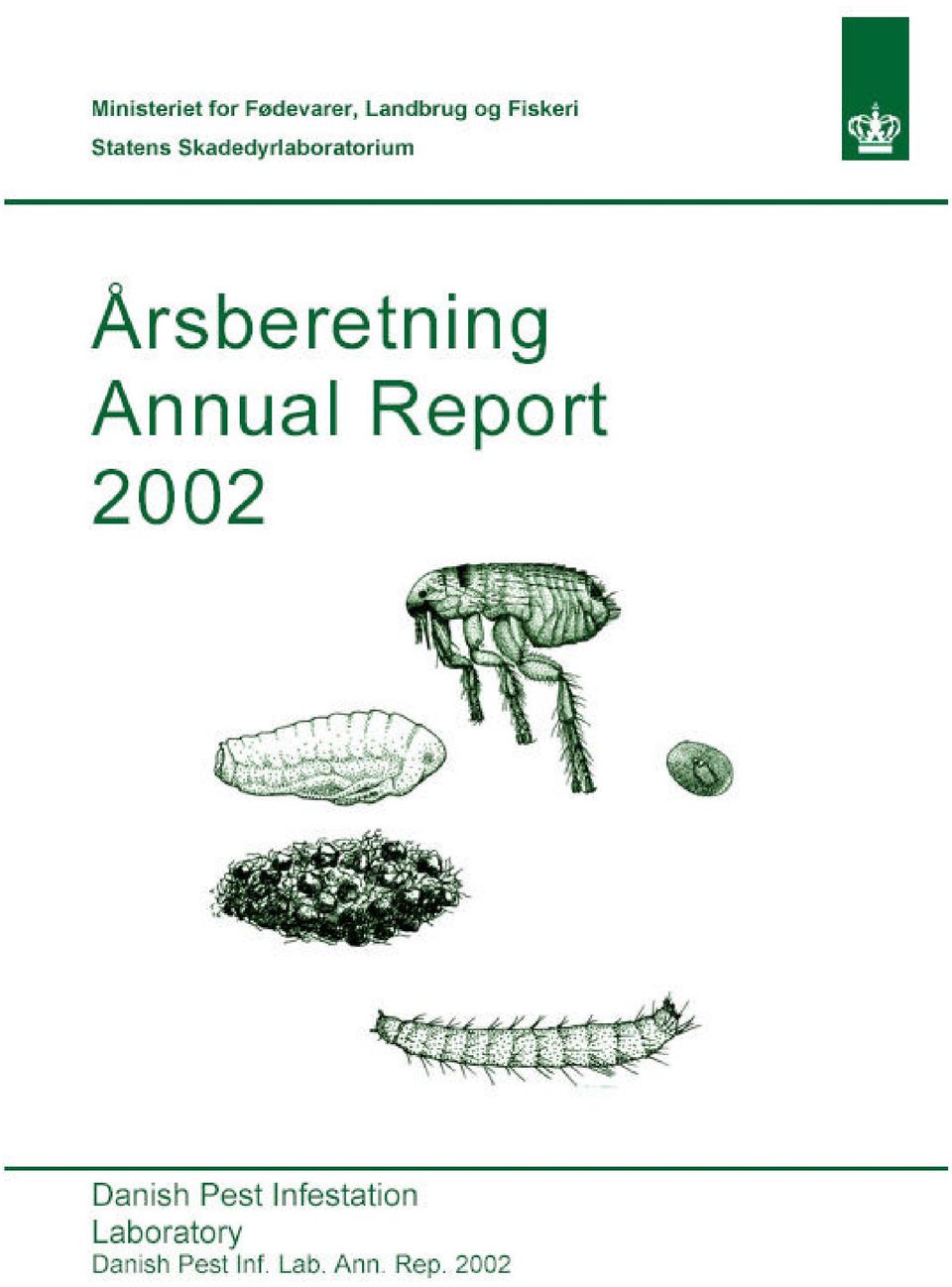
2 The Danish Pest Infestation Laboratory (DPIL) carries out research and compiles information concerning insect pests on livestock, in stables, stocks, buildings and the materials used. Research also covers rats, mice, water voles and moles. The objective is to achieve the highest possible level of pest control while minimizing the impact on the environment. Main research areas include chemical control, alternative control, prevention, pest biology and behaviour, pesticide resistance, the environmental impacts of pesticides as well as medical and veterinary problems caused by pests. DPIL also provides a consultancy service advising on particularly complicated pest problems, for example, on farms, in the food industry and in homes. Statens Skadedyrlaboratorium (SSL) gennemfører forskning og indsamler viden, der vedrører skadelige insekter på husdyr, i stalde, lagre, bygninger og anvendte materialer. Endvidere forskes i rotter, mus, mosegrise og muldvarpe. Målet er at opnå størst mulig bekæmpelse med mindst mulig miljøbelastning. Særlige indsatsområder er kemisk bekæmpelse, alternativ bekæmpelse og forebyggelse, skadedyrs biologi og adfærd, pesticidresistens og pesticiders miljøpåvirkning samt medicinske og veterinære problemer forårsaget af skadedyr. SSL yder desuden konsulentbistand til afhjælpning af særligt komplicerede skadedyrsproblemer, f.eks. på landbrugsejendomme, i levnedsmiddelbranchen og i boliger. Statens Skadedyrlaboratorium, Årsberetning 2002 Danish Pest Infestation Laboratory, Annual Report 2002 Kgs. Lyngby, 2003, 60 pp. Editors: J. B. Jespersen and M. Christensen Drawing: K.-M. Vagn Jensen ISSN: X
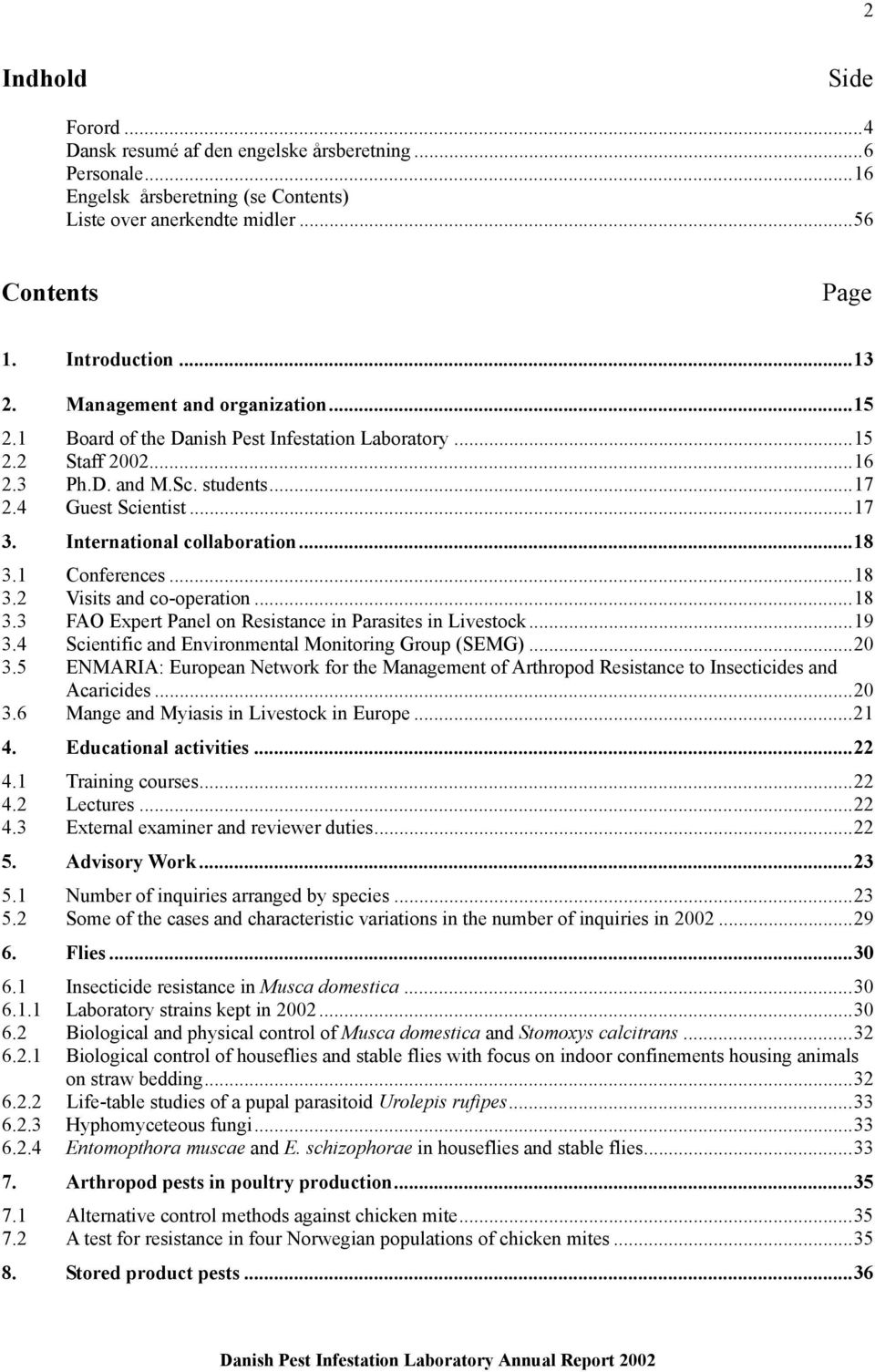
3 2 Indhold Side Forord...4 Dansk resumé af den engelske årsberetning...6 Personale...16 Engelsk årsberetning (se Contents) Liste over anerkendte midler...56 Contents Page 1. Introduction Management and organization Board of the Danish Pest Infestation Laboratory Staff Ph.D. and M.Sc. students Guest Scientist International collaboration Conferences Visits and co-operation FAO Expert Panel on Resistance in Parasites in Livestock Scientific and Environmental Monitoring Group (SEMG) ENMARIA: European Network for the Management of Arthropod Resistance to Insecticides and Acaricides Mange and Myiasis in Livestock in Europe Educational activities Training courses Lectures External examiner and reviewer duties Advisory Work Number of inquiries arranged by species Some of the cases and characteristic variations in the number of inquiries in Flies Insecticide resistance in Musca domestica Laboratory strains kept in Biological and physical control of Musca domestica and Stomoxys calcitrans Biological control of houseflies and stable flies with focus on indoor confinements housing animals on straw bedding Life-table studies of a pupal parasitoid Urolepis rufipes Hyphomyceteous fungi Entomopthora muscae and E. schizophorae in houseflies and stable flies Arthropod pests in poultry production Alternative control methods against chicken mite A test for resistance in four Norwegian populations of chicken mites Stored product pests...36
4 3 8.1 Official examination of consignments Rapid analysis methods for detection of pests and moulds in stored grain Storage pests in Northern Guinea Savannah of Benin in West Africa with special reference to the Angoumois grain moth Sitotroga cerealella The role of Sitotroga cerealella as a post-harvest pest in the Guinea Savannah region in Benin Developmental time and age-specific fecundity of Sitotroga cerealella in relation to temperature and relative humidity Intra- and interspecific competition between Sitophilus zeamais and Sitotroga cerealella Acoustical monitoring of insect pests in stored products Various other arthropods Determination of the lower lethal temperature of museum pests Temperature preferences of the cat flea Rodents Resistance to anticoagulants Resistance in the Norway rat Population effects of anticoagulant rodenticide resistance in Norway rats Vitamin K requirement in Danish anticoagulant-resistant Norway rats Other work on rodents and rodent management Pest problems in organic pig production Rodents, Salmonella and Campylobacter STAPLERAT: Protecting staple crops in eastern Africa: integrated approaches for ecologically-based field rodent pest management Population ecology of the African multimammate mouse Mastomys natalensis List of species maintained at DPIL Publications and reports Publications by members of staff in Appearances in the media Unpublished reports on laboratory tests and/or field trials Evaluation of the efficacy of pesticides and medical and veterinary products Pesticides Medical and veterinary products Formulations approved by the Danish Pest Infestation Laboratory as of 1 March
5 4 Forord Det er mig en glæde at præsentere laboratoriets årsberetning Den i 2001 varslede undersøgelse vedrørende sektorforskningens fremtid blev iværksat i 2002 og involverede laboratoriets medarbejdere kraftigt i flere perioder. På baggrund af den usikre fremtid valgte laboratoriet at undlade at besætte tre ledigblevne forskerstillinger. I 2000 påbegyndtes en udvidelse og renovering af laboratoriets faciliteter. Byggeprojektet blev afsluttet officielt den 2. marts 2002 med indvielse af de i alt 1200 m² nye laboratorie- og kontorområder. Hertil kommer, at mere end 800 m² af de mest nedslidte faciliteter i det gamle byggeri er blevet renoveret. Resultatet er, at laboratoriet i dag kan gennemføre sin forskning i moderne laboratorier med høj grad af sikkerhed. Den 24. juni besøgte Fødevareminister Mariann Fischer Boel laboratoriet. Besøget formede sig som en rundvisning i de nye faciliteter, hvor udvalgte forskningsprojeker og arbejdsområder blev præsenteret for ministeren af laboratoriets medarbejdere. Laboratoriets årsberetning indeholder som sædvanlig en omtale af en række forskningsaktiviteter samt andre aktiviteter, hvori laboratoriets medarbejdere har været involveret året igennem. Som det vil fremgå af beretningen, har aktivitetsniveauet været højt, og jeg vil gerne benytte denne lejlighed til at takke alle medarbejdere for et godt samarbejde i det forløbne år. Der bringes også en tak til bestyrelsens medlemmer for deres interesse for laboratoriets arbejde samt for et godt samarbejde. Jørgen Brøchner Jespersen
6 5 Den 31. marts, 2003 gik forstander på Statens Skadedyrlaboratorium gennem 18 år, Nils Bille, på pension. Nils Bille var uddannet som dyrlæge og havde tidligere været beskæftiget med undervisning og forskning i svinesygdomme samt i toksokologi. Dermed medbragte han erfaring og ekspertise i de toksikologiske aspekter ved anvendelse af pesticider, i lovgivning, administration og forskning. Dette, i kombination med hans ledelsesmæssige kvalifikationer, gav ham en god udgangsposition som leder af Statens Skadedyrlaboratorium. Disse kvalifikationer har der været god brug for i de 18 år, han har stået i spidsen for laboratoriet. Han har ført Statens Skadedyrlaboratorium gennem flere forandringsfaser: fra at være kontrol- og forsøgslaboratorium til at være en sektorforskningsinstitution fra fortrinsvis at forske i kemisk bekæmpelse til at bidrage til fødevarekvalitet og sikkerhed ved at forske i udvikling af ikke-kemiske bekæmpelsesmetoder fra laboratoriets oprindelige udseende gennem en om- og tilbygning, således at SSL i dag fremstår som en moderne, veludstyret forskningsinstitution fra at være en lille, selvstændig institution til at forberede laboratoriet til de politiske forandringer, der har betydet, at SSL fusioneres med Danmarks JordbrugsForskning pr. 1. januar, 2004 Nils Bille har været den kompetente leder i disse udviklingsprocesser, hele tiden med stor lydhørhed over for de forskellige holdninger, der kunne være blandt individer eller grupper af ansatte. Han har altid været velorienteret i spørgsmål, der var af betydning for SSL, og nød stor respekt i Fødevareminsteriet, hos nøglepersoner på andre forskningsinstituioner og hos SSL s samarbejdspartnere. Nils Bille udviser stor alsidighed i sine øvrige interesser: samfundsforhold, politik, historie, kunst, havebrug, madlavning, hvilket leverede stof til mange livlige diskussioner omkring SSL s frokostbord. Hans uformelle ledelsesstil og ægte interesse i sine medmennesker gør ham til en behagelig samtalepartner, som vil blive savnet på laboratoriet. Vi vil hermed gerne takke Nils Bille for mange års indsats og godt samarbejde og ønsker ham alt godt i fremtiden. Personalet på Statens Skadedyrlaboratorium
7 6 Dansk resumé af den engelske årsberetning (SSL= Statens Skadedyrlaboratorium) Der henvises til den engelske tekst for en nærmere omtale af de enkelte afsnit (se indholdsfortegnelsen). Internationalt samarbejde Årsberetningen indledes med en omtale af det internationale samarbejde, der spiller så stor en rolle for SSL s virke både ved udveksling af informationer og ideer, og ved at SSL yder rådgivning og undervisning til folk i andre lande og internationale organisationer. En række medarbejdere deltog i 2002 i internationale konferencer eller kongresser i Belgien, England, Grækenland, Italien, Malawi, Norge, Spanien, Sydafrika, Tanzania, Tjekkiet, Tyskland og Uruguay. Arbejde for FAO. Siden 1998 har J. B. Jespersen været medlem af FAO Panel of Experts on Resistance in Parasites. Arbejde for EU. Siden 1988 har J. B. Jespersen været medlem af SEMG, som er en videnskabelig styringsgruppe for udvikling og implementering af bæredygtig husdyrproduktion i udviklingslande. I 1996 opnåedes støtte til en Concerted Action (ENMARIA) med henblik på at udvikle og implementere strategier til forebyggelse af insekticid- og acaricid-resistens i Europa. Indsatsen involverer 13 europæiske lande samt industriens repræsentanter og ledes af J. B. Jespersen. Fra 1998 har J. B. Jespersen og O. Kilpinen været medlem af en Cost Action vedrørende bekæmpelse af skab og myasis hos husdyr. L. Stengård Hansen og T. Steenberg er medlemmer af en COST Action om Biological control of pest insects and mites, with special reference to Entomophthorales. L. Stengård Hansen er desuden medlem af management committee og viceformand for arbejdsgruppe IV om Biocontrol of arthropod pests in stored products. Undervisning I lighed med tidligere år har laboratoriet afholdt kurser om skadedyr og skadedyrsbekæmpelse: Muldvarpebekæmpelse og gnaverbekæmpelse. Endvidere har laboratoriet holdt foredrag for grupper af kolleger og studerende. Konsultationen Bemærkelsesværdige enkeltsager og karakteristiske variationer i antallet af henvendelser i 2002 I 2002 var der igen færre henvendelser til laboratoriet, end der har været i de foregående år. Dette kan sandsynligvis tilskrives, at antallet af informationsblade om skadedyr og andre dyr på SSL s hjemmeside i løbet af året kom op på 75. Antallet af besøgende på hjemmesiden ( ) er til gengæld steget med ca. 60% i forhold til året før, og det tyder på, at mange borgere, firmaer, institutioner og andre finder de oplysninger, som de har brug for, på hjemmesiden. De mest besøgte sider i 2002 handlede om hovedlus, mosegris, almindelig borebille, rotte, gedehams, sort havemyre, møl i tekstiler, mus, husmår og muldvarp. Det faldende antal henvendelser til laboratoriet betyder, at registreringen omkring de enkelte dyr bliver mere usikker.
8 7 I 2002 fik Statens Skadedyrlaboratorium usædvanligt mange henvendelser om klyngefluer. De fleste henvendelser skete i september og oktober, men der var også en del i november og december. I efterårsmånederne berettede mange af de mennesker, der henvendte sig, om et enormt antal fluer, der især i solskin sad udvendigt på huset oftest på de syd- eller vestvendte gavle. Undertiden kravlede fluerne ind gennem sprækkerne i vinduerne og kom derved ind i huset, hvor de var til stor gene for beboerne. Andre fortalte om et stort antal fluer i deres loftsrum, og i vintermånederne drejede henvendelserne sig især om fluer, der kom ned fra lofter eller frem fra sprækker og revner og fløj sløve rundt i huset. Den mest almindelige klyngeflue herhjemme er Pollenia rudis. Klyngefluen overvintrer som voksen flue, og sidst på sommeren begynder den at lede efter et sted, som kan beskytte den mod vinterkulden. I stort antal kan den finde på at trænge ind under taget eller op på loftsrummene i huse. Oftest sidder fluerne ubevægelige hele vinteren uden at genere nogen. Sker der af en eller anden grund en opvarmning, vågner de og søger ned i selve beboelsen. hvor man så vil opleve en invasion af fluer midt om vinteren. Statens Skadedyrlaboratorium har ikke noget forslag til en egentlig bekæmpelse af fluerne men kan berolige med, at fluerne ikke gør skade og ikke lægger æg i huset. Om foråret forlader fluerne igen deres overvintringssted og flyver til græsarealer, hvor æggene lægges. Ofte vil man dog opleve, at fluerne vender tilbage til det samme hus for at overvintre år efter år. Der er ikke nogen forklaring på, hvorfor de foretrækker visse huse frem for andre. Tilsyneladende vælger de først og fremmest huse med høj rejsning eller huse, der ligger højt. Større arealer med græs omkring beboelsen kan muligvis også have betydning. Laboratoriet har ikke umiddelbart nogen forklaring på, at klyngefluerne har optrådt i så usædvanligt stort antal her i efterår og vinter 2002 men vil følge udviklingen videre i det kommende år. I 80 erne have laboratoriet mange henvendelser om væggelus, mens der i løbet af 90 erne var betydeligt færre. I de seneste år har der været en svag tendens til, at antallet af henvendelser, som vedrører væggelus, igen er stigende. De fleste tilfælde kan relateres til mennesker, der under deres ophold i udlandet har fået væggelus med hjem i bagagen. Om forklaringen på det stigende antal henvendelser skyldes, at folk generelt rejser mere, end de gjorde tidligere, eller at væggelus er blevet mere udbredte på steder, hvor mange forskellige mennesker overnatter, vides ikke. I april måned fik laboratoriet tilsendt nogle dyr, som var fundet kravlende rundt i en seng. Bestemmelse af dyrene afslørede, at der var tale om termitter af slægten Cryptotermes. Blandt de indsendte termitter var et par vingede individer, som antydede, at kolonien var i færd med at sværme. En forespørgsel hos afsenderen af termitterne afslørede, at de stammede fra en seng lavet af træ, som var importeret fra Østen, og at sengen havde stået ca. et år i lejligheden, inden dyrene dukkede op. I juli måned var der igen en henvendelse vedrørende sværmende termitter i en lejlighed i København. I dette tilfælde var de blevet importeret med et skab fra Ægypten, der havde stået i lejligheden i flere år. En nærmere undersøgelser viste, at de havde bredt sig til andre møbler i lejligheden, og laboratoriet rådede derfor beboerne til at søge hjælp hos et professionelt skadedyrsbekæmpelsesfirma. I nogle tilfælde ser man spor efter termitter i træ importeret fra troperne, men det er yderst sjældent, at der registreres levende angreb af termitter i Danmark. Undersøgelser og afprøvninger Insektafdelingen Laboratoriets samling af resistente fluestammer udgjorde ved årets udgang 19 stammer. Disse repræsenterede et bredt udsnit af resistensmekanismer og oprindelser. Stammerne anvendes til undersøgelse af nye midler og resistensforskning i ind- og udland. Detaljerede oplysninger om de enkelte stammer kan ses i Tabel 6a i det engelsksprogede afsnit. Biologisk bekæmpelse af stuefluer og stikfluer. Tidligere undersøgelser har vist, at snyltehvepsen Spalangia cameroni (Årsrapport 2000) var en mulig kandidat til biologisk bekæmpelse af stuefluer og stikfluer i danske svine- og kvægstalde. Som en forlængelse af disse studier blev det undersøgt under feltbetingelser, hvilken effekt 50, 100 og 200 udsatte S. cameroni pr. m 2 havde på parasiteringsprocenten af udlagte
9 8 laboratoriedyrkede stuefluepupper. Generelt viste undersøgelserne, at udsætningsmængden havde en lille effekt på parasiteringsprocenten tidligt på året (april-juni), hvorimod der var en tydeligt forhøjet parasitering ved 200 S. cameroni pr. m 2 i den varme periode (august-september) af fluesæsonen. Undersøgelsen viste yderligere, at udsætninger af voksne individer af S. cameroni er nødvendige hver anden uge, idet mange af de udsatte hvepse sandsynligvis dør af alder og prædation. Baseret på en tidligere pilotundersøgelse, hvor S. cameroni ( hunner pr. uge og pr. m 2 ) blev udsat, og hvor tætheden af stuefluer faldt fra ca. 400 til 9-12 fluer pr. voksent dyr inden for én måned, blev det undersøgt, om en mere realistisk udsætningsmængde ville kunne reducere stuefluer på samme vis til et acceptabelt niveau. Derfor i sensommer og efterårsmånederne (august-december) blev ca. 200 hunner af S. cameroni pr. uge og pr. m 2 dybstrøelse udsat i 6 udvalgte økologiske stalde. Den relative betydning i perioden af Entomophtora-svampe for stuefluernes bestandssvingninger blev ligeledes undersøgt. Selv om detaljerede analyser mangler at blive udført, peger data i retning af, at S. cameroni har et forholdsvis ringe potentiale for at kunne anvendes til direkte bekæmpelse (biopesticid) af stuefluer. Dette er vurderet i lyset af, at hvis mængder af 800 individer pr. m 2 er nødvendige for at bringe fluetallet ned, vil det ikke være økonomisk rentabelt for et firma. Dette er baseret på, at det ikke vil være rentabelt, hvis udsætningstætheder på 800 individer pr. m 2 skal anvendes. Entomophthora-svampe i fluer i stalde. Forekomsten af insektpatogene Entomophthora-svampe i stuefluer blev fulgt på seks gårde fra august til november som en del af en undersøgelse af fluers populationsdynamik. Infektionsprocenten nåede et maksimum på mellem 38% og 78% og der var ingen umiddelbar sammenhæng mellem stigende infektionsprocent og stigende fluetæthed. Hanner var oftere inficeret end hunner. Stikfluen Stomoxys calcitrans inficeres kun i ringe grad af disse svampe, men på en enkelt gård blev der observeret 30% infektion i stikfluer. Svampen blev isoleret i et flydende vækstmedium, og vil efterfølgende indgå i smitteforsøg. Lagerskadedyr i Nordlige Guinea Savanne, Benin Vest Afrika. Udviklingstid og aldersspecifik fekunditet af et lagerskadedyr, Sitotroga cerealella i lagre af majs blev bestemt i laboratoriet på SSL ved fire forskellige temperaturer (20º, 25º, 30º og 35º C) og to luftfugtigheder (44% og 80% RH). Data anvendes til at beregne populationsspecifikke parametre som den øjeblikkelige vækstrate (r m ), reproduktionstid (R) samt generationstid (Tc) - faktorer der er vigtige i forbindelse med bygning af en matematisk simuleringsmodel samt i forbindelse med biologisk bekæmpelse, hvor det er vigtigt at kunne sammenligne populationsvækstrater af nyttedyr og skadedyr. I forbindelse med et specialprojekt blev intra- og interspecifik konkurrence (sameksistens) undersøgt imellem majssnudebillen og Sitotroga cerealella, idet begge skadedyr gør skade i lagre af majs. Laboratorieforsøgene kunne ikke vise, at der var tale om sameksistens, men ved at indføje en spatiel (rumlig) faktor i forsøgsopstillingen blev ny viden om mekanismerne bag konkurrence belyst. Et supplerende forsøg viste, at S. cerealella undgår at lægge æg i majskorn allerede inficeret med tredje og fjerde stadium, hvilket kan minimere den intraspecifikke konkurrence mod, at populationstilvæksten øges. I forbindelse med en mindre survey, hvor majskolber blev indsamlet fra lagre i landdistrikterne i Benin, blev der ikke konstateret S. cerealella hvilket var en overraskende, men i overensstemmelse med en anden survey udført af the International Institute of Tropical Agriculture (IITA) i Benin. Hurtigmetoder til bestemmelse af skadedyr og mykotoksiner i korn. Mulighederne for at anvende Near Infrared Transmission Spectroscopy (NIT) til at bestemme forekomst af skadedyr og mykotoksiner i lagret korn bliver undersøgt i et nordisk projekt med deltagelse af forskere, repræsentanter fra grovvarebranchen og analyseudstyrsbranchen i Sverige, Norge, Finland og Danmark. SSL har ansvaret for et delprojekt om lagermider, og i første omgang anvendes kornmiden, Lepidoglyphus destructor. Det er meget vanskeligt og tidskrævende at bestemme midetætheder i korn. En flotationsmetode til midebestemmelse er ved at blive indarbejdet som referencemetode for NIT-apparaturet. Der skal laves undersøgleser af kornprøver med midetætheder på 600 til mider pr. kg korn. Projektets fremdrift kan følges på
10 9 Bestemmelse af nedre letaltemperatur hos museumsskadedyr. Målet med disse undersøgelser er at fastlægge, hvorvidt det er muligt - inden for 24 timer at bekæmpe en række museumsskadedyr under forhold, der opnås i en almindelig husholdningsfryser. Insekterne indsættes i store træklodser (materialetykkelse 9 cm). Indledende undersøgelser viser, at nedkøling fra 20 C til -20 C tager ca. 9 timer. Larver af henholdsvis tæppebiller og klædemøl dør under disse betingelser, hvilket antyder, at det er muligt at bruge frysning ved temperaturer langt over de -35 C, der anbefales for tiden på grund af mangel på præcise data. Udvikling af alternative metoder til bekæmpelse af kyllingemider. I det første år af det delvist EUfinansierede projekt, CHIMICO, har arbejdet fokuseret på isolering af semiochemicals, som kan påvirke kyllingemidernes adfærd, og på at identificere svampepatogener, der potentielt kan appliceres i fjerkræhuse til kontrol af kyllingemider. De første ekstrakter med tiltrækkende virkning på kyllingemider er blevet produceret, og flere typer af bioassay, som skal bruges til at undersøge effekten af semiochemicals på midernes adfærd, er blevet udviklet og testet. En kortlægning af sanse sensilla på forben og palper af kyllingemider har skaffet vigtige oplysninger, som skal bruges i senere elektrofysiologiske undersøgelser. En survey af naturligt forekommende midepatogene svampe i danske og spanske kyllingemidepopulationer er blevet startet - hidtil dog uden succes. I en nyudviklet bioassay er svampeisolater fra andre dyr blevet testet på kyllingemider, og fem specielt effektive isolater er blevet udvalgt til videre undersøgelser bl.a. af svampenes holdbarhed i det fysiske miljø, der kendetegner fjerkræstalde, samt spredningen i midepopulationer. En undersøgelse af forekomst af resistens mod tre acaricider i fire norske kyllingemidepopulationer. Kyllingemider, Dermanyssus gallinae, indsamlet fra fire norske populationer blev testet for resistens mod tre aktivstoffer: carbaryl, malathion og permethrin. Til sammenligning blev SSL s laboratoriekultur af D. gallinae testet. Resultaterne viste, at der i alle fire norske populationer var udbredt resistens mod permethrin. Ved en koncentration på 4 x LC 99 var der næsten ingen døde mider i tre af de fire populationer, og i den sidste nåede dødeligheden kun op i nærheden af 100%. For de to andre aktivstoffer kunne der ikke påvises resistens; der var kun en let nedsat følsomhed mod malathion, men det burde ikke være mere, end at malathion stadig har rimelig effektivitet. På grund af det lille antal forsøgspopulationer er det dog ikke muligt at konkludere noget om resistensudbredelsen generelt i hele Norge. Lydmonitering af skadelige insekter i fødevareindustrien. Formålet med dette projekt er at udvikle en hurtig, følsom og praktisk anvendelig metode til monitering af lydene fra insekter, der gnaver eller bevæger sig omkring i cerealier. Kornsnudebiller er de væsentligste skadedyr i kornlagre. Det har vist sig muligt at følge deres aktivitet på baggrund af den støj, der opstår, når de bevæger sig eller gnaver. I en række forsøg er kerner blevet åbnet, og larvernes bevægelser er blevet fulgt med video, samtidig med at gnavelydene er blevet registreret, og en mulighed for computerbaseret analyse af resultaterne er etableret. Formålet med disse forsøg har været at knytte enkelte dele af lydmønstret til mere specifikke adfærdselementer. Rismelbillerne er et stort problem lokalt i industrimøller, hvor de etablerer sig i varmeproducerende maskiner m.v. Der er p.t. ikke iværksat egentlige forsøg, men et design er fastlagt for en forsøgsrække, der skal afsløre, i hvilket omfang og under hvilke betingelser det vil være muligt at opfange lyde fra disse billers aktivitet. Med udgangspunkt i disse dyrs helt anderledes biologi skal der skabes en ny forsøgsopstilling. Dette er ved at være gennemført, og det forventes, at de første resultater af forsøgene er klar i første halvår af For at bestemme, hvor godt lyd transmitteres gennem korn, er der opbygget en opstilling til at måle dæmpningen, og der er foretaget målinger med en højttaler som lydkilde. Disse målinger viste en relativt stor dæmpning sandsynligvis p.g.a det begrænsede hulrum mellem kernerne, og det er derfor planen i 2003 at fortsætte med tilsvarende målinger med vibrationer. Der er foretaget indledende eksperimenter med detektion af vibrationer, og de viste, at en tynd metalplade med et accelerometer placeret i den ene ende giver en god kobling til vibrationerne i kornet.
11 10 Katteloppers temperatur præferencer. Formålet med denne undersøgelse er at opnå en bedre forståelse af fordelingen af kattelopper på katte. Lopper fra en laboratoriekultur anbringes i en lukket beholder, hvor temperaturen kan kontrolleres fra en computer. Ved at indstille temperaturen i de to ender af kammeret forskelligt er det muligt at studere loppernes temperaturpræferencer. Til sammenligning måles hudtemperaturen forskellige steder på kroppen på katte. Pattedyrafdelingen Resistens mod antikoagulante bekæmpelsesmidler. I alt 346 rotter blev modtaget til undersøgelse. Resistens mod warfarin blev for første gang fundet i følgende kommuner: Augustenborg, Gram, Vojens, Tønder, Vejen, Blaabjerg, Gjern, Hadsten, Midtdjurs, Rougsø, Ry, Silkeborg og Sønderhald; mod coumatetralyl i Gram, Vojens, Ry og Sønderhald; mod bromadiolon i Augustenborg, Christiansfeld, Gram, Vojens, Vejen, Blaabjerg, Nørre Djurs, Ry, Skanderborg Sønderhald og Århus; og endelig mod difenacoum i Gram, Vojens, Vejen, Blaabjerg, Ry, Skanderborg, Århus og Brøndby. Frilandsgrise og skadedyr, især rotter, er hovedemnet for SSL s deltagelse i et samarbejdsprojekt om økologisk svineproduktion. En analyse af svar i en spørgeskemaundersøgelse til landmænd med frilandsgrise viser, at valg af foder- og vandingssystem samt hyttetype kan være afgørende for, hvorvidt der opstår problemer med rotter eller mus. En direkte undersøgelse af især rottebestande på to udvalgte forsøgsgårde startede for alvor i 2002 og vil blive fortsat i Gnaveres betydning for spredning af Salmonella og Campylobacter er en del af et større samarbejdsprojekt om den vilde faunas betydning for forekomst af de nævnte bakterier i produktionsdyr. Feltdelen af projektet er afsluttet, og nu følger en nærmere analyse af resultaterne. STAPLERAT er et EU-støttet forskningsprojekt med partnere fra Ethiopien, Kenya, Tanzania, Zambia, Norge og Italien, og det koordineres af SSL. Projektet undersøger gnavernes rolle som skadevoldere, deres biologi og bekæmpelse i kornmarker i Østafrika. I løbet af projektets første to-års del er der foretaget indsamlinger og artsbestemmelser af de forekommende gnavere. Der er foretaget undersøgelser og analyser af skadesomfang og -niveau i forhold til driftsform, økonomi og effektivitet af bekæmpelse, gnavernes populationsdynamik, varslingsmodeller, virkning af repellenter ved udsåning samt biologisk bekæmpelse af gnaverne foruden brug af særlige planter som barriere for gnaverne på de dyrkede marker. Projektet fortsætter i det kommende år, så derfor er en række resultater stadig præliminære. Populationsøkologien hos den afrikanske gnaver Mastomys natalensis er blevet undersøgt i et Ph.D.- projekt. Mus gør stor skade på majs i Tanzania, og det årlige tab svarer til, at man kan brødføde 2,3 mill. mennesker. Traditionel kemisk musebekæmpelse er ikke effektiv med den tanzanianske landbrugsstruktur med mange små brug på hver ca. 0,5 ha. Af miljømæssige årsager er længerevarende anvendelse af kemiske midler desuden en uholdbar løsning. Der er således behov for udvikling af bæredygtige skadedyrsbekæmpelsesmetoder, der i ringe grad baseres på ikke-kemisk bekæmpelse. Et væsentligt element i projektet var at vurdere effekten af rovfugle og ugler (prædatorer) på den dominerende museart (Mastomys), som er det mest almindelige skadedyr på afgrøder i Østafrika. Projektet undersøgte, hvorledes prædation påvirkede bestandene af mus i små majsmarker ved enten at fjerne rovfugle og ugler ved hjælp af net eller ved at tiltrække disse fugle ved hjælp af siddepæle og redekasser. Forsøgsmarkerne blev fulgt gennem et par år og blev sammenlignet med marker, der blev drevet på normal vis. Forsøgene viser, at prædatorer som rovfugle og ugler kan reducere antallet af mus, men at anvendelse af siddepæle og redekasser tilsyneladende ikke kan reducere antallet yderligere. Til trods for dette påvirkede metoden med siddepæle og redekasser alligevel høstudbyttet positivt. Det kan betyde, at prædatorer ikke kun reducerer antallet af mus, men at de også på anden vis kan påvirke musene f.eks. ved at ændre på deres fourageringsadfærd.
12 11 Populationseffekten af antikoagulant rodenticidresistens i den brune rotte. Et Ph.D.-projekt omhandlende populationseffekter af antikoagulantresistens i danske populationer af brune rotter blev afsluttet i maj Projektet var finansieret af SSL, Forskerakademiet og Strukturdirektoratet (Fødevareministeriet). Projektet blev udført ved SSL og Afdelingen for Evolutionsbiologi, Zoologisk Institut, Københavns Universitet. Antikoagulantresistens hos brune rotter medfører et forhøjet behov for vitamin K. Hvilken eller hvilke konsekvenser, dette kan have for den enkelte rotte eller for hele populationer rotter, er ukendt. Dette projekt havde til formål at undersøge og måle mulige effekter. Vilde brune rotter blev indfanget på to lokaliteter, hvor bromadiolonresistens tidligere var dokumenteret. Rotterne blev overført til laboratoriefaciliteter fordelt på fire eksperimentelle fritgående populationer. To af disse populationer gennemgik antikoagulantbehandling (0,005 % bromadiolon) to gange årligt (treatment) og to andre populationer forblev ubehandlede (non-treatment). Over en periode på to år blev bl.a. resistensniveauet målt i de fire populationer. Vi kunne konkludere, at selvom antikoagulant-selektion var fjernet (non-treatment), var de negative konsekvenser af antikoagulantresistens ubetydelige i omfang, da vi ikke her kunne se nedgang i antallet af resistente individer i forhold til følsomme individer. Men vi fandt dog klare indicier for, at der var omkostninger forbundet med antikoagulantresistens, da vi i begge ubehandlede populationer observerede, at resistente rotter døde som følge af vitamin K-mangel. Denne effekt var dog ikke så stor, at den kunne modsvare tilfældig genetisk drift. Vitamin K-behov hos danske antikoagulantresistente brune rotter. Et specialestudium, der belyser vitamin K-behovet hos danske antikoagulantresistente brune rotter (Rattus norvegicus), blev afsluttet i maj Hos britiske antikoagulantresistente rotter er det dokumenteret, at den antikoagulante resistens er korrelleret med et øget behov for vitamin K. Formålet med specialestudiet var 1) at belyse, om danske antikoagulantresistente rotter har et øget behov for vitamin K sammenlignet med følsomme rotter, og 2) at belyse, om behovet for vitamin K er differentieret mellem geografisk adskilte rottepopulationer. Vilde bromadiolonresistente rotter, indsamlet fra 10 forskellige lokaliteter i Danmark, og rotter fra to bromadiolonresistente avlskulturer blev udsat for fodring med en vitamin K-fattig diæt. Fodringsperioden strakte sig maksimalt over 15 dage. Der blev observeret udvikling af vitamin K-underskud hos 43% (N=106) af de resistente rotter, mens der ikke blev registreret vitamin K-underskud hos følsomme individer. Resistente rotter, der ikke modtog et vitamin K-supplement før teststart, udviklede signifikant hurtigere vitamin K-underskud end resistente rotter, der modtog et supplement, hvilket antyder, at en delvis vitamin K-lagring kan finde sted. Vitamin K- behovet blev konkluderet moderat forøget hos danske homozygotresistente sammenlignet med følsomme individer. Behovet er på niveau med det, der er observeret i den skotske resistenstype, der kendes fra Storbritannien. Der blev ikke fundet evidens for, at det øgede vitamin K-behov er differentieret mellem rotter fra geografisk adskilte populationer. Effektivitetsvurdering af bekæmpelsesmidler og lægemidler Vurderingen af effektiviteten og anvendeligheden af de kemiske bekæmpelsesmidler, der anmeldes til godkendelse og klassificering hos Miljøstyrelsen, er en vigtig opgave for SSL. Resultatet danner grundlag for bedømmelsen af nye etiketter og brugsanvisninger.
13 12 I nogle tilfælde måtte der kræves mere dokumentation for effektiviteten eller ændring i anvendelsesområdet, før midlet kunne indstilles til godkendelse. I andre tilfælde kunne vi ikke anbefale midlets anvendelse til det ønskede formål. Der tages ved denne vurdering hensyn til specielle danske forhold, f.eks. med hensyn til udvikling af resistens mod midlet eller mod beslægtede midler. I 1999 indledte SSL et samarbejde med Lægemiddelstyrelsen med henblik på at deltage i arbejdet med at udarbejde EU-retningslinier for afprøvning af effektivitet af visse medicinske og veterinære lægemidler. Andre oplysninger i årsberetningen I afsnit 11 kan man finde de insekter og pattedyr, der holdes i kultur på Statens Skadedyrlaboratorium. I afsnit 12 kan man finde medarbejdernes publikationer og forsøgsrapporter udarbejdet i 2002 og første halvdel af I afsnit 13 kan man læse om effektivitetsvurderinger af pesticider og medicinske og veterinærmedicinske produkter. I afsnit 14 findes en oversigt over de af Statens Skadedyrlaboratorium anerkendte bekæmpelsesmidler mod skadedyr.
14 13 1. Introduction It is a pleasure for me to introduce the laboratory s 2002 Annual Report. The investigation announced in 2001 concerning the future of governmental research institutes was initiated in 2002 and required heavy involvement of the staff of the DPIL for several periods of time. On account of this uncertain future the laboratory chose not to fill three vacant scientist positions. In 2000 an extension and a renovation of the facilities of the laboratory was commenced. The construction project was officially finished on the 2 nd of March, 2002 with the inauguration of 1200 m 2 of new laboratory and office space. In addition 800 m 2 of the most worn-down facilities in the existing buildings were renovated. The result is that today s DPIL is capable of carrying out its research in modern laboratories with the highest degree of safety. On the 24 th of June Mrs Mariann Fischer Boel, Minister of Food, Agriculture and Fisheries, visited the laboratory. The visit consisted of a guided tour of the new facilities, where selected research projects and work areas were presented to the Minister by the staff. The Annual Report of the laboratory contains the usual description of a number of research activities as well as other activities, in which the staff has been involved throughout the year. As it will appear from the report, the level of activity has been high, and I would like to take this opportunity to thank the entire staff for a fine cooperation in the past year. I also thank the members of the board for their interest in the work of the laboratory as well as thank them for their cooperation. Jørgen Brøchner Jespersen
15 14 On March , Nils Bille retired from his position as the director of the Danish Pest Infestation Laboratory, a post he has held since Educated as a veterinary doctor, Nils Bille had previously been employed as a scientist and lecturer in the field of diseases of pigs and, later, specialised in the field of toxicology. Thus, he brought with him expertise and experience in the toxicological aspects of pesticides, application and registration of pesticides, research as well as administrative and legislative matters. This, combined with his management qualities, put him in a strong position as the manager of the DPIL. These qualities have been in great demand during his 18 years at the head of the laboratory. He has brought the laboratory through several transitions: from being primarily a control and testing agency to being a research institute from researching primarily in aspects of chemical pest control and to its present position as a research institution involved in aspects of pest control that are related to food quality and safety reflected in the development of non-chemical control methods from its initial appearance through a major expansion and refurbishment phase, so that the DPIL today has modern, well equipped research facilities from being a small, independent institute to preparing the DPIL for recent political developments, i.e. negotiating the fusion of the DPIL with the Danish Institute of Agricultural Sciences (January 1, 2004) Nils Bille led these transition procedures with competence and, on all occasions, with great respect for different opinions among individuals or groups of DPIL staff. He was always well informed about matters of importance for the laboratory and was well respected by representatives of the Ministry, other research institutions and the collaborative partners of the DPIL. Nils Bille s versatile interests cover many different fields: public matters, politics, history, art, gardening, cooking, giving material for lively discussions around the lunch table at the laboratory. His informal management style combined with a genuine consideration for his fellow human beings led to many pleasant conversations, which will be missed at the laboratory. We would like to thank Nils Bille for the effort he has put into bringing the DPIL to its present position and wish him all the best in the years to come. Staff, Danish Pest Infestation Laboratory
16 15 2. Management and organization 2.1 Board of the Danish Pest Infestation Laboratory Members: Niels Ørnbjerg Danish Bilharziasis Laboratory Chairman Lars Damberg Danish Pest Infestation Laboratory Susanne Harding Royal Veterinary and Agricultural University Peter Esbjerg Royal Veterinary and Agricultural University Vice-chairman Lise Stengård Hansen Danish Pest Infestation Laboratory Ghita Cordsen Nielsen Danish Agricultural Advisory Centre Hanne Storgaard Schultz / Asbjørn Brandt Danish Medicines Agency Peter Weile Danish Environmental Protection Agency Bent Aagaard Petersen Research Secretariat, Danish Directorate for Development Observer
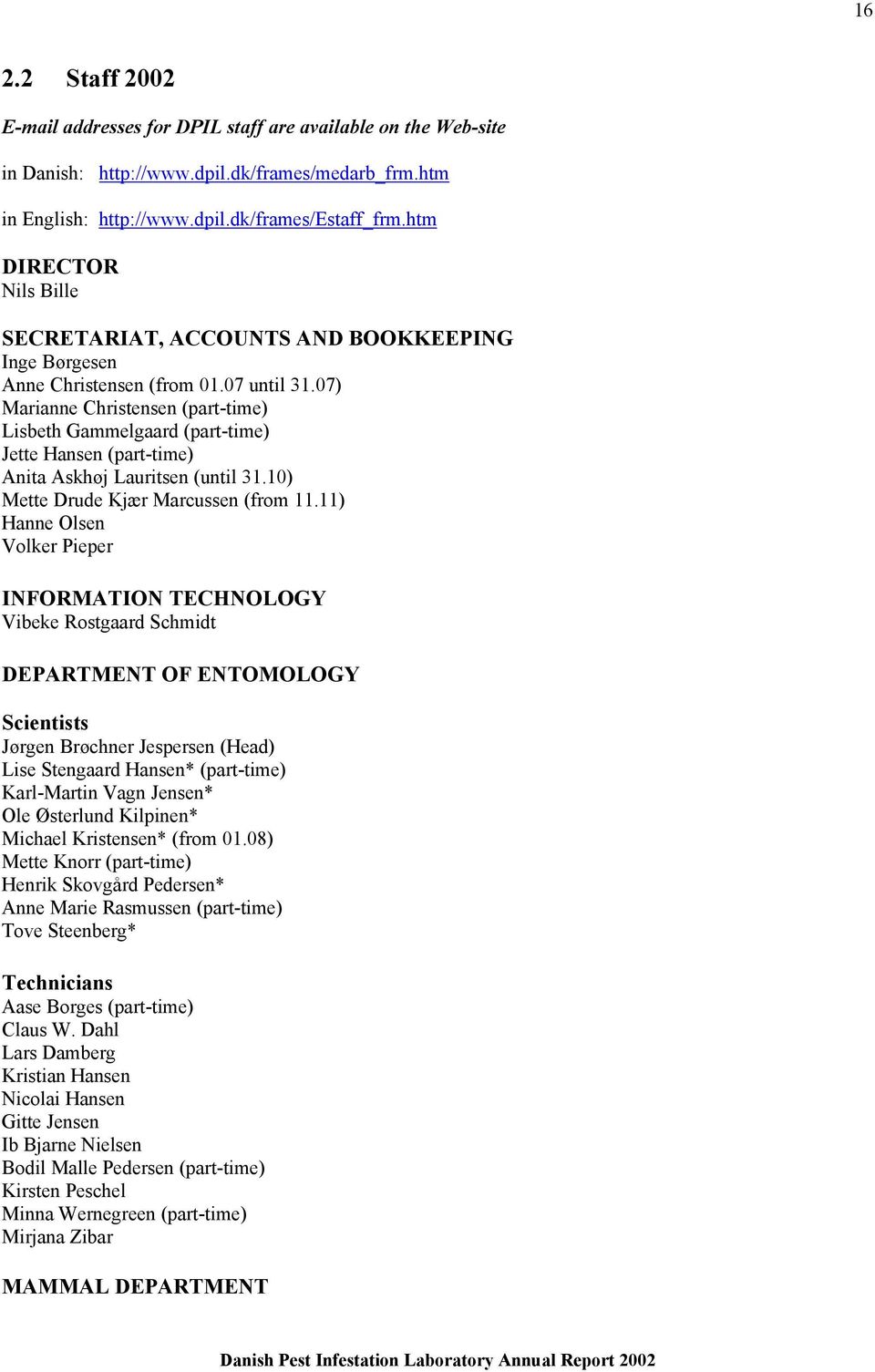
17 Staff addresses for DPIL staff are available on the Web-site in Danish: in English: DIRECTOR Nils Bille SECRETARIAT, ACCOUNTS AND BOOKKEEPING Inge Børgesen Anne Christensen (from until 31.07) Marianne Christensen (part-time) Lisbeth Gammelgaard (part-time) Jette Hansen (part-time) Anita Askhøj Lauritsen (until 31.10) Mette Drude Kjær Marcussen (from 11.11) Hanne Olsen Volker Pieper INFORMATION TECHNOLOGY Vibeke Rostgaard Schmidt DEPARTMENT OF ENTOMOLOGY Scientists Jørgen Brøchner Jespersen (Head) Lise Stengaard Hansen* (part-time) Karl-Martin Vagn Jensen* Ole Østerlund Kilpinen* Michael Kristensen* (from 01.08) Mette Knorr (part-time) Henrik Skovgård Pedersen* Anne Marie Rasmussen (part-time) Tove Steenberg* Technicians Aase Borges (part-time) Claus W. Dahl Lars Damberg Kristian Hansen Nicolai Hansen Gitte Jensen Ib Bjarne Nielsen Bodil Malle Pedersen (part-time) Kirsten Peschel Minna Wernegreen (part-time) Mirjana Zibar MAMMAL DEPARTMENT
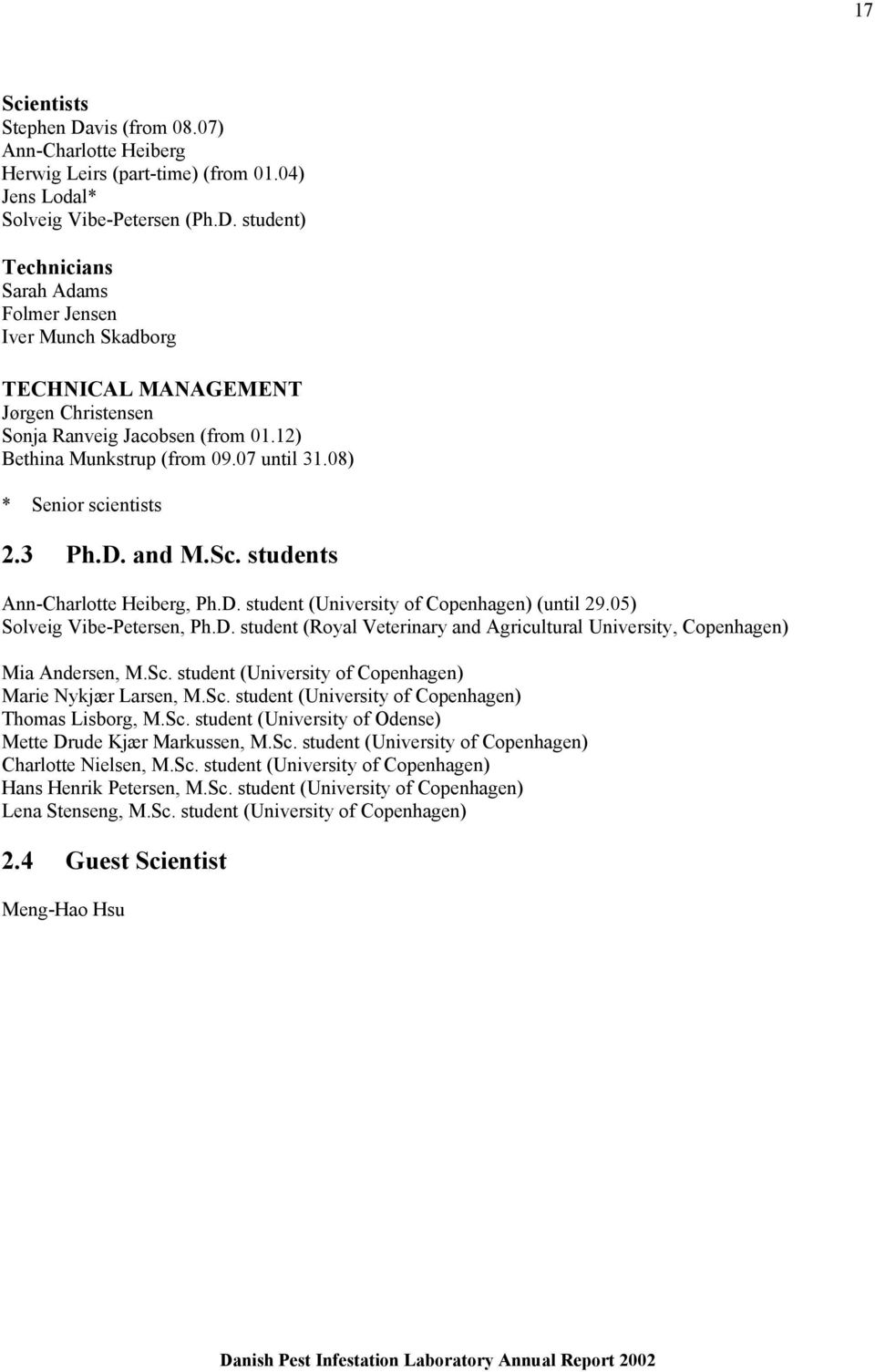
18 17 Scientists Stephen Davis (from 08.07) Ann-Charlotte Heiberg Herwig Leirs (part-time) (from 01.04) Jens Lodal* Solveig Vibe-Petersen (Ph.D. student) Technicians Sarah Adams Folmer Jensen Iver Munch Skadborg TECHNICAL MANAGEMENT Jørgen Christensen Sonja Ranveig Jacobsen (from 01.12) Bethina Munkstrup (from until 31.08) * Senior scientists 2.3 Ph.D. and M.Sc. students Ann-Charlotte Heiberg, Ph.D. student (University of Copenhagen) (until 29.05) Solveig Vibe-Petersen, Ph.D. student (Royal Veterinary and Agricultural University, Copenhagen) Mia Andersen, M.Sc. student (University of Copenhagen) Marie Nykjær Larsen, M.Sc. student (University of Copenhagen) Thomas Lisborg, M.Sc. student (University of Odense) Mette Drude Kjær Markussen, M.Sc. student (University of Copenhagen) Charlotte Nielsen, M.Sc. student (University of Copenhagen) Hans Henrik Petersen, M.Sc. student (University of Copenhagen) Lena Stenseng, M.Sc. student (University of Copenhagen) 2.4 Guest Scientist Meng-Hao Hsu
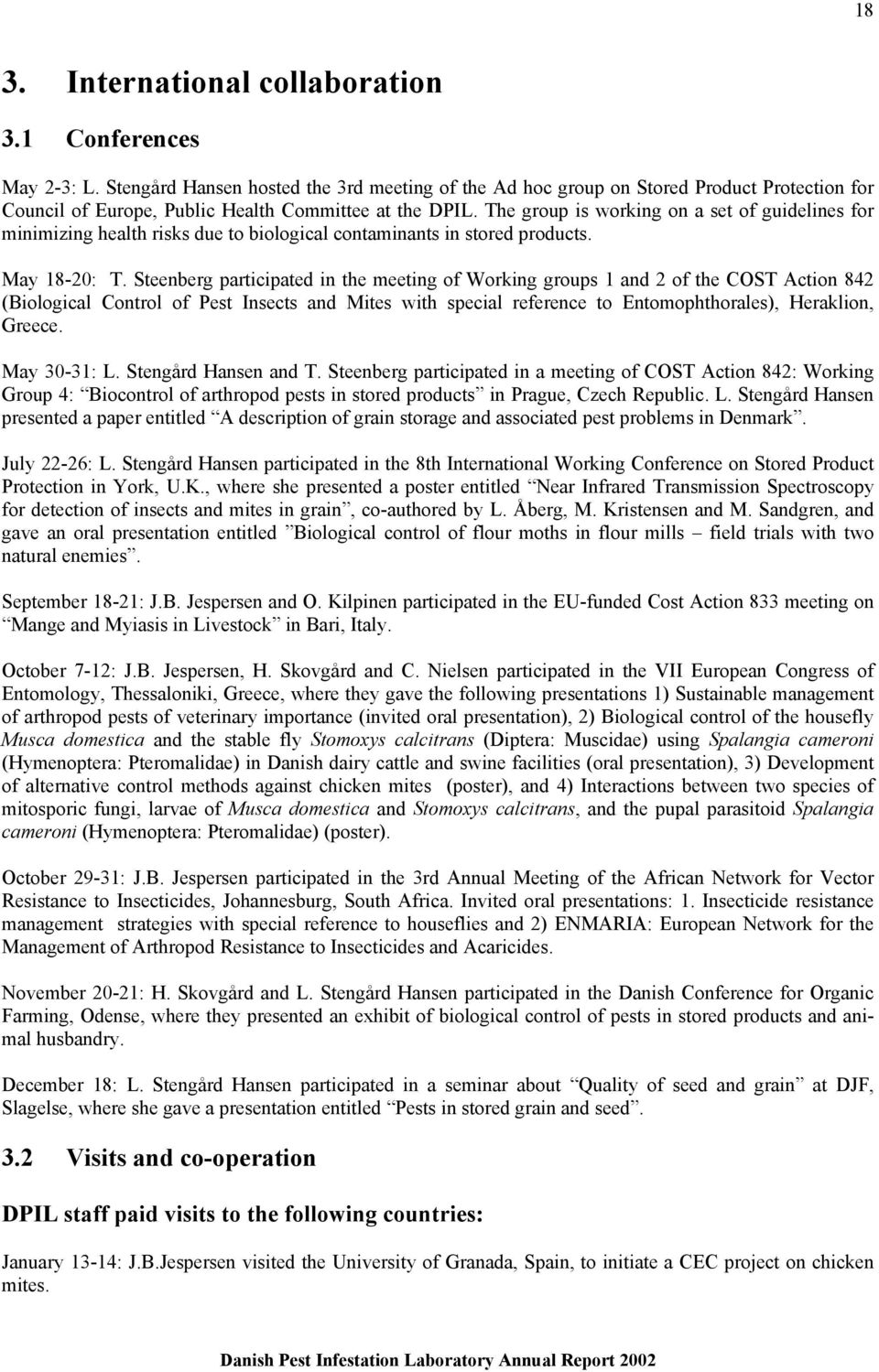
19 18 3. International collaboration 3.1 Conferences May 2-3: L. Stengård Hansen hosted the 3rd meeting of the Ad hoc group on Stored Product Protection for Council of Europe, Public Health Committee at the DPIL. The group is working on a set of guidelines for minimizing health risks due to biological contaminants in stored products. May 18-20: T. Steenberg participated in the meeting of Working groups 1 and 2 of the COST Action 842 (Biological Control of Pest Insects and Mites with special reference to Entomophthorales), Heraklion, Greece. May 30-31: L. Stengård Hansen and T. Steenberg participated in a meeting of COST Action 842: Working Group 4: Biocontrol of arthropod pests in stored products in Prague, Czech Republic. L. Stengård Hansen presented a paper entitled A description of grain storage and associated pest problems in Denmark. July 22-26: L. Stengård Hansen participated in the 8th International Working Conference on Stored Product Protection in York, U.K., where she presented a poster entitled Near Infrared Transmission Spectroscopy for detection of insects and mites in grain, co-authored by L. Åberg, M. Kristensen and M. Sandgren, and gave an oral presentation entitled Biological control of flour moths in flour mills field trials with two natural enemies. September 18-21: J.B. Jespersen and O. Kilpinen participated in the EU-funded Cost Action 833 meeting on Mange and Myiasis in Livestock in Bari, Italy. October 7-12: J.B. Jespersen, H. Skovgård and C. Nielsen participated in the VII European Congress of Entomology, Thessaloniki, Greece, where they gave the following presentations 1) Sustainable management of arthropod pests of veterinary importance (invited oral presentation), 2) Biological control of the housefly Musca domestica and the stable fly Stomoxys calcitrans (Diptera: Muscidae) using Spalangia cameroni (Hymenoptera: Pteromalidae) in Danish dairy cattle and swine facilities (oral presentation), 3) Development of alternative control methods against chicken mites (poster), and 4) Interactions between two species of mitosporic fungi, larvae of Musca domestica and Stomoxys calcitrans, and the pupal parasitoid Spalangia cameroni (Hymenoptera: Pteromalidae) (poster). October 29-31: J.B. Jespersen participated in the 3rd Annual Meeting of the African Network for Vector Resistance to Insecticides, Johannesburg, South Africa. Invited oral presentations: 1. Insecticide resistance management strategies with special reference to houseflies and 2) ENMARIA: European Network for the Management of Arthropod Resistance to Insecticides and Acaricides. November 20-21: H. Skovgård and L. Stengård Hansen participated in the Danish Conference for Organic Farming, Odense, where they presented an exhibit of biological control of pests in stored products and animal husbandry. December 18: L. Stengård Hansen participated in a seminar about Quality of seed and grain at DJF, Slagelse, where she gave a presentation entitled Pests in stored grain and seed. 3.2 Visits and co-operation DPIL staff paid visits to the following countries: January 13-14: J.B.Jespersen visited the University of Granada, Spain, to initiate a CEC project on chicken mites.
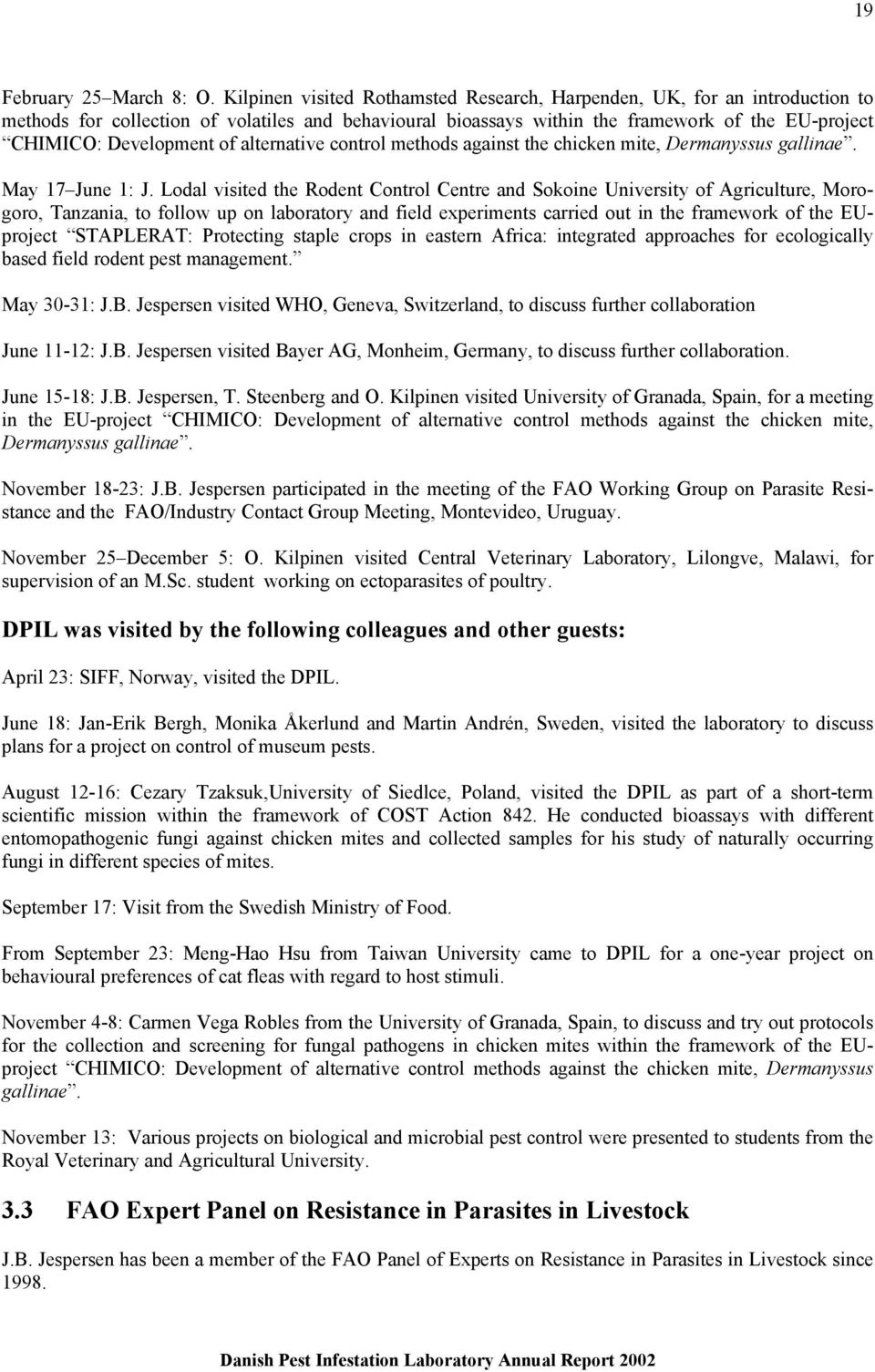
20 19 February 25 March 8: O. Kilpinen visited Rothamsted Research, Harpenden, UK, for an introduction to methods for collection of volatiles and behavioural bioassays within the framework of the EU-project CHIMICO: Development of alternative control methods against the chicken mite, Dermanyssus gallinae. May 17 June 1: J. Lodal visited the Rodent Control Centre and Sokoine University of Agriculture, Morogoro, Tanzania, to follow up on laboratory and field experiments carried out in the framework of the EUproject STAPLERAT: Protecting staple crops in eastern Africa: integrated approaches for ecologically based field rodent pest management. May 30-31: J.B. Jespersen visited WHO, Geneva, Switzerland, to discuss further collaboration June 11-12: J.B. Jespersen visited Bayer AG, Monheim, Germany, to discuss further collaboration. June 15-18: J.B. Jespersen, T. Steenberg and O. Kilpinen visited University of Granada, Spain, for a meeting in the EU-project CHIMICO: Development of alternative control methods against the chicken mite, Dermanyssus gallinae. November 18-23: J.B. Jespersen participated in the meeting of the FAO Working Group on Parasite Resistance and the FAO/Industry Contact Group Meeting, Montevideo, Uruguay. November 25 December 5: O. Kilpinen visited Central Veterinary Laboratory, Lilongve, Malawi, for supervision of an M.Sc. student working on ectoparasites of poultry. DPIL was visited by the following colleagues and other guests: April 23: SIFF, Norway, visited the DPIL. June 18: Jan-Erik Bergh, Monika Åkerlund and Martin Andrén, Sweden, visited the laboratory to discuss plans for a project on control of museum pests. August 12-16: Cezary Tzaksuk,University of Siedlce, Poland, visited the DPIL as part of a short-term scientific mission within the framework of COST Action 842. He conducted bioassays with different entomopathogenic fungi against chicken mites and collected samples for his study of naturally occurring fungi in different species of mites. September 17: Visit from the Swedish Ministry of Food. From September 23: Meng-Hao Hsu from Taiwan University came to DPIL for a one-year project on behavioural preferences of cat fleas with regard to host stimuli. November 4-8: Carmen Vega Robles from the University of Granada, Spain, to discuss and try out protocols for the collection and screening for fungal pathogens in chicken mites within the framework of the EUproject CHIMICO: Development of alternative control methods against the chicken mite, Dermanyssus gallinae. November 13: Various projects on biological and microbial pest control were presented to students from the Royal Veterinary and Agricultural University. 3.3 FAO Expert Panel on Resistance in Parasites in Livestock J.B. Jespersen has been a member of the FAO Panel of Experts on Resistance in Parasites in Livestock since 1998.
21 Scientific and Environmental Monitoring Group (SEMG) In 1985 the European Commission formed the SEMG to monitor the application of insecticide in the Regional Tsetse and Trypanosomiasis Control Programme (RTTCP) in Malawi, Mozambique, Zambia and Zimbabwe. In 1992 the mandate of SEMG expanded to include other effects of tsetse control with regard to land use and other possible environmental effects. In addition the activities of SEMG were not to be restricted to just RTTCP, but could now also involve all other EDF-funded projects in Africa. In 1997 the role and mandate of the SEMG were reviewed again. The mission of SEMG is now to support the European Commission, its member states and partners in the development and implementation of socially, economically and environmentally sustainable livestock production systems for agriculture. J. B. Jespersen has been the Danish member of SEMG since ENMARIA: European Network for the Management of Arthropod Resistance to Insecticides and Acaricides ENMARIA (European Network for the Management of Arthropod Resistance to Insecticides and Acaricides), an EU-funded Concerted Action, was launched in November 1996 to promote the development and implementation of management strategies for insecticide and acaricide resistance throughout Europe, thereby minimizing reliance on these chemicals and avoiding their increased use following resistance outbreaks. Nominated participants in ENMARIA include scientists and advisors from 13 countries and the agrochemical industry s Insecticide Resistance Action Committee (IRAC). ENMARIA hopes to achieve progress in four main areas - compilation of a European resistance database, workshops, training visits and publicity. The database will detail all individuals and institutions engaged in insecticide and acaricide resistance research activities and all available information on the incidence, impact and management of resistance in EU and EFTA countries. It will also include information on insect strains (especially susceptible reference strains) cultured by various laboratories that could be shared to save unnecessary duplication of effort. The workshops will aim at developing and promoting standardized methods for detection and monitoring of resistance and at identifying and disseminating guidelines for its management. The first workshop was held at IACR-Rothamsted in April 1997, in conjunction with the Resistance 97 International Conference on Pesticide Resistance. The second workshop took place in Almería in southern Spain in May 1998, whereas the third workshop took place in Thessaloniki, Greece in May Difficulties encountered in these regions with insect and mite control encapsulate well the need to integrate resistance management tactics with nonchemical approaches and are relevant to protected horticulture and agriculture throughout Europe. ENMARIA sponsors technical training visits, focusing on techniques for monitoring resistance and evaluating resistance. Until now 10 such training visits have been funded. The primary long-term objective of ENMARIA is to encourage close and formal scientific collaboration on resistance research between European laboratories, thereby avoiding duplication of effort and expertise. In addition, ENMARIA will remain committed to creating an environment more favourable for the implementation of resistance management strategies, notably by promoting open and frequent dialogue between researchers, pest management advisors, the agrochemical industry and regulatory authorities. Involvement in ENMARIA is open to all interested individuals and organizations; further details are available from the main coordinators whose details are as follows: Dr. Jørgen Brøchner Jespersen Danish Pest Infestation Laboratory Dr. Ian Denholm IACR-Rothamsted
22 21 Skovbrynet 14 Harpenden DK-2800 Kgs. Lyngby Herts, AL5 2JQ Denmark United Kingdom Tel.: (45) Tel.: (44) Fax: (45) Fax: (44) ENMARIA has established a Website giving information about its activities. The Homepage includes logos, maps and details of participants, and the site will eventually include working papers prepared by national representatives reviewing resistance problems in their respective countries. The address is: Mange and Myiasis in Livestock in Europe As part of the European co-operation in the field of scientific and technical research, a European COST Action 833 on Mange and Myiasis in Livestock was established in 1998 with the following objectives: 1. To develop accurate means of diagnosis of mange and myiasis in livestock and so prevent suffering and improve animal welfare. 2. To develop effective and environmentally sensitive methods of treatment and control of these diseases and so increase economic performance and decrease pressure on the environment. 3. To increase the epidemiological knowledge of these diseases in order to facilitate control and eradication programmes. Altogether, 16 countries are involved in implementation of the COST Action 833, which is organized by the Management Committee. In 1998 J.B. Jespersen was appointed the Danish representative of the Management Committee. In 2002 J.B. Jespersen participated in a Management Committe meeting in Cordoba, Spain.
23 22 4. Educational activities 4.1 Training courses In February and March ten one-day courses for personnel using phosphine-generating pellets for control of moles and water voles were run by J. Lodal in various parts of the country. A total of 743 persons participated. 4.2 Lectures 22 January, J. Lodal gave a lecture on rat resistance to anticoagulants at an Authorization Course in Rat Control held by the Ministry of the Environment. 8 April, L. Stengård Hansen gave two lectures on pests in relation to storage and processing of food for food technician students at the Royal Veterinary and Agricultural University, Copenhagen. 12 april, L. Stengård Hansen gave a presentation entitled Common furniture beetle infestations in roof timber in Danish medieval churches at the National Museum, Copenhagen. 21 August, A.-C. Heiberg gave a lecture on rat resistance and vitamin K requirement at an Authorization Course in Rat Control held by the Ministry of the Environment. December 18, O. Kilpinen gave a lecture on the techniques for collecting ectoparasites at the Royal Veterinary and Agricultural University. 4.3 External examiner and reviewer duties L. Stengård Hansen served as external examiner in the subject of forest entomology and ecology for forestry students at the Royal Veterinary and Agricultural University, Copenhagen. A-C. Heiberg served as a referee for Australian Center for International Agricultural Research (ACIAR). O. Kilpinen served as referee for the Journal of Medical Entomology and acted as external supervisor for one M.Sc. student from the Network for Smallholder Poultry Development at The Royal Veterinary and Agricultural University. T. Steenberg was external supervisor for C. Nielsen, University of Copenhagen, acted as referee for the journals Experimental and Applied Acarology and BioControl, and served as reviewer of a grant proposal submitted to the Binational Agricultural Research and Development Fund.
24 23 5. Advisory Work 5.1 Number of inquiries arranged by species In 2002 DPIL answered approximately 7600 general inquiries from farmers, the food industry and other firms, veterinary surgeons, doctors and other health services, the news media, and private individuals with pest problems. Of these inquiries, 64% were telephone calls, 27% were letters (with animals enclosed for identification), 6% were s and 3% visits to the laboratory. Many were answered by a leaflet on the subject, whereas others required replies in more detail, sometimes after extensive studies. Some of the inquiries led to inspections on location, but this type of examination is laborious and has been kept at a minimum since other engagements have higher priority at the laboratory. The subject of most of the visits was attacks of wood-boring insects in buildings. The species which generated the most inquiries were the hornet (Paravespula spp.), the common black ant (Lasius niger), the common furniture beetle (Anobium punctatum), head lice (Pediculus humanus capitis), carpet beetles (Anthrenus spp.), the Indian-meal moth (Plodia interpunctella), the dermestid beetle (Attagenus smirnovi), mice (Muridae), the stone marten (Martes foina) and book lice (psocids) (Psocoptera). Together these ten subjects made up 34% of the total number of inquiries. Since 2000 information about more than 75 different animals were placed on the laboratory s homepage ( In 2002 the laboratory observed more than 171,000 visits to pages concerning these animals. This fact explains without a doubt why the number of telephone calls concerning pest problems has decreased over the last three years. The pests on the homepage asked for most frequently were headlice (Pediculus humanus capitis), the water vole (Arvicola terrestris), the common furniture beetle (Anobium punctatum), the Norway rat (Rattus norvegicus), the common black ant (Lasius niger), the hornet (Paravespula spp.), mice (Muridae), the mole (Talpa europaea), pests on textiles (Tinea pellionella and Tineola bisselliella) and the stone marten (Martes foina). Together these ten pests made up approximately 40% of the pages asked for. In Table 5a, the inquiries to the laboratory are arranged by subject from a practical rather than a consistently zoological point of view. Many of the animal species or groups in the list do not deserve pest status. However, opinions vary and, for instance, in food articles any animal (or even trace of an animal) is often considered a problem. A.-M. Rasmussen and H. Skovgård
25 24 Table 5a. Number of inquiries in 2002 Leaflets (in Danish) in paper version are available on pests marked with an asterisk (*) nearly all of these leaflets are available in an electronic version as well Thysanura Børstehaler * Lepisma saccharina... Sølvkræ * Thermobia domestica... Ovnfisk... 4 * Collembola... Springhaler...14 Orthoptera Retvinger * Acheta domestica... Husfårekylling...13 Orthoptera div Blattaria Kakerlakker Blatta orientalis... Orientalsk kakerlak...5 * Blattella germanica... Tysk kakerlak...40 Ectobius laponica... Skovkakerlak...1 Neostylopyga rhombifolia... Harlekin kakerlak...2 Periplaneta americana... Amerikansk kakerlak...3 * Supella longipalpa... Brunstribet kakerlak...4 Blattaria div.... Kakerlakker div...59 Isoptera... Termitter...3 Dermaptera Ørentviste * Forficula auricularia... Alm. ørentvist...11 * Copeognatha... Støvlus Mallophaga... Pelslus og fjerlus...2 Siphunculata Lus * Pediculus capitis... Hovedlus * Phthirus pubis... Fladlus...2 Siphunculata div * Thysanoptera... Thrips...12 Hemiptera Næbmunde * Cimex lectularius... Væggelus * Reduvius personatus... Støvtæge...2 Hemiptera div... Tæger, bladlus, cikader div Neuroptera Netvinger * Chrysopa spp... Guldøjer...10 Lepidoptera Sommerfugle * Aphomia sociella... Humlevoksmøl...41 * Caradrina clavipalpes... Tagorm...2
26 25 * Endrosis sarcitrella... Klistermøl... 4 * Ephestia elutella... Kakaomøl...2 * Ephestia kuehniella... Melmøl...13 * Hofmannophila pseudospretella... Frømøl...28 * Plodia interpunctella... Tofarvet frømøl Sitotroga cerealella... Kornmøl...1 * Tinea pellionella... Pelsmøl...50 * Tineola bisselliella... Klædemøl...69 * Lepidoptera div.... Sommerfugle div...99 Coleoptera Biller Ahasverus advena * Alphitobius diaperinus... Lille melbille...1 Amphimallon solstitiale... Sankthansoldenborre...5 * Anobium punctatum... Alm. borebille * Anoplodera rubra... Rød blomsterbuk...13 * Anthrenus spp... Tæppebiller * Attagenus pellio... Pelsklanner...32 * Attagenus smirnovi... Brun pelsklanner Attagenus woodroffe... Båndet pelsklanner...1 Bostrychidae... Bostrychider...4 Bruchidae... Bønnebille...4 * Callidium violaceum... Violbuk...12 * Carabidae... Løbebiller...41 Carpophilinae... Tørfrugtbiller...1 Cerambycidae... Træbukke...19 Clytus arietis... Hvepsebuk...3 Coccinellidae... Mariehøns...1 Corynetes coeruleus... Skinkebille...1 * Criocephalus rusticus... Brun træbuk...15 Cryptolestes ferrugineus... Rustfarvet kornbille...6 * Cryptophagus spp... Skimmelbiller...20 * Dermestes haemorrhoidalis... Husklanner...40 * Dermestes lardarius... Flæskeklanner...32 * Ernobius mollis... Blød borebille...7 Europhryum confine... Boresnudebille...5 * Hadrobregmus pertinax... Rådborebille...16 * Hylesinus fraxini... Askebarkbille...5 * Hylobius abietis... Nåletræssnudebille...5 * Hylotrupes bajulus... Husbuk...11 * Lasioderma serricorne... Tobaksbille...20 * Lyctus spp... Splintvedbiller...7 Lymexylidae... Værftsbille...1 * Meligethes aeneus... Glimmerbøsser...2 Melolontha melolontha... Alm. oldenborre...5 * Nacerdes melanura... Bolværksbille...6 Niptus hololeucus... Messingtyv...3 * Ocypus olens... Stor rovbille...6 Opilo domesticus... Huspræstebille...1 Oryctes nasicornis... Næsehornsbille...3 Oryzaephilus mercator... Jordnøddebille...20 * Oryzaephilus surinamensis... Savtakket kornbille...30 * Otiorhynchus sulcatus... Væksthussnudebille...8
27 26 * Otiorhyncus spp... Øresnudebille...36 * Phyllopertha horticola... Gåsebille...42 * Phymatodes testaceus... Bøgebuk...39 Ptinus pectinicornis... Kamhornet borebille...1 Ptinus fur... Alm. tyvbille...3 * Ptinus tectus... Australsk tyvbille...4 * Reesa vespulae... Amerikansk klanner...6 Rhyzopertha dominica... Kornkapuciner...2 * Scolytidae... Barkbiller...12 Serica brunnea... Natoldenborre...4 * Sitona lineatus... Stribet bladrandbille...7 * Sitophilus granarius... Kornsnudebille...37 * Sitophilus oryzae... Rissnudebille...32 Sitophilus zea-mais... Majssnudebille...4 * Staphyllinidae... Rovbiller...12 * Stegobium paniceum... Brødbille * Tenebrio molitor... Melbille...52 Tribolium castaneum... Kastaniebrun rismelbille...3 * Tribolium confusum... Rismelbille...47 * Tribolium destructor... Lysolbille...1 Trogoderma angustum... Smal frøklanner...7 Trogoderma granarium... Khabrabille...2 * Xestobium rufovillosum... Egens borebille...6 Coleoptera div... Biller div Hymenoptera Årevinger * Andrena spp... Jordbier...22 * Apis mellifica... Honningbi...12 * Bombus spp.... Humlebier...85 * Camponotus spp.... Herkulesmyrer...12 * Colletes daviesanus... Murbi Formicidae... Myrer Formica rufa... Rød skovmyre...51 * Lasius fuliginosus... Orangemyre...13 * Lasius niger... Sort havemyre * Lasius umbratus and others... "Gule myrer"...24 Leptothora nylanderi * Monomorium pharaonis... Faraomyre...20 * Osmia spp... Murerbier...12 * Paravespula spp.... Gedehamse Pheidole megacephala * Siricidae... Træhvepse...10 Sphecoidae... Gravehvepse...10 Tapinoma melanocephalum Tetramorium caespitum... Græstørvsmyrer...1 * Vespa crabro... Stor gedehams...22 Hymenoptera div.... Årevinger div...63 Diptera Tovinger Borboridae... Springfluer...3 * Calliphoridae... Spyfluer...37 * Ceratopogonidae... Mitter...20 Chironomidae... Dansemyg...7
28 27 * Crataerina pallida... Mursejlerlusflue...1 * Culicidae... Stikmyg...28 * Drosophila spp.... Bananfluer...67 Eristalis spp... Dyndfluer...5 * Fannia canicularis... Lille stueflue...11 * Musca domestica... Stueflue...48 * Mycetophilidae... Svampemyg...30 * Ornithomyia spp... Lusfluer...3 Phoridae... Pukkelfluer...9 * Pollenia spp... Klyngefluer * Psychodidae... Sommerfuglemyg...38 * Simuliidae... Kvægmyg...2 Stomoxys calcitrans... Stikflue...12 * Tabanidae... Klæger...15 * Thaumatomyia notata... Græsflue...21 Tipulidae... Stankelben...6 Diptera div.... Tovinger div Siphonaptera Lopper * Ceratophyllus spp... Fuglelopper...77 * Ctenocephalides spp... Katte- og hundelopper...99 Ceratophyllus (Monopsyllus) sciurorum sciurorum... Egernloppe...2 * Pulex irritans... Menneskeloppe...3 Siphonaptera div.... Lopper div Pests on textiles... Tekstilskadedyr Pests in food... Kolonialskadedyr...30 Pests in wood... Træskadedyr...54 Various insects... Diverse insekter...43 Acarina Mider * Acarus siro... Melmide...17 * Bryobia praetiosa... Brunmide...31 Carpoglyphus lactis... Sveskemide...1 * Cheyletiella spp.... Pelsmider...3 * Dermanyssus spp... Fuglemider...10 * Dermatophagoides spp... Husstøvmider...7 Gamasidae... Gamasider...1 * Glycyphagus domesticus... Husmide...5 * Ixodes ricinus... Skovflåt...50 Oribatidae... Pansermider...1 * Rhipicephalus sanguineus... Husflåt...2 * Sarcoptes scabiei... Fnatmide...5 * Mites in grain, straw and hay... Lagermider...9 Acarina div... Mider div...33 * Araneae... Edderkopper...53 Pholcus phalangoides Scorpiones... Skorpioner...2
29 28 * Pseudoscorpiones... Mosskorpioner...5 * Diplopoda... Ægte tusindben...69 Polyxenus phalangoides Chilopoda Skolopendre Chilopoda div... Skolopendre div * Oniscoidea... Bænkebidere...66 Oligochaeta Sadelbørsteorme Lumbricidae... Regnorme...6 Gastropoda Snegle Arion lusitanicus... Iberisk skovsnegl...34 * Limacidae... Kældersnegle...11 Gastropoda div... Snegle div...54 Amphibia... Padder...7 Lamellibranchiata Muslinger Teredo navalis... Pæleorm...1 Reptilia... Krybdyr...3 Aves Fugle * Columba livia domestica... Tamdue Aves div.... Fugle div Mammalia Pattedyr Apodermus flavicollis... Halsbåndmus...64 * Arvicola terrestris... Mosegris Chiroptera spp... Flagermus...18 Felis domestica... Huskat...3 * Martes foina... Husmår * Muridae... Mus * Rattus norvegicus... Brun rotte Sciurus vulgaris... Egern...3 * Talpa europaea... Muldvarp Vulpes vulpes... Ræv...19 Mammalia div.... Pattedyr div Various animals... Diverse dyr Imaginary animals... Indbildte dyr...77 Pesticides... Bekæmpelsesmidler...93 Sundries... Diverse...210
30 Some of the cases and characteristic variations in the number of inquiries in 2002 An unusual amount of inquiries concerned cluster flies. Most of them occurred in September and October, but November and December were also quite busy. During autumn, and on sunny days in particular, many people had seen a huge number of flies outside the house - especially on sides facing south or west. Sometimes the flies crawled inside through window chinks and became a great nuisance to the occupants. Other inquirers had a large number of flies in the attic, and in the winter months the cluster flies mainly appeared from ceilings and crevices and flew slowly around. The most common cluster fly in Denmark is Pollenia rudis. Cluster fly overwinters as an adult, and late in the summer it starts looking for a place for protection against winter. Therefore, many flies make their way up under the roof or into the attic. Primarily, they stay there motionless throughout the winter without bothering anybody. If - for some reason - a heating occurs, they wake up and move down into the occupied rooms, where you have an invasion on your hands in the middle of winter. DPIL is unable to advise on a control of the flies, but can reassure that the flies do no damage and lay no eggs in the house. In the spring they leave their wintering place and fly to grass areas for oviposition. The flies often return to the same house to overwinter year after year. There is no explanation to the fact that they prefer some houses to others. Apparently they select houses with a high pitch or elevated houses. Large areas with grass surrounding the house may be important as well. We have no immediate explanation to the fact that cluster flies have been so numerous in the autumn and winther of 2002, but development will be followed in the year to come. In the eighties the laboratory received many inquiries about bedbugs, whereas the number was considerably smaller in the nineties. During the past year there was a slight tendency for an increase in inquiries concerning bedbugs again. In most cases the bedbugs were imported by people travelling abroad. It is not known whether the increasing number of bedbugs is a result of a higher travel activity than before or a result of a larger bedbug population in places where many people spend the night. In April the laboratory received some animals that had been crawling in a bed. The animals were identified as termites of the genus Cryptotermes. Among the termites sent in a couple of winged specimens were found indicating that the colony was about to swarm. It turned out that the termites came from a wooden bed imported from the East, and that the bed had been in an apartment for about a year before the termites appeared. In the month of July another person contacted us concerning termites in an apartment in Copenhagen, and in this case they had been imported in a cupboard from Egypt which had been in the apartment for several years. A further examination showed that they had spread to other pieces of furniture, and the laboratory advised the occupants to seek help from a professional control company. Now and then there are traces of termites in wood imported from the tropics, but live termite attacks are very seldom registered in Denmark. A.-M. Rasmussen and H. Skovgård
31 30 Scientific and technical work 6. Flies 6.1 Insecticide resistance in Musca domestica Laboratory strains kept in 2002 At the end of 2002, DPIL kept 19 strains representing a wide variety of resistance mechanisms and origins for use in testing and research work. A list of the strains and their origins is given in Table 6a. In all these strains, the resistance originated in the field. In several strains, selection with one (or two) insecticide(s) is carried out between one and four times a year in order to maintain the particular resistance type. As has been the case since the beginning of our investigation of resistance in houseflies in 1948, all our strains are available to laboratories that wish to use them for research, development of new insecticides, etc. This has assisted international research on insecticide resistance and given us useful feedback on our resistance problems. J. B. Jespersen, M. Kristensen and M. Knorr
32 31 Table 6a. Laboratory strains of Musca domestica maintained during 2002 Strain Origin Year Remarks Lab pressure 1. Strains subjected to periodic insecticidal pressure (adult dipping, exposure to vapour, or feeding with treated sugar) from a compound to which at least part of the population showed clear resistance at the time of collection 17 e DK 1950 lindane 39 m 2 b DK 1969 tetrachlorvinphos* 49 r 2 b DK 1970 dimethoate* 381 zb DK 1978 permethrin and dimethoate* 690 ab DK 1984 methomyl feeding* 594 vb DK 1988 azamethiphos feeding* 571 ab Japan 1980 High OP-R fenitrothion 698 ab Burma 1985 (not kdr) DDT 790 bb DK 1997 diflubenzuron 802 ab DK 1997 cyromazine 807 ab DK 1997 diflubenzuron 2. Originally resistant field strains kept without insecticidal pressure 7 DK 1948 Reverted DDT-R None 772 a DK 1989 Common lab. test strain None 791 a DK 1997 Multi-R None 3. Susceptible strains BPM Leiden 1955 None WHO Ij ² Pavia 1988 None NAIDM Texas 1991 None 4. Strains with resistance mechanisms isolated A 2 bb DK 1982 Super-kdr None Chr. 1, 2 and 3 with marker genes LPR USA 1995 Pyr-R kdr, P450 monooxygenase None * Some resistance to various (other) OP compounds and to DDT
33 Biological and physical control of Musca domestica and Stomoxys calcitrans Biological control of houseflies and stable flies with focus on indoor confinements housing animals on straw bedding Based on previous studies (see Annual Report 2000) the parasitoid, Spalangia cameroni Perkins (2-3 mm in size) was identified as a suitable candidate for biological control of houseflies and stable flies. The effect on parasitism of releasing 50, 100 and 200 female S. cameroni per m 2 in straw-bedded areas of six organic farms in the early period of the fly season (April-May) and middle part of the fly period (June- August) was evaluated. The aim was to examine if a relationship exists between release density and the number of fly pupae parasitized, and to evaluate the effect of the season on parasitoid activity. As control for activity of naturally occurring parasitoids, sentinel pupal bags were exposed in the bedding a week before the release of S. cameroni. Parasitism was measured by means of sentinel pupal bags from the day of release and weekly for four weeks. Early in the fly season, the overall parasitism of S. cameroni was low (10.5 ± 1.6% SE) and not related to release rates. In June, the average parasitism increased significantly across treatments to 19.7 ±2.9% SE, mainly due to an increase in ambient temperature, (F 1,59 =4.24; P<0.04). The highest release rate, 200 female parasitoids per m 2 led to the highest level of parasitism although not significantly different from 50 and 100 females per m 2 (F 2,23 =0.38; P<0.6888). Further, a significant decline in parasitism was found following the second week of the release of parasitoids. Thus, massive releases of S. cameroni early in the fly season (April-May) may have little overall effect on the fly development, since most of the released individuals will be inactive because of relatively low outdoor temperatures (12-15 C). Later in the season, parasitoid activity will increase significantly, due to a raise in temperatures, though a high release rate of parasitoids per m 2 in the present study did not result in a correspondingly higher percentage of fly pupae killed. Approximately 200 female S. cameroni per m 2 of straw bedding seem to be the maximum when related to the cost of producing parasitoid. Furthermore, as suggested previously (see Annual Report 2001) releases of S. cameroni should be made biweekly due to a high death rate of released individuals. Another field experiment with biocontrol of housefly and stable fly populations was conducted on six organic dairy cattle farms in the period August-November where approximately 200 female S. cameroni per m 2 of straw bedding were released biweekly. The aims of the study were: i) To examine whether S. cameroni could suppress the fly populations below a nuisance level given that the onset of control occurred when the flies were abundant in the stables. ii) To examine the relative impact of temperature, pupal parasitism and infection of adult flies with Entomophtorales (see section for Entomophthora) on the population dynamics of housefly populations in the period August and until primo December. Six organic dairy cattle farms with a history of high housefly and stable fly densities were selected for the study and split up into one group of three farms receiving parasitoids (200 females per m 2 ) and the other group was kept as controls. Activity of released S. cameroni including naturally occurring parasitoids was measured by exposing laboratory-reared housefly pupae in sentinel bags in the stables. Furthermore, the direct effect of S. cameroni on the fly populations was measured using a pseudologarithmic scale defined by the DPIL where index=0 denotes 0-3 flies per animal and index=7 denotes flies per animal. The final outcome of the control part (i) still has to be thoroughly analysed, but it seems that the suppressive effect of S. cameroni is rather limited when the populations of houseflies and stable flies have already reached high levels. However, in a previous study albeit covering one dairy cattle farm only, especially the
34 33 housefly population was brought down from index=7 to index=2 within one month by S. cameroni. In that study about female S. cameroni were released per m 2, a release rate four- to five-fold higher than in the 2002 study. If S. cameroni is released early in the fly season where the populations of houseflies and stable flies are still low, less than 200 female S. cameroni per m 2 seem sufficient to maintain the populations of especially the housefly at acceptable, low levels throughout the fly season (see annual Report 2000). In contrast if control of the flies is initiated late (July-August) when the flies build up high population levels, release rates of approx females S. cameroni per m 2 seem more appropriate, but not commercially feasible Life-table studies of a pupal parasitoid Urolepis rufipes H. Skovgård In August 2002, Lena Steenseng defended her M.Sc. entitled Life-table studies of the pupal parasitoid Urolepis rufipes (Hymenoptera: Pteromalidae) on the housefly Musca domestica (Diptera: Muscidae). The manuscript included in the report has been accepted for publication in a refereed journal Hyphomyceteous fungi H. Skovgård and L. Steenseng Hyphomycetous fungi are considered as potential biocontrol agents against adult and immature stages of houseflies and the compatibility of the entomopathogenic fungus Metarhizium anisopliae and the pupal parasitoid S. cameroni was evaluated in the laboratory (see Annual report 2000 for further describtion). The susceptibility of female parasitoids to fungus infection as well as the effect on female reproduction, survival, and population dynamics was determined. The isolate of M. anisopliae was moderately virulent at high conidia concentrations ( conidia ml -1 ) to the parasitoid, causing 68% mortaltity after 6 days. When S. cameroni was provided with optimal reproductive conditions, no overall effect of fungal treatment on reproduction was found (F 3,73 = 0.684, P = 0.508), although treatment with conidia ml -1 caused 50% infected females. Furthermore, the physiological susceptibility of the parasitoids to the fungal treatment was not expressed in the lifetable parameter r m, compared with a control group, which seems to indicate that the isolate of M. anisopliae would also be compatible with S. cameroni under field conditions Entomopthora muscae and E. schizophorae in houseflies and stable flies T. Steenberg and C. Nielsen The prevalence of E. muscae and E. schizophorae in houseflies was determined on six farms on a weekly basis from August to November as part of the study mentioned in Maximum infection rates varied from 38% to 78% with no general trend of increasing prevalences with increasing fly populations. Males were infected more often than females. E. schizophorae was recorded on three farms in late July, and on all six farms later in the season; this species infected up to 25% of the specimens killed by Entomophthoralean fungi. Cadaver counts were made on vertical surfaces on all farms also on a weekly basis. Despite the finding of a few specimens of fungus-infected cadavers of Drosophila sp. and Stomoxys calcitrans, subsequent sampling of live flies of the two species did not reveal fungus infection in these populations. In September, an unusually high number of sporulating cadavers of Stomoxys calcitrans was noticed on a dairy farm in Jutland. Incubation of live stable flies and houseflies showed that both species were infected by E. muscae, with prevalences of approx. 30%. The fungi have been isolated in vitro in liquid medium and will be screened for their ability to produce infective spores from cultures transferred to solid substrate (egg-
35 34 yolk medium). Transmission experiments using in vivo strains from the two fly species are under way to study the host specificity not only on species level but also in different fly strains. Tove Steenberg
36 35 7. Arthropod pests in poultry production 7.1 Alternative control methods against chicken mite In the first year of the EU-funded project, CHIMICO, work has focused on the isolation of semiochemicals with behaviour-modifying effects on the chicken mites as well as identifation of fungal pathogens with the potential for application in poultry houses. The first biologically active extracts which are attractive to chicken mites have been produced. Several different types of bioassays have been tested for their suitability for chicken mites, and a modified system is now available which has shown promising results. An air entrainment system was tested in pilot tests and an olfactometer set-up was constructed. Both systems are now ready for implementation. Scanning electron microscopy (SEM) was used for studies of the sensilla on foreleg tarsi and on the palps of chicken mites. Mapping of the sensilla most likely to function as sensory sensilla has provided crucial information for subsequent work on electrophysiology. Preliminary chemical analysis of solvent washings of blood-fed and unfed mites was conducted using high resolution gas chromatography (GC) and coupled gas chromatography-mass spectrometry (GC-MS). Crude samples were separated into volatile and non-volatile fractions by vacuum distillation, and GC revealed promising differences in the volatile profiles of blood-fed and unfed samples. A survey for naturally occurring fungal pathogens in chicken mites from Denmark and Spain was initiated. Live mites were incubated in arenas for ten days, and dead mites were examined for fungus after incubation in moist chambers. So far, the survey has not provided any findings of fungus-infected mites from the field samples. A bioassay was developed to study the effect of fungal isolates from other sources, on blood-fed chicken mites. All tested isolates proved virulent to chicken mites when applied as dry spores at high inoculum levels. Five isolates (Beauveria bassiana and Metarhizium anisopliae) were selected for further studies on fungus persistence in the poultry environment and on fungus epidemiology in mite populations. Studies were initiated which will investigate the effect of various physical factors present in poultry houses, on fungal pathogens and chicken mites. T. Steenberg, O. Kilpinen and J. B. Jespersen 7.2 A test for resistance in four Norwegian populations of chicken mites Chicken mites, Dermanyssus gallinae, collected from four Norwegian populations were tested for resistance against three acaricides: carbaryl, malathion and permethrin. The results were compared to the results from a test on the laboratory culture of D. gallinae at the DPIL. The results showed that all four Norwegian populations were resistant to permethrin. A concentration of 4 x LC 99 had hardly any effect at all on three of the four populations, in the last population the mortality almost reached 100% at this concentration. There was no resistance against the two other active ingredients, only a slightly reduced sensitivity against malathion. However, both compounds should be sufficiently effective to control D. gallinae. Due to the low number of mite populations tested it has not been possible to make any general conclusions on the resistance in Norwegian mite populations. O. Kilpinen
37 36 8. Stored product pests 8.1 Official examination of consignments 2002 DPIL examines consignments of grain and other dried plant products intended for export. Based on the results of these examinations, the Plant Directorate of the Ministry of Food, Agriculture and Fisheries issues a phytosanitary certificate for countries requiring such certification. In 2002 a total of 1095 consignments were examined: 152 lots of grain, 73 lots of malt, 109 lots of pulses (dried peas and beans), 184 lots of tobacco and 577 consignments of other products. Live insects were found in a total of 5 lots, in all cases in lots of grain and malt. The following pests were found: Sitophilus granarius, Oryzaephilus surinamensis, Tribolium confusum, T. destructor and Cryptolestes ferrugineus. L. Stengård Hansen 8.2 Rapid analysis methods for detection of pests and moulds in stored grain The potential for detecting mites and mycotoxins in grain by the means of near infrared transmittance spectroscopy is being investigated in a three-year project supported by the Nordic Industrial Fund. Participants in the project are scientists and representatives from instrumental industries and cereal industries in Sweden, Finland, Norway and Denmark. The DPIL is responsible for the subproject concerning storage mites. Before calibration curves can be developed, a reliable reference method must be established. Precise and reproducible determination of mite densities is very difficult. A flotation method has been established and analyses conducted using grain samples seeded with the grain mite, Lepidoglyphus destructor, in densities ranging from 600 to 25,000 mites per kg grain. The method is being adjusted to improve recovery rates and minimize the variation. The progress of the project will be reported on L. Stengård Hansen 8.3 Storage pests in Northern Guinea Savannah of Benin in West Africa with special reference to the Angoumois grain moth Sitotroga cerealella The present work aims at elucidating the role of S. cerealella as a pest of stored maize. Although S. cerealella has been relatively well studied as a pest of sorghum, its population dynamics, destructive potential and ecological relations (including natural enemies and pathogens) as a pest of maize in West Africa are not well understood. O. Gbati, K. Hell, B. Azoma and H. Skovgaard The role of Sitotroga cerealella as a post-harvest pest in the Guinea Savannah region in Benin In 10 different locations in the Guinea Savannah of Benin 50 maize farmers were surveyed. The surveys were undertaken between June 2001 and September Five farmers were chosen in each village for an initial exploratory questionnaire. This was followed by four surveys in the stores, carried out in the first, third and sixth months, respectively, after the first one. From each store, 60 cobs were taken and evaluated to study pest and predator densities, evaluate losses and damage levels. Hidden immature stages including natural enemies in the grains were reared out at IITA s experimental station in Cotonou, Benin. Furthermore, in four villages experimental granaries were established to study the effect of storing maize with husk, without husk and as grains on storage pest dynamics.
38 37 At the end of the survey P. truncatus and S. zeamais were found in all stores surveyed in Southern Guinea Savannah. In Northern Guinea Savannah P. truncatus was found in 25% of the stores. S. zeamais was rarely observed. In all sites Sitotroga cereallela was absent. The natural enemy of P. truncatus, Teretriosoma nigrescens was found in all stores in which P. truncatus was found. Three natural enemies of maize weevil, Anisopteromalus calandrae, Lariophagus distinguendus and Theocolax elegans were found in all sites where S. zeamais was present. Maize weight losses reached 10-15% at the end of survey. The problem of storage fungi arises especially in the southern part of the Southern Guinea Savannah and the fungi most frequently found were: Fusarium spp., Penicillium spp. and Aspergillus spp. The absence of S. cerealella was in clear contrast to some areas of Nigeria where the moth is common and often reaches pest status on stored sorghum and maize. Although S. cerealella was absen, the data give valuable insight into pest relationships in stores of maize in Benin. Data will be used to update the grainstorage model developed in cooperation between IITA and the Danish Institute of Agricultural Sciences (DIAS). O. Gbati, K. Hell, B. Azoma and H. Skovgaard Developmental time and age-specific fecundity of Sitotroga cerealella in relation to temperature and relative humidity The developmental time and age-specific fecundity of Sitotroga cerealella was determined in the laboratory at combinations of four temperatures (20, 25, 30 and 35 C) and two levels of relative humidity (low (44% RH) and high (80% RH). Some results are reported here: developmental times (egg to adult moth) ranged between 37 days at 30 C, high RH, to 105 days at 20 C, low RH. Fecundity was highest (mean 123 eggs per female) at 20 C, high RH. At 35 C, juvenile survival as well as oviposition were negligible. The data were used to calculate population development parameters; the highest intrinsic rate for natural increase, r m, was found at 30 C, high RH. L. Stengård Hansen and H. Skovgaard Intra- and interspecific competition between Sitophilus zeamais and Sitotroga cerealella Competition experiment. Sitophilus zeamais and Sitotroga cerealella are two important pests on maize in West Africa. Previous studies have demonstrated that S. zeamais is the dominant species and eliminates S. cerealella in laboratory experiment. Nevertheless, the two species are found coexisting in nature. As part of an M.Sc. project the question of coexistence was assessed in a competition experiment where resources were divided into discrete patches. It was hypothesized that coexistence would be sustained if the more fugitive species S. cerealella could reach and exploit new uninfested resources before S. zeamais. This hypothesis was rejected since S. zeamais dispersed more rapidly to the uninfested grains. The results of the competition experiment did not explain the coexistence, but by incorporating a spatial dimension new information on the mechanisms of competition was revealed. Furthermore by fitting of a logistic model to the data an estimate of the intrinsic rate of natural increase for S. zeamais was obtained (r per week). Maximising progeny production a laboratory experiment. The eggs of S. zeamais are deposited within the grains and the four larval instars develop and feed inside the grains. When adult S. zeamais exploit the grains they may damage the larvae inside. An additional experiment was conducted in order to study whether the distribution of adult S. zeamais was influenced by the presence of larvae inside the grains. It was found that adult S. zeamais avoid grains which contain a third or fourth instar larvae. Species composition - a field study. Insects on maize cobs sampled from stores in Benin were identified. The species list contains 14 insect orders. Within the Coleoptera 30 species were represented and within the
39 38 Hymenoptera 8 species were identified. S. zeamais was found in high numbers, but no S. cerealella were found, which was in line with data obtained by IITA in Benin. Correlations between the pest species, their natural enemies and different explanatory variables affecting the species composition in a maize store were examined. 8.4 Acoustical monitoring of insect pests in stored products M. Nykjær and H. Skovgård The purpose of this project is to develop a fast, reliable and sufficiently sensible method to monitor the presence of insect pests in the cereal industry. The grain weevil Sitophilus granarius is the most important pest in stored grain in Denmark. It is possible to measure its activity based on noise it produces during movement or chewing inside the kernels. A correlation between the level of activity and the sound recorded Sound recording from a grain beetle larvae in a wheat kernel will be determined. In a series of experiments single grains have been cut open and the behaviour of the larvae has been recorded on video tape simultaneously with the sound produced. By the means of computerbased video and sound analysis it will be possible to describe the sound produced by specific behavioural elements. The confused flour beetle Tribolium confusum is a major pest in industrial flour mills, where it congregates in large numbers in heat producing machinery. A new experimental set-up will be constructed to reveal whether it is possible to detect this insect based on the sound or vibrations that it produces. The transmission of sound through grain has been determined in a set-up where a loudspeaker was used as the sound source and the attenuation was measured at different distances. These investigations revealed a relatively large attenuation, probably due to the limited amount of free air space between the grains. The plan is to continue these measurements with vibrations instead of sound. Initial experiments have shown that an accelerometer attached to a thin metal plate provides an efficient connection to the grain.
40 39 O. Kilpinen, K.-M. Vagn Jensen, L. Stengård Hansen and Finn Agerkvist
41 40 9. Various other arthropods 9.1 Determination of the lower lethal temperature of museum pests The aim of these investigations is to determine the temperature necessary to kill a number of museum pest species by exposing them to low temperatures. To mimic the worst-case conditions in museums, the insects are exposed inside a wooden block (material thickness: 9 cm) and total exposure time is 24 hours at temperatures that can be obtained in a household freezer in order to facilitate practical application in small museum units, so the practical application is simple. With wooden blocks of this dimension it takes 9 hours to cool the interior from 20 C to 20 C. A series of trails have been conducted with Anthrenus verbasci to develop the experimental set-up. It is possible to determine when each single larva among a group of ten passes its super-cooling point. For A. verbasci this occurred at temperatures between 18 and 20 C, and all ten larvae died after exposure to 24 C. For Tineola bisselliella, ten larvae were exposed to 18 C; all ten died but only one larva passed its super-cooling point. This indicates that it may be possible to control some species of museums pests at higher temperatures than the 35 C that is recommended at present due to lack of precise information about the lethal temperatures. Investigations will be conducted on five species of dermestids, in as many stages as possible, and temperatures increased to determine the actual lower lethal temperature. 9.2 Temperature preferences of the cat flea K.-M. Vagn Jensen and L. Stengård Hansen The purpose of this study (financed by the National Science Council of Taiwan) is to obtain a better understanding of the distribution of cat fleas on the body of a cat. In a laboratory study the behavioural response of cat fleas to a temperature gradient is studied. The cat fleas are introduced to a closed chamber in which the floor temperature can be controlled from a computer. By setting up different temperatures in the two ends of the chamber the temperature preferences of cat fleas can be observed. For a comparison surface skin temperatures are measured on different body parts of a cat. Meng-Hao Hsu and Ole Kilpinen
42 Rodents 10.1 Resistance to anticoagulants Resistance in the Norway rat During 2002, a total of 346 Norway rats (Rattus norvegicus) from 37 municipalities were received for anticoagulant resistance testing. Warfarin resistance was found for the first time in the municipalities Augustenborg, Gram, Vojens, Tønder, Vejen, Blaabjerg, Gjern, Hadsten, Midtdjurs, Rougsø, Ry, Silkeborg and Sønderhald; coumatetralyl resistance in Gram, Vojens, Ry and Sønderhald; bromadiolone resistance in Augustenborg, Christiansfeld, Gram, Vojens, Vejen, Blaabjerg, Nørre Djurs, Ry, Skanderborg Sønderhald and Århus; and difenacoum resistance in Gram, Vojens, Vejen, Blaabjerg, Ry, Skanderborg, Århus and Brøndby. Brøndby is a municipality situated in the vicinity of Copenhagen whereas all other municipalities mentioned are situated in Jutland Population effects of anticoagulant rodenticide resistance in Norway rats J. Lodal A Ph.D. study investigating the effects of anticoagulant resistance in populations of Danish Norway rats was finished in May Resistance to anticoagulant rodenticides in Norway rats is documented to be associated with pleiotropic effects, notably with an increased dietary vitamin K requirement. The aim of this study was to quantify these effects in populations of Norway rat in Denmark and to see how they manifested themselves by differential selection depending on whether anticoagulants were being used or not. Experimental breeding populations were established under semi-natural conditions with wild rats trapped at two Danish farms, where bromadiolone resistance was prevalent. The individuals caught on each of the two farms were divided into two experimental groups. One group was regularly exposed to bromadiolone (treatment group) whereas the other group was untreated. The two treatment populations were exposed to bromadiolone bait (0.005 %) for one week twice a year. The level of bromadiolone resistance in the four experimental breeding populations was followed for two years. Resistant rats were found to be favoured in the treatment populations, whereas pleiotropic selection against resistance in the two non-treatment populations was found to be insignificant. We did not find a reduced tolerance to 0.005% bromadiolone when rats, from the non-treatment populations, were tested in a subsequent no-choice feeding test. We concluded that absence of anticoagulant, under the environmental conditions provided, did not lead to a selection favouring sensitive rats. However, selection against presumed homozygous resistant rats under non-anticoagulant conditions was suggested as some animals that died showed clear signs of haemorrhage though they had not been exposed to anticoagulants. Haemorrhagic symptoms are not only observed in sensitive rats that have been exposed to anticoagulants but are also a symptom for severe vitamin K deficiency in resistant rats. This suggests that bromadiolone resistance leads to loss of fitness, albeit the cost is not strong enough to reduce the phenotypic resistance level or counteract the effect of genetic drift. The Blood Clotting Response (BCR) test was implemented in this study and used for the identification of bromadiolone resistance in two Danish rat populations. In order to evaluate the BCR as a possible substitute or supplement for the no-choice feeding tests in the Danish monitoring programme, 254 rats (progenies of the experimental breeding populations) were tested in bromadiolone BCR and a subsequent 0.005% bromadiolone no-choice feeding test. The BCR test was found to be superior to the feeding test in the identification of bromadiolone resistance and as such recommendable for implementation in the Danish monitoring programme. However, the BCR test could not be used to predict the degree of resistance in the examined
43 42 rats. Thus, the test was incapable of differentiating between rats being either a potential control problem or not. In this study molecular markers were introduced in order to elucidate different population genetic aspects of the Norway rat. Mating and reproductive success are impossible to observe or measure in free-ranging populations of rodents due to their secretive nature. For that purpose molecular markers have shown to be powerful. Five different multiplex polymerase chain reaction (PCR) systems were developed from already known Rattus norvegicus specific microsatellite primers. A total of sixteen microsatellites were used to estimate effective population sizes (N e ) in the four experimental breeding populations over the study period of two years. Two different estimates of N e were used and compared. One estimate was based on a maximum likelihood approach using observed temporal changes in allele frequencies and the other estimate was based on knowledge obtained from parentage assignments of the actual number of reproducing individuals and number of progeny assigned to the individual parent. The two estimates were of comparable sizes and we found both estimates of N e to give reliable estimates. The sixteen microsatellite markers were furthermore used for parentage assignment using the software package CERVUS 1.0. The resolution of the used markers proved to be too low to resolve the parentages with high confidence. However, we were able to utilize detailed information on the life history of most of the implicated individuals, which proved to be valuable for the evaluation of the individual assignments. Thus, despite the lack of genetic variation we achieved a success rate of 77% to 94% for first parent assignments and 67% to 87% of the offspring was successfully assigned to a second parent. In addition, multiple paternity was verified in wild Norway rats based on the usage of microsatellite markers. Though the power of paternity assignments in CERVUS is sensitive to relatedness among candidate fathers, the likelihood-based approach was found to be superior to the method based on presence of non-maternal alleles. Furthermore, the CERVUS assignments are considerably more informative on mating strategies in populations of promiscuous individuals than would be obtained from mere observations. Though the number of litters is too low to draw definitive conclusions, the data do indicate that there is an age-dependent mating strategy. The older females mated with one single older male, whereas younger females tended to mate with multiple mates. It is speculated that mating among older individuals to a higher extent is dominated by pre- and post-copulatory mechanisms than among the younger and inexperienced individuals Vitamin K requirement in Danish anticoagulant-resistant Norway rats A.-C. Heiberg A M.Sc. study investigating vitamin K requirement of Danish bromadiolone resistant Norway rats was finished may Today one of the consequences of anticoagulant resistance in Norway rats (Rattus norvegicus) that has been acknowledged in British resistant rats is increased requirements of dietary vitamin K. The purpose of this study was to 1) elucidate the level of vitamin K requirement of Danish anticoagulant-resistant Norway rats and 2) to examine if anticoagulant resistant rats from different geographic localities had different requirements of vitamin K. Wild bromadiolone-resistant rats sampled from different localities in Denmark and rats from bromadiolone-resistant and susceptible laboratory strains were fed on a vitamin K deficient diet over a maximum period of 15 days. Development of vitamin K deficiency was found in 43% (N=106) of the Danish resistant rats. The level of vitamin K requirement was found to be moderately increased compared to susceptible rats and resembled that of the Scottish resistance type that has been identified in the UK. We found that development of deficiency was slower for resistant rats that were vitamin K3-supplemented prior to the feeding test, suggesting storage of the vitamin K body pool. We did, however, not find evidence of a
44 43 locality-dependent response to the vitamin K deficient feeding that could indicate that more than one type of anticoagulant resistance was present in Denmark Other work on rodents and rodent management Pest problems in organic pig production M.D.K. Markussen, A.-C. Heiberg and H. Leirs Within the framework of the Research Programme for Organic Agriculture (FØJO/DARCOF) a collaborative research project entitled "Management in relation to health and food safety in organic pig production" was started in Researchers from the Danish Institute of Agricultural Siences and the Royal Veterinary and Agricultural University and DPIL make up the project group. DPIL has a work package "Development of strategies for pest management in selected production systems". A questionnaire survey has been conducted as a first step for identification of pest problems and pest-supporting factors. The results of the survey showed that rats and smaller rodents (mice and voles), foxes and hares were the most frequently occurring mammals in fields with pigs. The farmers considered rats and foxes to be the most important (pest) problems. Occurrence of rats is reported significantly more frequently in organic pig farming than in traditional pig farming in open fields. The answers given by the farmers have been analysed further as to possible relationships between occurrence of / problems with rodents and the practice regarding the pig farming. The results of the analysis indicate certain factors that may be practicable as preventive measures against rodents. The type of feeding and water supply systems, type of hut and the distance to stacks of hay and straw in the fields are examples of factors to be considered by farmers when a production system is to be established. The second step of the project is more direct ecological studies of the rodents at two selected farms with the aim of defining the key factors that may be limiting for the size of the pest populations. The field studies will continue in Rodents, Salmonella and Campylobacter J. Lodal, H. Leirs and M. Knorr A collaborative research project involving researchers from the Danish Veterinary Institute, Zoological Museum and DPIL entitled "Wildlife as a source of salmonella infection in food-animal production" was initiated in 2000 and is to be finalized in Due to supplementary funding it has become possible also to include campylobacter in the project. Farms with pig, cattle or poultry or without production animals have been included. As part of the project rats, mice and voles have been trapped or faeces from the rodents have been collected. The data are now being analysed, and the results will be published elsewhere. J. Lodal STAPLERAT: Protecting staple crops in eastern Africa: integrated approaches for ecologicallybased field rodent pest management STAPLERAT is a collaborative project with different partners in Africa and Europe: DPIL, University of Antwerp, Belgium, University of Rome La Sapienza, Italy, University of Oslo, Norway, Sokoine University of Agriculture, Morogoro, Tanzania, Rodent Control Center, Morogoro, Tanzania, Kenyatta University, Nairobi, Kenya, Addis Ababa University, Ethiopia and Mutanda Research Station, Solwezi, Zambia. DPIL co-ordinates the project. Two years have passed in the STAPLERAT project and all studies are well established with a large amount of data collected already. Although some of the data analyses are still preliminary a number of interesting results can already be listed from the data. Brief summaries of achievements in each work package are listed below.
45 44 Identifying the pest rodents. Genetic work on the rodents present in staple crop fields in Ethiopia, Kenya, Tanzania and Zambia has identified several species of the genera Arvicanthis, Tatera, Mastomys, Aethomys, Mus, Lemniscomys and Cryptomys. Often more than one species of a genus occur at the same site, which is important since different species may have different properties with regard to damage or control. Further species identifications will be carried out for rodents belonging to the genus, Grammomys, Graphiurus, Acomys, Mus, Praomys (Myomys), Dendromus (?), Thallomys, Lemniscomys and Tachyoryctes. The taxonomic collections of rodents have identified the five most important potential pest species from the study sites: Mastomys sp. in all study sites, Arvicanthis sp. in Ethiopia and Kenya, Tatera sp. in Ethiopia and South Tanzania, Saccostomus sp. in Zambia and Mus sp. in Zambia and Kenya. Mastomys sp. is by far the most abundant species at all sites although Arvicanthis sp. is also abundant in Ethiopia. The relative density of the rodent species at different growth stages of the maize fields shows very different patterns between countries. Such variations are probably related to the reproductive patterns and will be investigated more intensively by an examination of reproduction patterns in rodents from removal grids. Damage characteristics. Data from the farmer participatory research (FPR) have been analysed for Ethiopia showing that the majority of farmers are small-scale farmers, who cultivate fields of about 1-1½ ha. Most farmers ranked rodents as crop pests higher than insects and reported maize to be the most affected crop. The farmers experienced highest damage during planting of the maize and therefore applied rodent control before planting. This shows that the farmers know when rodent control is most effective. The farmers use several control approaches but field sanitation is prioritized very low. It is therefore doubtful whether the farmers realise the importance of field sanitation in reducing rodent numbers and crop damage. The damage assessments in Tanzania show that rodents are not the sole source of damage to maize. However, both crop yields and rodent populations were unusually low, probably due to very limited rainfall, and the damage patterns may therefore also be affected. Economics and effects of control. An important preliminary result of this work package is that rodent control must be highly effective in reducing population size in order to give a damage reduction, which is economically interesting. The data, however, are still too scanty for a proper analysis, and more complete results are only expected after the third year. Rodent population dynamics. The capture-recapture studies in maize fields continue in Tanzania and Zambia but were terminated as planned in Kenya. Mastomys is the most important rodent genus in all study sites but Tatera sp. is also fairly abundant in the Southwest Tanzanian study site. Seasonal variations in the rodent populations are apparent in the two study populations from central Tanzania. The study populations from Southwest Tanzania and West Kenya on the other hand show no seasonality, although reproduction seems to be restricted to a specific period in Southwest Tanzania. Due to a large data gap in Zambia the population dynamics patterns cannot yet be investigated. Preliminary studies of key factors in one of the central Tanzanian populations show that features favouring survival are particularly important outside the breeding season, whereas features favouring reproduction are of course only particularly important during the breeding season. This would suggest that the most efficient way of affecting population growth is by affecting survival outside the breeding season. The key factor approach will be adapted for all study sites in the coming project year as well as further demographic analyses will be carried out. Population models and early warning systems. Historical outbreak data have still been very difficult to obtain, but the effort continues to locate those data. Historical rainfall data have been obtained from the sites of the WP4 study in Kenya and Zambia as well as from additional areas in Zambia where outbreaks have been recorded previously, but since rainfall data must be matched with the historical outbreak data this task has been postponed again.
46 45 Habitat studies show that the demography of M. natalensis is basically similar in fallow land, maize fields in monocultures and maize fields in mosaic cultures of field and fallow land. This finding entitles previous models from fallow land to be used in maize field situations with only minor changes to be adapted. Spatial studies show that 0.5 ha maize fields are recolonized very quickly after control actions during the planting season. The speed at which this happens is not dependent on the success of the control action, thus suggesting that the rodents are very mobile and that control actions have to be synchronized over large areas to be effective. Due to the delay in the outbreak and rainfall data tasks it has not yet been possible to develop the prediction models. Still, a formal analysis to evaluate the economic benefits of forecasting rodent outbreaks has been carried out. When using forecasts the farmers can minimize the economic impact of rodents. Bioeconomics in rodent management. The originally planned work for this work package was already finished earlier than scheduled during the first year and therefore the opportunity has been taken to take the work further than anticipated. We did this by using a comparative approach, comparing our data on African multimammate rats with the situation with other species on other continents and pointing out the generic nature of the bioeconomic approach. Protecting seed with repellents. Three identified seed dressing compounds (HALT, Thiram and Cinnamamide) were used to treat maize seeds and tested for repellent effects on M. natalensis in choice and nochoice laboratory experiments and in outdoor pens. The results show clear potential for Thiram and Cinnamamide to protect seeds from rodent damage whereas HALT in some cases (i.e. the outdoor experiment) causes increased damage to seeds compared to untreated seeds. Further studies will establish the efficacy of Thiram and Cinnamamide as repellent compounds in the field. Biological control with predators. The study has been delayed in Tanzania due to initial reluctance among farmers, but has now been established since April this year. Consequently, few data are still available. The study in Kenya, on the other hand, has been very successful with a high occupancy rate of barn owl nest boxes and a high owl-breeding index already. A large number of avian pellets has been collected and identification of prey species composition in the pellets has started. The appearance of pellets shows high seasonal variation with one peak in a year at one study grid and two peaks in a year at another study grid. These findings suggest that barn owl populations have been limited in nest site availability and that the populations may very well be increased by the application of artificial nest boxes. The owls potential as biocontrol agents will be evaluated by investigations of the effects on the rodent population. Agroforestry as a rodent management tool. The use of Tephrosia vogelii as a repellent agent and a physical barrier to mole rat activity has yielded very promising results in Zambia so far. Its presence in cassava fields, planted as an intercrop or as a fence, reduced the mole rat activity in the fields significantly. The cassava harvest in the coming year will show whether this has a positive effect on the final yield per field. In contrast, the plant has difficulties establishing at high altitudes of Ethiopia (where enset grows), in spite of many attempts to improve the growth conditions. Consequently mole rat damage is unaltered in the enset farms. Attempts have been made to introduce the plant at a lower altitude and results show that the growth there is faster suggesting that climatic conditions may prevent the use of T.vogelii as a mole rat control strategy in enset growing areas. S. Vibe-Petersen, H. Leirs and J. Lodal Population ecology of the African multimammate mouse Mastomys natalensis
47 46 S. Vibe-Petersen finished the data analysing of her Ph.D. project Predation pressure and population dynamics in African Mastomys rats: possibilities for integrated pest management? The research project began in November 1997 and evaluates the effects of predation pressure on the population dynamics of the most common rodent pest species in eastern Africa, the multimammate mouse Mastomys natalensis. The research was conducted in Tanzania in small (0.5 ha) maize fields where natural rodent populations were subjected to a combination of predation and dispersal treatments. Three levels of predation risk were used: no predation pressure (excluding predators by nets), natural predation pressure (unmanipulated control) and increased predation pressure (attracting predators by nest boxes and perch poles). Because dispersal of the rodents could mask the effects of predation, control and predator exclusion treatments were repeated in enclosures. Monthly rodent data were collected by a capture mark-recapture study. M. natalensis population growth during the increase season was faster in the absence of predators and peak population size increased. Otherwise dynamics patterns were similar for populations where predators had access or were attracted, suggesting that compensatory mechanisms operate when rodents are exposed to high levels of predation risk. Reducing dispersal of rodents removed the negative effect of predation pressure on population growth and peak size, suggesting that predators may be a strong driving-force for emigration in M. natalensis populations. Maize yield was largest in fields where predators were attracted, despite the fact that the population dynamics did not differ from fields where predators had access. This indicates that other factors than direct mortality caused by predators affected the rodent damage to the crop. The body weight of subadults was highest in populations where predators were attracted in the first population increase season, but highest in populations where predators were absent in the following increase season. Predation pressure may reduce the prey s foraging activity, whereas the reduction of population size due to predation ( thinning ) may improve conditions for the survivors due to decreased intraspecific competition. We propose that when food is abundant, increased predation risk negatively affects individual body weight of rodents by reducing their foraging activity, while thinning has no compensatory effect. When food becomes depleted, increased predation risk has no effect on individual body weight, but thinning affects it positively. Modelling survival and capture probability showed that attracting predators increased the survival probability of subadult females in the annual population increase season. For subadult males the survival probability increased both when predators had access and were attracted. Dispersal lowered the survival probability and in subadult males could explain the difference observed between predation treatments whereas in subadult females it could not. In the annual population decrease season the survival probability decreased when predators were attracted, especially for subadult males. Dispersal lowered the survival probability but only for subadult females. Predation may affect the survival probability of subadult M. natalensis both negatively and positively. The findings suggest the existence of a compensatory mechanism when subadult females are exposed to high predation pressure. We propose that during the increase season when food is still available and predation pressure only slowly increases, increased predation pressure selects for the female individuals with the lowest fitness thereby improving the conditions for the remaining female individuals and increasing their survival probability. During the population decrease season when food becomes increasingly sparse and predation pressure high, both subadult females and males trade off energy gain against survival, thereby increasing exposure to predation and decreasing the survival probability. Excluding predators extended the period of sexual activity in M. natalensis females and tended to lower the proportion of breeding females, probably due to an increased density of sexually active but non-breeding females. The sex ratio differed between predation treatments at capture sessions around the population peak and/or at capture sessions during the decrease season; in most cases the proportion of females was lowest in fields where predators had access or were attracted, indicating that predators selectively predate on females.
48 47 Despite this, the predatory effect on onset and cessation of actual breeding, on breeding intensity and thereby on reproductive output was insignificant, probably due to a low presence of avian predators during the main breeding season. The results suggest that the use of avian predators as a single control approach of M. natalensis may be ineffective in reducing rodent density, since the avian predation pressure was low during the breeding seasons in our study years and was only built up with a delay of some months to the annual prey population increase seasons. Still, because this pattern of predation pressure depends on the types of avian predator species that inhabit the population, it need not mean that avian predators in general may be ineffective bio-control agents of M. natalensis. In years with off-season breeding, the breeding will coincide with the high avian predation pressure. Hence, it is possible that avian predators have an impact on breeding in years with a potential risk for population eruption. Further, although manipulating predation pressure by perch poles and nest boxes may not affect the rodent population dynamics directly, it may still have an indirect beneficial effect on maize yield. S. Vibe-Petersen
49 List of species maintained at DPIL The numbers in square brackets [a,b] after some of the species indicate the following: a = the number of strains kept at DPIL; b = the number of resistant strains (if tested); - = no information is available. ARACHNIDA Acarina Dermanyssus gallinae Lepidoglyphus destructor Blattisocius tarsalis INSECTA Blattaria Blatta orientalis Blattella germanica [5,4] Periplaneta americana Supella longipalpa Lepidoptera Ephestia kuehniella Plodia interpunctella Tineola bisselliella Coleoptera Anthrenus museorum Anthrenus verbasci Attagenus smirnovi Attagenus unicolor (piceus) Attagenus woodroffei Oryzaephilus surinamensis Ptinus tectus Prostephanus truncatus Reesa vespulae Sitophilus granarius Stegobium paniceum Tribolium confusum Trogoderma angustum Trogoderma granarium Diptera Fannia canicularis [5,-] Haematobia irritans Musca autumnalis Musca domestica [23,20] Neomyia cornicina (Orthellia caesarion) Siphonaptera Ctenocephalides felis SPINDLER Mider Kyllingemide Kornmide Rovmide INSEKTER Kakerlakker Orientalsk kakerlak Tysk kakerlak Amerikansk kakerlak Brunstribet kakerlak Sommerfugle Melmøl Tofarvet frømøl Klædemøl Biller Museumsklanner Almindelig tæppebille Brun pelsklanner Sort pelsklanner Båndet pelsklanner Savtakket kornbille Australsk tyvbille (intet dansk navn) Amerikansk klanner Kornsnudebille Brødbille Rismelbille Smal frøklanner Khaprabille Tovinger (myg og fluer) Lille stueflue Lille stikflue Kvægflue Stueflue Grøn kokasseflue Lopper Katteloppe
50 49 MAMMALIA Mus musculus/domesticus [3,1] Rattus norvegicus PATTEDYR Husmus (lys og mørk) Brun rotte
51 Publications and reports 12.1 Publications by members of staff in 2002 Scientific publications in international, peer-reviewed journals and books Bekele, A., H. Leirs & R. Verhagen, 2002: Composition of rodents and damage estimates on maize farms at Ziway, Ethiopia. In: G. R. Singleton, L. A. Hinds, C. J. Krebs, and D. M. Spratt, eds., Rats, Mice and People: Rodent Biology and Management. Canberra, Australian Center for International Agricultural Research, Friis, N.F., S.E. Jorsal, B. Kokotovic, J. Lodal, L.M. Nielsen, A.L. Schirmer, V. Sørensen & F. Thorup, 2002: [Leptospirosis in swine: A short review with a report on new outbreaks of Leptospirosis in Danish sow herds.] Dansk Veterinærtidsskrift 85 (5), (In Danish: Leptospirose hos svin. Et kort tilbageblik med orientering om nye udbrud ledsaget af alvorlige abortproblemer. English summary) Hansen, L.S. & K.-M.V. Jensen, 2002: Effect of Temperature on Parasitism and Host-Feeding of Trichogramma turkestanica (Hymenoptera: Trichogrammatidae) on Ephestia kuehniella (Lepidoptera: Pyralidae). Journal of Economic Entomology 95(1): Heiberg, A-C., H. Leirs & H.R. Siegismund, Bromadiolone resistance does not respond to absence of anticoagulants in experimental populations. In: G. R. Singleton, L.A. Hinds, C.J. Krebs & D.M. Spratt, eds., Rats, Mice and People: Rodent Biology and Management. Canberra, Australian Center for International Agricultural Research, Kilpinen, O., 2002: Activation of the poultry red mite, Dermanyssus gallinae (Acari: Dermanyssidae), by increasing temperatures. Experimental and Applied Acarology 25: Leirs, H. 2002: Management of rodents in crops: the Pied Piper and his orchestra. In: G.R. Singleton, L.A. Hinds, C.J. Krebs & D.M. Spratt, eds., Rats, Mice and People: Rodent Biology and Management. Canberra, Australian Center for International Agricultural Research, Leirs, H., A. Skonhoft, N.C. Stenseth & H.P. Andreassen, 2002: A bioeconomic model for the management of Mastomys natalensis mice in maize fields. In: G.R. Singleton, L.A. Hinds, C.J. Krebs & D.M. Spratt, eds., Rats, Mice and People: Rodent Biology and Management. Canberra, Australian Center for International Agricultural Research, Massawe, A. W., H. Leirs, W.P. Rwamugira & R.H. Makundi, 2002: Effect of land preparation methods on spatial distribution of rodents in crop fields. In: G.R. Singleton, L.A. Hinds, C.J. Krebs & D.M. Spratt, eds., Rats, Mice and People: Rodent Biology and Management. Canberra, Australian Center for International Agricultural Research, Mulungu, L. S., R.H. Makundi & H. Leirs, 2002: Robustness of techniques for estimating rat damage and yield loss in maize fields. In: G.R. Singleton, L.A. Hinds, C.J. Krebs & D.M. Spratt, eds., Rats, Mice and People: Rodent Biology and Management. Canberra, Australian Center for International Agricultural Research, Mulungu, L. S., R.H. Makundi, H. Leirs, A.W. Massawe, S. Vibe-Petersen & N.C. Stenseth, 2002: The rodent density-damage function in maize fields at an early growth stage. In: G.R. Singleton, L.A. Hinds, C.J. Krebs & D.M. Spratt, eds., Rats, Mice and People: Rodent Biology and Management. Canberra, Australian Center for International Agricultural Research,
52 51 Ngowo, V., J. Lodal, L.S. Mulungu, R.H. Makundi, A.W. Massawe & H. Leirs, 2002: Evaluation of thiram and cinnamamide as potential repellents against maize-seed depredation by the multimammate rat, Mastomys natalensis, in Tanzania. In: G.R. Singleton, L.A. Hinds, C.J. Krebs & D.M. Spratt, eds., Rats, Mice and People: Rodent Biology and Management. Canberra, Australian Center for International Agricultural Research, Sichilima, A.M., M.S. Zulu and H. Leirs, The effects of Tephrosia vogelii and land preparation methods on mole rat activity in cassava fields. In: G.R. Singleton, L.A. Hinds, C.J. Krebs & D.M. Spratt, eds., Rats, Mice and People: Rodent Biology and Management. Canberra, Australian Center for International Agricultural Research, Sironen, T., A. Plyusnina, H.K. Andersen, J. Lodal, H. Leirs, J. Niemimaa, H. Henttonen, A. Vaheri, Å. Lundkvist & A. Plyusnin, 2002: Distribution of Puumala Hantavirus in Denmark: analysis of Bank voles (Clethrionomys glareolus) from Fyn and Jutland. Vector Borne and Zoonotic Diseases 2: Skovgård, H. & T. Steenberg, 2002: Activity of pupal parasitoids of the stable fly Stomoxys calcitrans and prevalence of entomopathogenic fungi in the stable fly and the house fly Musca domestica in Denmark. BioControl 47: Skovgård, H., 2002: Dispersal of the filth fly parasitoid Spalangia cameroni (Hymenoptera: Pteromalidae) in a swine facility using fluorescent dust marking and sentinel pupal bags. Environmental Entomology 31: Steenberg, T. & J.B. Jespersen, 2002: Control of house flies and filth flies. Encyclopedia of Pest Management, Marcel Dekker, Inc., New York, Other scientific publications Adler, C., S. Navarro, M. Schöller & L.S. Hansen (eds.), 2002: Integrated Protection of Stored Products. Bulletin IOBC/wprs 25(3). 267 pp. Baggesen, D.L., M.N. Skov, J.J. Madsen, C. Rahbek, J. Lodal, J.B. Jespersen, J.C. Jørgensen & H.H. Dietz, 2002: Investigations on the significance of non-food animals in relation to introduction and persistence of Salmonella enterica in Danish food production animal herds. Proceedings of the International symposium Salmonella & salmonellosis, France, 2002: Hansen, L.S. & K.-M.V. Jensen, 2002: Trichogramma turcestanica against Ephestia kuehniella in flour mills: extent of host-feeding and initial results of a field trial. Integrated Protection of Stored Products, IOBC Bulletin, 25(3): Hansen, L.S., 2002: A description of grain storage and associated pest problems in Denmark. In: Proceedings of the 2nd meeting of COST Action WG IV, May, 2002, Prague, Czech Republic, Kilpinen, O., T. Steenberg, J.B. Jespersen, M.D. Soler Cruz, M.C. Vega Robles, M. Birkett, S. Dewhirst & J. Pickett, 2002: Advances in the development of alternative control methods against chicken mites. Proceedings, Cost Action 833 Mange and Myiasis in Livestock 5th Annual Meeting in Bari, Italy, September 18-21, Expert reports and project reviews
53 52 Lodal, J. & O.C. Hansen, 2002: Human and Environmental Exposure Scenarios for Rodenticides Focus on the Nordic Countries. TemaNord 2002:575. Nordic Council of Ministers, Copenhagen. ISBN pp. Popular articles Jespersen, J.B., J.Pickett, M.D. Soler Cruz & M. Guillon, 2002: Development of alternative control methods for the chicken mite (Dermanyssus gallinae). Catalogue of projects related to Control of Infectious Diseases funded under the Quality of Life and Management of Living Resources Programme. Rasmussen, A. 2002: Kæm for alt hvad du har kært klø om så det gælder. Alex, (2): Schmidt, N.M., T.D. Lisborg, H. Olsen, & H. Leirs Betydning af græsning og høslæt på populationer af småpattedyr. In: Nielsen. L., ed., Ferske enge - ekstensiv landbrugsproduktion, natur og miljø. Konference, Forskningscenter Foulum. Tjele. 12. marts Danish Institute of Agricultural Sciences, Presentations and posters at conferences Baggesen, D.L., M.N. Skov, J.J. Madsen, C. Rahbek, J. Lodal, J.B. Jespersen, J.C. Jørgensen & H.H. Dietz, 2002: Investigations on the significance of non-food animals in relation to introduction and persistence of Salmonella enterica in Danish food production animal herds. Oral presentation at International Symposium Salmonella and Salmonellosis, Ploufragan, France, May. Hansen, L. Stengård & P. Sejerø Nielsen, 2002: Biological control of flour moths in flour mills field trials with two natural enemies. Oral presentation at workshop at 8th International Working Conference on Stored Product Protection, York, U.K, July. Hansen, L. Stengård, L. Åberg, M. Kristensen & M. Sandgren, 2002: Near Infrared Transmission Spectroscopy for detection of insects and mites in grain. Poster presented at the 8th International Working Conference on Stored Product Protection, York, UK, July. Hansen, L., 2002: Pests in stored grain and seed. Oral presentation at seminar about Quality of seed and grain, Danish Institute of Agricultural Sciences, Slagelse, 18 December. Jespersen, J.B., 2002: Flies in animal production: biology, importance, control measures, and insecticide resistance management strategies. Invited oral presentation at FAO-regional Meeting on pesticide resistance in parasites, Montevideo, Uruguay, November. Jespersen, J.B., O. Kilpinen, T. Steenberg, M.D. Soler Cruz, C.V. Robles, M. Birkett, S. Dewhirst & J. Pickett, 2002: Development of alternative control methods against chicken mites. Poster presentation, VII European Congress of Entomology, Thessaloniki, Greece, 7-13 October. Jespersen, J.B., H. Skovgaard, T. Steenberg, O. Kilpinen & K.M. Vagn Jensen, 2002: Sustainable management of arthropod pests of veterinary importance. Invited oral presentation, VII European Congress of Entomology, Thessaloniki, Greece, 7-13, October. Jespersen, J.B., 2002: 1) Insecticide resistance management strategies with special reference to houseflies, and 2) ENMARIA: European Network for the Management of Arthropod Resistance to Insecticides and Acaricides. Invited oral presentations at the 3rd Annual Meeting of the African Network for Vector Resistance to Insecticides, Johannesburg, South Africa, 29-31October. Kilpinen, O., T. Steenberg, J.B. Jespersen, M.D. Soler Cruz, M.C. Vega Robles, M. Birkett, S. Dewhirst & J. Pickett, 2002: Advances in the development of alternative control methods against chicken mites. Poster presentation, Cost Action 833 Mange and Myiasis in Livestock 5th Annual Meeting in Bari, Italy, 18-21
54 53 September. Leirs, H., 2002: African rodents: comes time, comes space. Invited opening keynote address at the 8th International Conference Rodens & Spatium, Louvain-la-Neuve, Belgium, July. Leirs, H., 2002: Conservation advices based on rodent pest biology? Invited lecture at the 10th Meeting of the International Hamsterworkgroup, Tongeren, Belgium, October. Lisborg, T.D., H. Olsen & H. Leirs, 2002: Effekt af græsning og høslæt på arealanvendelse hos nordmarkmus. Lecture at conference held by the Danish Mammal Society at Kalø, Rønde, Denmark, October. Minten, J. & H. Leirs, 2002: A description of the process of recolonisation after pest control of Mastomys natalensis mice in Tanzanian maize fields. Poster presented at the 9th Benelux Congress of Zoology, Antwerp, Belgium, 8-9 November. Mohr, K., S.Vibe-Petersen, L.L. Jeppesen, M. Bildsøe & H. Leirs, 2002: Foraging of multimammate mice (Mastomys natalensis) under different predation pressure: cover, patch dependent decisions and densitydependent GUDs. Poster presented at the 9th Benelux Congress of Zoology, Antwerp, Belgium, 8-9 November. Nielsen, C., H. Skovgård & T. Steenberg, 2002: Interactions between two species of mitosporic fungi, larvae of Musca domestica and Stomoxys calcitrans, and the pupal parasitoid Spalangia cameroni (Hymenoptera: Pteromalidae). Poster presentation, VII European Congress of Entomology, Thessaloniki, Greece, 7-13 October. Odhiambo, R., R. Verhagen, R. Makundi, N. Oguge, M. Corti, A. Bekele, A. Sichilima & H. Leirs, 2002: Rodent pests of staple crops in eastern Africa: densities and community dynamics. Poster presented at the 9th Benelux Congress of Zoology, Antwerp, Belgium, 8-9 November. Olsen, H., T.D. Lisborg, N.M. Schmidt & H. Leirs, 2002: Betydning af græsning og høslæt på populationer af småpattedyr. Lecture at conference held at Research Centre, Foulum. Tjele, Denmark, 12 March. Petersen, H.H., L.L. Jeppesen, S. Vibe-Petersen & H. Leirs, 2002: Predation risk assessment in the African multimammate mouse Mastomys natalensis (A. Smith 1834). Poster at the 8th International Conference Rodens & Spatium, Louvain-la-Neuve, Belgium, July. Skovgård, H., J.B. Jespersen & G. Nachman, 2002: Biological control of the house fly Musca domestica and the stable fly Stomoxys calcitrans (Diptera: Muscidae) using Spalangia cameroni (Hymenoptera: Pteromalidae) in Danish dairy cattle and pig facilities. Talk given at VII European Congress of Entomology, Thessaloniki, Greece, 7-13 October. Skovgaard, H., L. Stengård Hansen, T. Steenberg, K.-M.V. Jensen & O. Kilpinen, 2002: Naturlige fjender kan forebygge skadedyrproblemer. Poster and exhibition. Ecology Congress, Odense, Denmark, November. Sluydts, V. & H. Leirs, 2002: Population dynamics and demographic properties of Mastomys natalensis (Smith, 1834) in monoculture and mosaic fields. Poster presented at the 9th Benelux Congress of Zoology, Antwerp, Belgium, 8-9 November. Vibe-Petersen, S. & H. Leirs, 2002: Body weight of African multimammate mice exposed to different predation pressure. Poster at the 8th International Conference Rodens & Spatium, Louvain-la-Neuve, Belgium, July.
55 Appearances in the media Lodal, J.: Resistance in Norway. Danish Broadcasting Radio South, 27 September. Lodal, J.: Rat problems. Danish Broadcasting, 15 October. Lodal, J.: Ultrasonic devices against rats and mice. Swedish Television 1, 21 October. Rasmussen, A.: Fruitflies. Danish Broadcasting, 14 November Unpublished reports on laboratory tests and/or field trials The reports are confidential except those marked * Kristensen M., M. Knorr & J.B. Jespersen, 2002: Susceptibility to thimethoxam in Danish field populations of houseflies (Musca domestica), 28 pp Jespersen, J.B.: Kvit flue Strips indeholdende azamethiphos (Musca domestica), 4 pp Jespersen, J.B.: Retningslinier for fluebekæmpelse på gårde med husdyr i 2002, 7 pp Knorr, M.: Laboratory evaluation of sticky flytraps for control of the housefly Musca domestica, 11 pp Knorr, M.: Comparison of the capture efficiency of two types of glue boards for UV light traps, 11 pp Lodal, J.:Laboratorieforsøg for effektivitet og palatabilitet af blokke med bromadiolon til rottebekæmpelse, 21 pp Lodal, J.:Laboratorieforsøg for effektivitet og palatabilitet af præparat med bromadiolon til musebekæmpelse, 14 pp Jespersen, J.B.: Retningslinier for fluebekæmpelse på gårde med husdyr i 2003, 7 pp.
56 Evaluation of the efficacy of pesticides and medical and veterinary products 13.1 Pesticides According to the Danish Act on Chemical Substances and Products (No. 256 of 12. April 2000), the registration of a new pesticide formulation requires documentation of the efficacy of the formulation used according to the directions on the label and under Danish conditions. The National Agency of Environmental Protection makes decisions on registration concerned with the control of the pest in question, but the Agency sends the applications to a hearing at the national laboratories, e.g. DPIL. These institutes evaluate the efficacy and possible risks and drawbacks of using the formulation, including the potential for developing resistance and cross-resistance. In 2002, pesticides submitted for evaluation and registration included formulations for control of rodents and various insects, such as houseflies and flies on cattle, fleas, ectoparasites on livestock, ants, cockroaches, storage pests, and household insects generally, as well as insects attacking wood or textiles. Several formulations were recommended for approval, but in some cases it was concluded that more documentation was needed, supplementary tests should be carried out, or it was recommended that, for certain reasons, the formulation should not be permitted for the use requested. The registration authorities generally followed our recommendations. J. B. Jespersen 13.2 Medical and veterinary products Medical and veterinary medical products are registered according to a common EU-directive. Guidelines for testing the efficacy of such products have been worked out or are at the moment being established. In 1999, DPIL agreed with the Danish Medicines Agency - who makes decisions on registration of medicinal products - to comment on draft versions of guidelines for testing the efficacy of medical and veterinary products and to evaluate the efficacy and possible risks and drawbacks of using such products. J. B. Jespersen
57 Formulations approved by the Danish Pest Infestation Laboratory as of 1 March 2003 Fortegnelse over bekæmpelsesmidler anerkendt af Statens Skadedyrlaboratorium 1. marts 2003 Trade name Active material Conc. Company 1 Formulations for fly control (Midler til bekæmpelse af fluer) I Space sprays for indoor fly control (Forstøvningsmidler til udsprøjtning i luften til bekæmpelse af fluer i lukkede rum) (a) Solutions approved for fly control using fine atomization of at least 0.5 cm 3 per m 3 (Opløsninger anerkendt til bekæmpelse af fluer ved fin forstøvning af mindst 0,5 cm 3 per m 3 rum) Mortalin Special 86 pyrethrin I & II 0.4% Mortalin sprøjtevæske mod fluer bioresmethrin 0.05% piperonylbutoxyd 2.40% (b) Aerosols approved for fly control when sprayed for at least 7 seconds (approx. 10 g aerosol per 30 m 3 ) (Aerosoler (trykdåser) anerkendt til bekæmpelse af fluer ved sprøjtning i mindst 7 sekunder pr. 30 m 3 rum (svarende til ca. 10 g aerosol pr. 30 m 3 )) Mortalin Special Flueaerosol pyrethrin I & II 0.4% Mortalin bioresmethrin 0.05% piperonylbutoxyd 2.40% (c) Aerosols approved for fly control when sprayed for at least 5 seconds (approx. 10 g aerosol per 30 m 3 ) (Aerosoler (trykdåser) anerkendt til bekæmpelse af fluer ved sprøjtning i mindst 5 sekunder pr. 30 m 3 rum (svarende til ca. 10 g aerosol pr. 30 m 3 )) Trinol Turbo jet mod fluer pyrethrin I & II 0.40% Aeropak piperonylbutoxyd 2.00% II Paint-on baits or treated strips approved for supplementary fly control in animal houses (Smøremidler anerkendt til supplerende fluebekæmpelse i stalde) Paint-on baits: ALFICRON plus azamethiphos 10% Novartis Trinol smøremiddel propetamphos 6% Agro Dan mod fluer
58 57 Trade name Active material Conc. Company 2 Formulations for control of fleas on pets and in their surroundings (Midler til bekæmpelse af lopper på kat og hund og i omgivelserne) (a) Approved impregnated collars to be used in combination with group (c) or (d) (Anerkendte, imprægnerede halsbånd anvendes kombineret med gruppe (c) eller (d)) Lop-A' propoxur g per Bayer utøjshalsbånd collar (halsbånd) til hunde propoxur 2.9 til katte propoxur 0.8 Material Shop loppehalsbånd g per Bayer collar (halsbånd) til hunde propoxur 2.9 til katte propoxur 0.8 (b) Solutions approved for control of fleas in the surroundings (Sprøjtemidler anerkendt til bekæmpelse af lopper i omgivelserne) Gett chlorpyrifos 0.8 g per l Dow AgroSciences (c) Aerosols approved for preventive treatment of flea larvae in the surroundings (Anerkendte aerosoler godkendt til forebyggende bekæmpelse af loppelarver i omgivelserne) Pre-lop Spray methopren 0.3% Bayer (d) Pump spray approved for preventive treatment of fleas. The product acts as a flea ovicide when used on pet fur (cats or dogs) (Pumpespray anerkendt som forbyggende loppebehandling. Produktet forhindrer loppeæg i at klække, når katte- eller hundepels behandles) Material Shop kattespray methopren 0.5% Bayer med methopren 3 Formulations for flea control on farmed mink (Midler til bekæmpelse af lopper hos farmmink) Pulvex permethrin 1% Schering Plough Safrotin 1% D propetamphos 1% Novartis
59 58 Trade name Active material Conc. Company 4 Apparatus for control of hornets (Midler til bekæmpelse af gedehamse) Light trap for use in bakers shops, etc. (Lysfælde til brug i bagerforretninger, etc.) Insect-O-Cutor Elektrisk apparat Tanaco 5 Rodenticides for control of mice inside and around buildings (Midler til bekæmpelse af mus i og ved bygninger) (a) Baits for general use (Almindelige ædegifte) Brota Musekorn bromadiolon 0.01% Mortalin MausEx-Duo bromadiolon 0.01% Trinol Materialshop musekorn difenacoum 0.005% Sorex Ratak musekorn difenacoum 0.005% Sorex Trinol Musekorn bromadiolon 0.01% Trinol (b) Bait for control of mice in or around buildings at temperatures below 16 C (Ædegift til bekæmpelse af mus i og ved bygninger ved temperaturer under 16 C) Alta Musepasta chloralose 4.0% Mortalin 6 Formulations for control of the water vole (Arvicola terrestris) (Midler til bekæmpelse af mosegrise) Bromadiolone concentrate for the impregnation of fresh apple slices used for control of water voles (Bromadiolon-koncentrat til fremstilling af bromadiolon-æbler mod mosegrise) Brota Koncentrat bromadiolon 0.25% Mortalin
60 59 Trade name Active material Conc. Company 7 Rodenticides for control of rats (Rattus norvegicus and R. rattus) (Midler til bekæmpelse af rotter) The following 35 products were approved by the Danish Pest Infestation Laboratory as of 1 March A list of the various products is available on: (Følgende 35 produkter var pr. 1. marts 2003 anerkendt af Statens Skadedyrlaboratorium. En liste omfattende de forskellige produkter findes på: Hydroxycoumarines: Baits ( %) Solutions (0.03%) Paraffin blocks ( %) Tracking powders (0.3%) Concentrate (0.25%) for fresh apple 19 preparations 2 preparations 11 preparations 2 preparations 1 preparation 8 Formulations for control of the mole (Talpa europaea) (Midler til bekæmpelse af muldvarpe) Pellets containing 56-57% aluminium phosphide are approved for the control of moles. Restricted use. (Pellets med et indhold af 56-57% aluminiumphosphid er anerkendt til bekæmpelse af muldvarpe. Kan kun anvendes af personer, der har fået en særlig tilladelse.) 9 Traps for control of rodents (Fælder til bekæmpelse af gnavere) RM Mosegrisefælden Water vole trap RM-Service 10 Device to prevent sewer rats entering buildings via waste pipes (Aggregat til forhindring af kloakrotters indtrængning i bygninger via faldstammer) Rottestop Steel section to be inserted SR-Stål into ordinary waste pipe
61 60 List of companies Firmafortegnelse Company Address Abbreviation used in chapter 15 Forkortelse anvendt Firma Hjemsted i kapitel 15 Aeropak A/S Hedensted Aeropak Agro Dan A/S Fanø AgroDan c/o United Phosphorus Bayer A/S Kgs. Lyngby Bayer Dow AgroSciences Danmark A/S Kgs. Lyngby Dow AgroSciences KVK Agro A/S København SV KVK Medimerc A/S Tåstrup Medimerc A/S Mortalin Haslev Mortalin Novartis Agri A/S København Ø Novartis RM-Service/v. Herluf Rosing Brønderslev RM-Service Schering Plough Animal Health A/S Farum Schering Plough SR-Stål A/S Søborg SR-Stål Tanaco Danmark A/S Esbjerg Tanaco Sorex Limited St. Michael s Industrial Estate Sorex Widnes, Cheshire WA8 8TJ, UK Trinol A/S Nørresundby Trinol
Til slut bringes en tak til bestyrelsen og alle medarbejdere for et godt samarbejde i det forløbne år.
 4 Forord Det er mig en glæde at præsentere laboratoriets årsberetning 2001. Laboratoriets økonomi kom i løbet af året under pres. Årsagen var, at der i forbindelse med finansloven blev udmeldt besparelser
Sustainable use of pesticides on Danish golf courses
 Indsæt nyt billede: Sustainable use of pesticides on Danish golf courses Anita Fjelsted - Danish EPA Ministry of the Environment 27 May 2015 - STERF The Danish Environmental Protection Agency 450 employees
Årsberetning Annual Report 2000
 Ministeriet for Fødevarer, Landburg og Fiskeri Statens Skadedyrlaboratorium Danish Pest Infestation Laboratory Årsberetning Annual Report 2000 Address: Statens Skadedyrlaboratorium, Skovbrynet 14, DK-2800
Flag s on the move Gijon Spain - March 2010. Money makes the world go round How to encourage viable private investment
 Flag s on the move Gijon Spain - March 2010 Money makes the world go round How to encourage viable private investment Local action groups in fisheries areas of Denmark Nordfyn The organization of FLAG
SADCMET WATER PT By Donald Masuku SADCMET Regional Co-ordinatorordinator
 SADCMET WATER PT By Donald Masuku SADCMET Regional Co-ordinatorordinator Presentation Outline Background Objectives of SADCWATERLAB Association Membership and structure Role of the Local Coordinators Funding
Engelsk. Niveau C. De Merkantile Erhvervsuddannelser September 2005. Casebaseret eksamen. www.jysk.dk og www.jysk.com.
 052430_EngelskC 08/09/05 13:29 Side 1 De Merkantile Erhvervsuddannelser September 2005 Side 1 af 4 sider Casebaseret eksamen Engelsk Niveau C www.jysk.dk og www.jysk.com Indhold: Opgave 1 Presentation
Engelsk. Niveau D. De Merkantile Erhvervsuddannelser September Casebaseret eksamen. og
 052431_EngelskD 08/09/05 13:29 Side 1 De Merkantile Erhvervsuddannelser September 2005 Side 1 af 4 sider Casebaseret eksamen Engelsk Niveau D www.jysk.dk og www.jysk.com Indhold: Opgave 1 Presentation
Mission and Vision. ISPE Nordic PAT COP Marts Jesper Wagner, AN GROUP A/S, Mejeribakken 8, 3540 Lynge, Denmark
 Mission and Vision ISPE Nordic PAT COP Marts 2007 Mission Statement To provide a professional technical group to support all levels of competence of Process Analytical Technology within the Scandinavian
New Nordic Food 2010-2014
 New Nordic Food 2010-2014 Mads Randbøll Wolff Senior adviser Nordic Council of Ministers New Nordic Food The questions for today concerning New Nordic Food: - What is the goal for New Nordic Food? - How
Afprøvning af InVentilate Ventilationssystem
 Afprøvning af InVentilate Ventilationssystem P. Heiselberg Udarbejdet for: InVentilate A/S DCE Contract Report No. 108 Department of Civil Engineering Aalborg University Department of Civil Engineering
Dansk standard DS/EN ISO udgave Campingtelte. Camping tents
 Dansk standard DS/EN ISO 5912 2. udgave 2011-11-22 Campingtelte Camping tents DS/EN ISO 5912 København DS projekt: M245636 ICS: 97.200.30 Første del af denne publikations betegnelse er: DS/EN ISO, hvilket
Agenda Subject Time Status Annex Comments
 Board Meeting - Draft Agenda Wednesday, January, 30 th From 15.00 to 20.00 19.30: Dinner Agenda 1, Annex 01 Agenda Subject Time Status Annex Comments 1. Welcome and approval of the agenda 15.00 15.10 01
Skovgaard International In Denmark and Abroad
 Skovgaard International In Denmark and Abroad Skovgaard International ApS is an independent consulting company specialised in strategic planning and designing modern pig production units. Curriculum Vitae
Vores mange brugere på musskema.dk er rigtig gode til at komme med kvalificerede ønsker og behov.
 På dansk/in Danish: Aarhus d. 10. januar 2013/ the 10 th of January 2013 Kære alle Chefer i MUS-regi! Vores mange brugere på musskema.dk er rigtig gode til at komme med kvalificerede ønsker og behov. Og
To the reader: Information regarding this document
 To the reader: Information regarding this document All text to be shown to respondents in this study is going to be in Danish. The Danish version of the text (the one, respondents are going to see) appears
SKEMA TIL AFRAPPORTERING EVALUERINGSRAPPORT
 SKEMA TIL AFRAPPORTERING EVALUERINGSRAPPORT OBS! Excel-ark/oversigt over fagelementernes placering i A-, B- og C-kategorier skal vedlægges rapporten. - Følgende bedes udfyldt som del af den Offentliggjorte
 TA BUSSEN - LINIE 888 - HURTIGT BILLIGT BEHAGELIGT NEMT KØBENHAVN SILKEBORG ÅRHUS THISTED AALBORG KUN 120 KR. til Århus og Silkeborg. Aalborg og Thisted kun 140 kr. Ovenstående priser er for studerende
Tekniske specifikationer for centrifugalpumper Klasse III
 Dansk standard Tillæg DS/EN ISO 9908/A1 1. udgave 2011-06-08 Tekniske specifikationer for centrifugalpumper Klasse III Technical specifications for centrifugal pumps Class III Amendment 1 DS/EN ISO 9908/A1
Agenda. The need to embrace our complex health care system and learning to do so. Christian von Plessen Contributors to healthcare services in Denmark
 Agenda The need to embrace our complex health care system and learning to do so. Christian von Plessen Contributors to healthcare services in Denmark Colitis and Crohn s association Denmark. Charlotte
VPN VEJLEDNING TIL MAC
 VPN VEJLEDNING TIL MAC MAC OS X 1 VPN VEJLEDNING TIL MAC Formålet med en VPN forbindelse er, at du kan tilgå nogle af Aarhus Universitets services hjemmefra, som ellers kun er tilgængelige, når du er på
Kosmetik Metoder til prøvning af solbeskyttelse In vivo-bestemmelse af UVA-beskyttelse
 Dansk standard DS/EN ISO 24442 1. udgave 2012-02-01 Kosmetik Metoder til prøvning af solbeskyttelse In vivo-bestemmelse af UVA-beskyttelse Cosmetics Sun protection test methods In vivo determination of
Bilag. Resume. Side 1 af 12
 Bilag Resume I denne opgave, lægges der fokus på unge og ensomhed gennem sociale medier. Vi har i denne opgave valgt at benytte Facebook som det sociale medie vi ligger fokus på, da det er det største
Cross-Sectorial Collaboration between the Primary Sector, the Secondary Sector and the Research Communities
 Cross-Sectorial Collaboration between the Primary Sector, the Secondary Sector and the Research Communities B I R G I T T E M A D S E N, P S Y C H O L O G I S T Agenda Early Discovery How? Skills, framework,
Godkender modtagelse af donation. Kontoansvarlig hospitalsperson. Centerdirektør. Centerdirektør Johannes Jakobsen. Johannes Jakobsen.
 Aktivitet, projektnavn Fellow/Scolarship program hospital/ Projektansvarlig hospitalsperson Kontoansvarlig hospitalsperson Godkender modtagelse af donation Type af aktivitet/projekt/ udstyr/enhed Tidshorisont
Traffic Safety In Public Transport
 Traffic Safety In Public Transport 13 October 2014 Arriva Denmark 2 Arriva Denmark Arriva has been part of public transport in Denmark since 1997 Arriva Denmark provides passenger transport by bus, train
Teknisk tegning Flowdiagrammer til procesanlæg Generelle regler
 Dansk Standard DS/EN ISO 10628 1. udgave Godkendelsesblad Godkendt:2001-04-06 Teknisk tegning Flowdiagrammer til procesanlæg Generelle regler Flow diagrams for process plants General rules DANSK STANDARD
Papir og karton Bestemmelse af tykkelse, densitet og massevolumen
 Dansk standard DS/EN ISO 534 1. udgave 2012-01-04 Papir og karton Bestemmelse af tykkelse, densitet og massevolumen Paper and board Determination of thickness, density and specific volume DS/EN ISO 534
Gusset Plate Connections in Tension
 Gusset Plate Connections in Tension Jakob Schmidt Olsen BSc Thesis Department of Civil Engineering 2014 DTU Civil Engineering June 2014 i Preface This project is a BSc project credited 20 ECTS points written
Forventer du at afslutte uddannelsen/har du afsluttet/ denne sommer?
 Kandidatuddannelsen i Informationsvidenskab - Aalborg 2 respondenter 5 spørgeskemamodtagere Svarprocent: 40% Forventer du at afslutte uddannelsen/har du afsluttet/ denne sommer? I hvilken grad har uddannelsen
Medinddragelse af patienter i forskningsprocessen. Hanne Konradsen Lektor, Karolinska Institutet Stockholm
 Medinddragelse af patienter i forskningsprocessen Hanne Konradsen Lektor, Karolinska Institutet Stockholm Værdi eller politisk korrekt (formentlig krav i fremtidige fondsansøgninger) Hurtigere, effektivere,
Our activities. Dry sales market. The assortment
 First we like to start to introduce our activities. Kébol B.V., based in the heart of the bulb district since 1989, specialises in importing and exporting bulbs world-wide. Bulbs suitable for dry sale,
Nordisk Tænketank for Velfærdsteknologi
 VELKON, 22. oktober 2014 Nordisk Tænketank for Project Manager Dennis C. Søndergård, Nordens Velfærdscenter 23-10-2014 Nordic Centre for Welfare and Social Issues 1 Nordens Velfærdscenter...... Arbejder
Experience. Knowledge. Business. Across media and regions.
 Experience. Knowledge. Business. Across media and regions. 1 SPOT Music. Film. Interactive. Velkommen. Program. - Introduktion - Formål og muligheder - Målgruppen - Udfordringerne vi har identificeret
Green Care: Status from Denmark
 AARHUS UNIVERSITET Karen Thodberg 27. juni 2012 Green Care: Status from Denmark Senior scientist Karen Thodberg, Institute of Animal Science, Aarhus Universitet, og Carsten Ørting Andersen, Grøn Omsorg
Healthcare Apps. OUH Odense University Hospital & Svendborg Hospital. Kiel, Germany, November 2013 1 05/12/13
 Healthcare Apps OUH Odense University Hospital & Svendborg Hospital Kiel, Germany, November 2013 1 05/12/13 Jesper Lakman Senior Consultant Digital InnovaGon (4 employees) IT Department (140 employees)
Managing stakeholders on major projects. - Learnings from Odense Letbane. Benthe Vestergård Communication director Odense Letbane P/S
 Managing stakeholders on major projects - Learnings from Odense Letbane Benthe Vestergård Communication director Odense Letbane P/S Light Rail Day, Bergen 15 November 2016 Slide om Odense Nedenstående
I henhol til informationen givet i tryksagen Nationalt testcenter for vindmøller i Østerild Klitplantage fremsender undertegnede følgende forslag:
 Page 1 of 2 Hansen, Gitte Fra: Brøndum, Jette Sendt: 19. oktober 2009 13:34 Til: '[email protected]' Cc: Brøndum, Jette Emne: VS: Testcenter til vindmøller Niels Christian Jørgensen: Forslag Opførelse
Trolling Master Bornholm 2014
 Trolling Master Bornholm 2014 (English version further down) Den ny havn i Tejn Havn Bornholms Regionskommune er gået i gang med at udvide Tejn Havn, og det er med til at gøre det muligt, at vi kan være
A Strategic Partnership between Aarhus University, Nykredit & PwC. - Focusing on Small and Medium-sized Enterprises
 A Strategic Partnership between Aarhus University, Nykredit & PwC - Focusing on Small and Medium-sized Enterprises 04-12-2013 1 Why Danmark vinder bronze i innovation, men sakker bagud i forhold til vores
Tal og tabeller Facts and Figures
 SYDDANSK UNIVERSITET UNIVERSITY OF SOUTHERN DENMARK Telefon phone: +45 6550 1000 [email protected] www.sdu.dk Tal og tabeller Facts and Figures 2015 S Y D D A N S K U N I V E R S I T E T UNIVERSITY OF SOUTHERN
Molio specifications, development and challenges. ICIS DA 2019 Portland, Kim Streuli, Molio,
 Molio specifications, development and challenges ICIS DA 2019 Portland, Kim Streuli, Molio, 2019-06-04 Introduction The current structure is challenged by different factors. These are for example : Complex
Statistical information form the Danish EPC database - use for the building stock model in Denmark
 Statistical information form the Danish EPC database - use for the building stock model in Denmark Kim B. Wittchen Danish Building Research Institute, SBi AALBORG UNIVERSITY Certification of buildings
TOP SAFE projektet: fra idé til igangværende GUDP projekt. Anne Elsser-Gravesen ISI Food Protection ApS
 TOP SAFE projektet: fra idé til igangværende GUDP projekt Anne Elsser-Gravesen ISI Food Protection ApS Founded end of 2009 Facilities in Agro Food Park Highly specialised on applied food microbiology L3*
USERTEC USER PRACTICES, TECHNOLOGIES AND RESIDENTIAL ENERGY CONSUMPTION
 USERTEC USER PRACTICES, TECHNOLOGIES AND RESIDENTIAL ENERGY CONSUMPTION P E R H E I S E L BERG I N S T I T U T F OR BYGGERI OG A N L Æ G BEREGNEDE OG FAKTISKE FORBRUG I BOLIGER Fra SBi rapport 2016:09
Application form for access to data and biological samples Ref. no
 Application form for access to data and biological samples Ref. 2016-16 Project title: Applicant: Other partners taking part in the project Names and work addresses: Investigation of preventable risk factors
Centrale strømforsyningssystemer
 Dansk Standard DS/EN 50171 1. udgave 2001-08-29 Centrale strømforsyningssystemer Central power supply systems DS/EN 50171 København DS projekt: 30769 ICS: 29.200 Deskriptorer: belysning til nødudgang,elektriske
Miljøledelsessystemer Kravbeskrivelse med råd om anvendelse
 Dansk standard DS/EN ISO 14001 2. udgave 2004-11-30 Miljøledelsessystemer Kravbeskrivelse med råd om anvendelse Environmental management systems Requirements with guidance for use DS/EN ISO 14001 København
Forord. Det er mig en glæde at præsentere laboratoriets årsberetning 2000.
 4 Forord Det er mig en glæde at præsentere laboratoriets årsberetning 2000. Laboratoriets økonomi er ikke blevet forbedret i løbet af 2000. Laboratoriets forskning er fortsat på et tilfredsstillende niveau,
Kapslingsklasser (IP-kode)
 Dansk Standard DS/EN 60529+A1 1. udgave 2002-04-05 Kapslingsklasser (IP-kode) Degrees of protection provided by enclosures (IP Code) DS/EN 60529+A1 København DS projekt: 47050 ICS: 29.020 Deskriptorer:
Sport for the elderly
 Sport for the elderly - Teenagers of the future Play the Game 2013 Aarhus, 29 October 2013 Ditte Toft Danish Institute for Sports Studies +45 3266 1037 [email protected] A growing group in the population
YNKB TEMA 6. Adventure Playgrounds Copenhagen 2003
 YNKB TEMA 6 YNKB TEMA 6-2003 Baldersgade 70 st tv DK 2200 N tlf +45 35851037 fax +45 35851837 www.ynkb.dk ISSN 1602-2815 Adventure Playgrounds Copenhagen 2003 The idea for adventure playgrounds originated
Trolling Master Bornholm 2013
 Trolling Master Bornholm 2013 (English version further down) Tilmeldingerne til 2013 I dag nåede vi op på 77 tilmeldte både. Det er lidt lavere end samme tidspunkt sidste år. Til gengæld er det glædeligt,
Dansk standard DS/EN Loft ladders Requirements, marking and testing. 1. udgave
 Dansk standard DS/EN 14975 1. udgave 2007-02-26 Loftstiger Krav, mærkning og prøvning Loft ladders Requirements, marking and testing DS/EN 14975 København DS projekt: 55746 ICS: 97.145 Første del af denne
Observation Processes:
 Observation Processes: Preparing for lesson observations, Observing lessons Providing formative feedback Gerry Davies Faculty of Education Preparing for Observation: Task 1 How can we help student-teachers
Hvad skal der skrives under på? - A4 og A5 v/ Tais Sandal Nissen
 Hvad skal der skrives under på? - A4 og A5 v/ Tais Sandal Nissen A4 Associated beneficiary declaration and mandate 1/2 A4 skal underskrives og afleveres senest 1. April. Eksempel med Horsens: I, the undersigned,
Øjnene, der ser. - sanseintegration eller ADHD. Professionshøjskolen UCC, Psykomotorikuddannelsen
 Øjnene, der ser - sanseintegration eller ADHD Professionshøjskolen UCC, Psykomotorikuddannelsen Professionsbachelorprojekt i afspændingspædagogik og psykomotorik af: Anne Marie Thureby Horn Sfp o623 Vejleder:
Trolling Master Bornholm 2014
 Trolling Master Bornholm 2014 (English version further down) Så er ballet åbnet, 16,64 kg: Det er Kim Christiansen, som i mange år også har deltaget i TMB, der tirsdag landede denne laks. Den måler 120
Dendrokronologisk Laboratorium
 Dendrokronologisk Laboratorium NNU rapport 14, 2001 ROAGER KIRKE, TØNDER AMT Nationalmuseet og Den Antikvariske Samling i Ribe. Undersøgt af Orla Hylleberg Eriksen. NNU j.nr. A5712 Foto: P. Kristiansen,
Vina Nguyen HSSP July 13, 2008
 Vina Nguyen HSSP July 13, 2008 1 What does it mean if sets A, B, C are a partition of set D? 2 How do you calculate P(A B) using the formula for conditional probability? 3 What is the difference between
Plast Bestemmelse af termoplasts massesmelteindeks (MFR) og volumensmelteindeks (MVR) Del 1: Standardmetode
 Dansk standard DS/EN ISO 1133-1 1. udgave 2012-01-25 Plast Bestemmelse af termoplasts massesmelteindeks (MFR) og volumensmelteindeks (MVR) Del 1: Standardmetode Plastics Determination of the melt mass-flow
Aktivering af Survey funktionalitet
 Surveys i REDCap REDCap gør det muligt at eksponere ét eller flere instrumenter som et survey (spørgeskema) som derefter kan udfyldes direkte af patienten eller forsøgspersonen over internettet. Dette
Danish National Birth Cohort (DNBC)
 Danish National Birth Cohort (DNBC) Application form for access to data and biological samples ref. 2011-32 Project title: Applicant: Betydning af feber under graviditeten for barnets motoriske udvikling
PROJEKTLEDELSE I RAMBØLL AGENDA
 PROJEKTLEDELSE I RAMBØLL AGENDA Kort om Rambøll Vores udgangspunkt Rekruttering og kompetencer i forhold Til Ramboll Fundamentals og værdier Om projektledelse i Rambøll Project Excellence Jobfamilier;
Basic statistics for experimental medical researchers
 Basic statistics for experimental medical researchers Sample size calculations September 15th 2016 Christian Pipper Department of public health (IFSV) Faculty of Health and Medicinal Science (SUND) E-mail:
We are in. Alnarp, Sweden. Ås, Norway. Årslev, Denmark. Svalbard. Department, plants - Seedlab and active seed collection - DNA lab.
 Arni Bragason We are in Alnarp, Sweden Department, plants - Seedlab and active seed collection - DNA lab Service - Greenhouse and fields - IT, information og documentation - administration Ås, Norway Department
Trolling Master Bornholm 2016 Nyhedsbrev nr. 7
 Trolling Master Bornholm 2016 Nyhedsbrev nr. 7 English version further down Så var det omsider fiskevejr En af dem, der kom på vandet i en af hullerne, mellem den hårde vestenvind var Lejf K. Pedersen,
Pulvermaling Del 7: Bestemmelse af massetab efter ophedning i ovn
 Dansk standard DS/EN ISO 8130-7 1. udgave 2011-01-21 COPYRIGHT Danish Standards. NOT FOR COMMERCIAL USE OR REPRODUCTION. DS/EN ISO 8130-7:2011 Pulvermaling Del 7: Bestemmelse af massetab efter ophedning
Danish Language Course for International University Students Copenhagen, 12 July 1 August Application form
 Danish Language Course for International University Students Copenhagen, 12 July 1 August 2017 Application form Must be completed on the computer in Danish or English All fields are mandatory PERSONLIGE
Bedømmelse af klinisk retningslinje foretaget af Enhed for Sygeplejeforskning og Evidensbasering Titel (forfatter)
 Bedømmelse af klinisk retningslinje foretaget af Enhed for Sygeplejeforskning og Evidensbasering Titel (forfatter) Link til retningslinjen Resumé Formål Fagmålgruppe Anbefalinger Patientmålgruppe Implementering
Rødsand laboratoriet et samarbejde mellem KU, Femern & DHI
 Rødsand laboratoriet et samarbejde mellem KU, Femern & DHI Ulrik Lumborg DHI Rødsand laboratoriet I 2012 var det erkendt at Rødsand lagune ville være et fokusområde i forbindelse med etableringen af Femernforbindelsen
DK - Quick Text Translation. HEYYER Net Promoter System Magento extension
 DK - Quick Text Translation HEYYER Net Promoter System Magento extension Version 1.0 15-11-2013 HEYYER / Email Templates Invitation Email Template Invitation Email English Dansk Title Invitation Email
Udbud på engelsk i UCL. Skabelon til beskrivelse
 Udbud på engelsk i UCL Skabelon til beskrivelse Indhold 1. Forord... 3 2. What to do... 3 3. Skabelon... 4 3.1 Course Overview... 4 3.2 Target Group... 4 3.3 Purpose of the module... 4 3.4 Content of the