
- I, OM OG MED MATEMATIK OG FYSIK
|
|
|
- Merete Vestergaard
- 10 år siden
- Visninger:
Transkript
1 - I, OM OG MED MATEMATIK OG FYSIK Opgavesamling til Termodynamik og Statistisk mekanik Eksamensopgaver stillet i perioden januar 1977 til januar 2013 Redigeret af Lyt Baden og Bo Jakobsen august 2013 nr. 495a

2 Roskilde University, Department of Science, Systems and Models, IMFUFA P.O. Box 260, DK Roskilde Tel: Fax: Opgavesamling til Termodynamik og Statistisk mekanik Redigeret af Lyt Baden & Bo Jakobsen, august 2013 IMFUFA tekst nr. 495a/ sider ISSN: Denne tekst indeholder eksamensopgaver i termodynamik og statistisk mekanik stillet i perioden januar 1977 til januar Tekst nr. 495 består af tre dele: Nr. 495a: Opgavesamling til Termodynamik og Statistisk mekanik Nr. 495b: Opgavesamling til Elektrodynamik og Relativitetsteori Nr. 495c: Opgavesamling til Kvantemekanik Tilsammen indeholder de opgaverne fra tekst nr. 429/2004, 406/2001 og 25/1980 og erstatter dermed disse. I en længere periode bestod eksamenssættene til de såkaldte dybdekurser af opgaver i flere teoribygninger. I denne tekstserie (495 a c) er disse opgaver fordelt i de relevante tekster. Ønsker man at studere de originale, samlede eksamenssæt, henvises til tekst nr. 429/2004. En del af eksamenssættene findes på engelsk, dels fra eksamener, som blev givet på engelsk, og dels fra senere oversættelser.

3 Indhold Januar 1977: Termodynamik og statistisk mekanik (Dansk) Januar 1979: Termodynamik og generel dynamik (Dansk) Juni 1981: Termodynamik (Dansk) Januar 1988: Termodynamik (Dansk) Juni 1988: Termodynamik (Dansk) Juni 1989: Statistisk mekanik (Dansk) Januar 1992: Termodynamik (Dansk) Juni 1992: Termodynamik (Dansk) Januar 1993: Termodynamik (Dansk) January 1993: Thermodynamics (English translation) Januar 1994: Termodynamik og statistisk mekanik (Dansk) Juni 1994: Termodynamik og statistisk mekanik (Dansk) Januar 1996: Termodynamik og statistisk mekanik (Dansk) Januar 1998: Termodynamik og statistisk mekanik (Dansk) Juni 1998: Termodynamik og statistisk mekanik (Dansk) Januar 2000: Termodynamik og statistisk mekanik (Dansk) Januar 2002: Termodynamik og statistisk mekanik (Dansk) Januar 2004: Termodynamik og statistisk mekanik (Dansk) January 2004: Thermodynamics and statistical mechanics (English translation) Januar 2006: Termodynamik og statistisk mekanik (Dansk) January 2006: Thermodynamics and statistical mechanics (English translation) Juni 2006: Termodynamik og statistisk mekanik (Dansk) June 2006: Thermodynamics and statistical mechanics (English translation) Januar 2008: Golden Sheet (Dansk) Januar 2008: Termodynamik og statistisk mekanik (Dansk) January 2008: Thermodynamics and statistical mechanics (English translation) Januar 2009: Termodynamik og statistisk mekanik (Dansk) January 2009: Thermodynamics and statistical mechanics (English translation) Efterår 2009: Golden Sheet (Dansk) Januar 2010: Termodynamik og statistisk mekanik (Dansk) January 2010: Thermodynamics and statistical mechanics (English translation) Autumn 2010: Golden Sheet (English) Januar 2011: Termodynamik og statistisk mekanik (Dansk) January 2011: Thermodynamics and statistical mechanics (English)

4 4 INDHOLD Juni 2011: Termodynamik og statistisk mekanik (Dansk) June 2011: Thermodynamics and statistical mechanics (English translation) Autumn 2011: Golden Sheet (English) Januar 2012: Termodynamik og statistisk mekanik (Dansk) January 2012: Thermodynamics and statistical mechanics (English) Juni 2012: Termodynamik og statistisk mekanik (Dansk) June 2012: Thermodynamics and statistical mechanics (English translation) Autumn 2012: Golden Sheet (English) Januar 2013: Termodynamik og statistisk mekanik (Dansk) January 2013: Thermodynamics and statistical mechanics (English)
5 Januar 1977: Termodynamik og statistisk mekanik (Dansk) 5
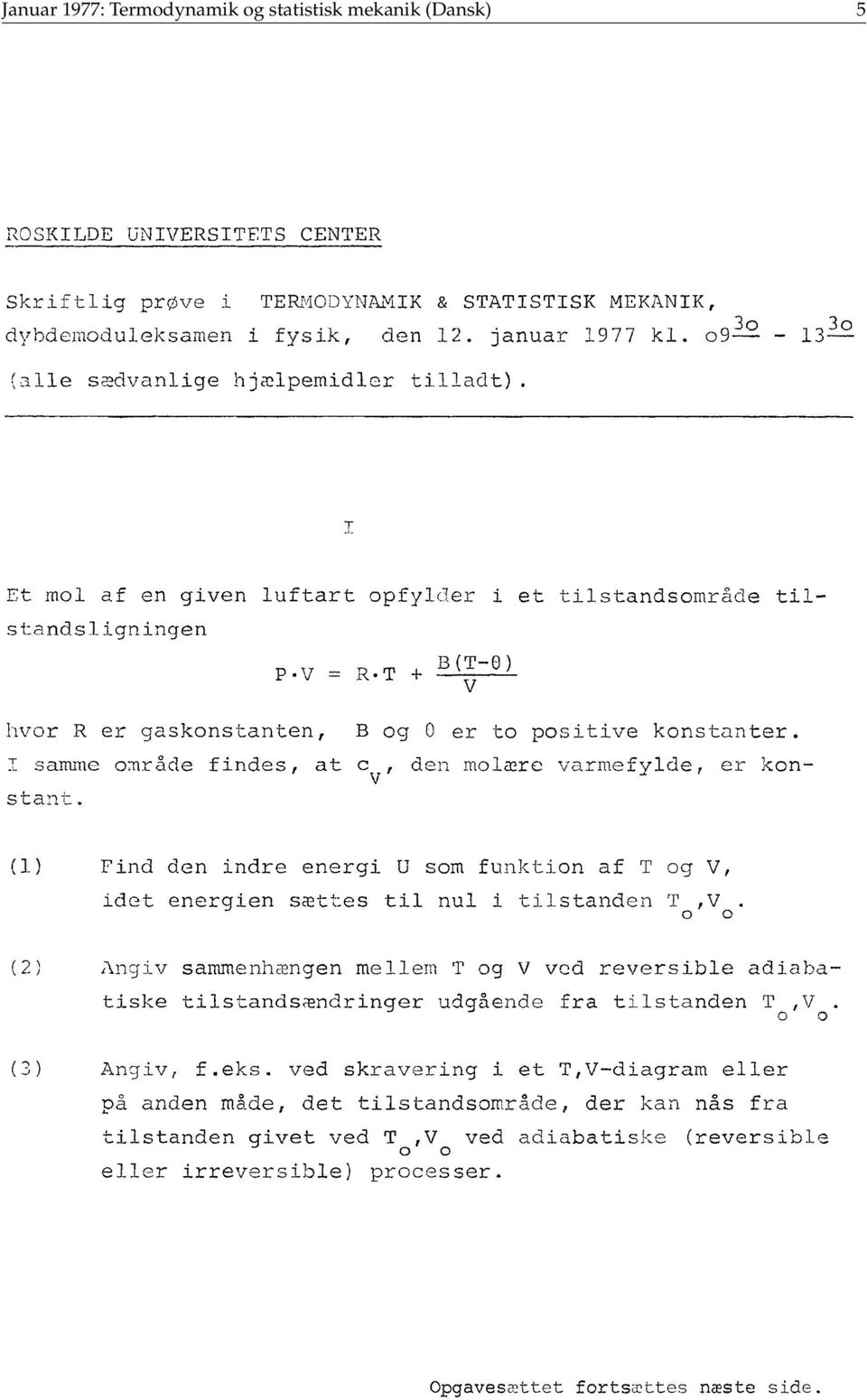
6 6 Januar 1977: Termodynamik og statistisk mekanik (Dansk)

7 Januar 1977: Termodynamik og statistisk mekanik (Dansk) 7

8 8

9 Januar 1979: Termodynamik og generel dynamik (Dansk) 9
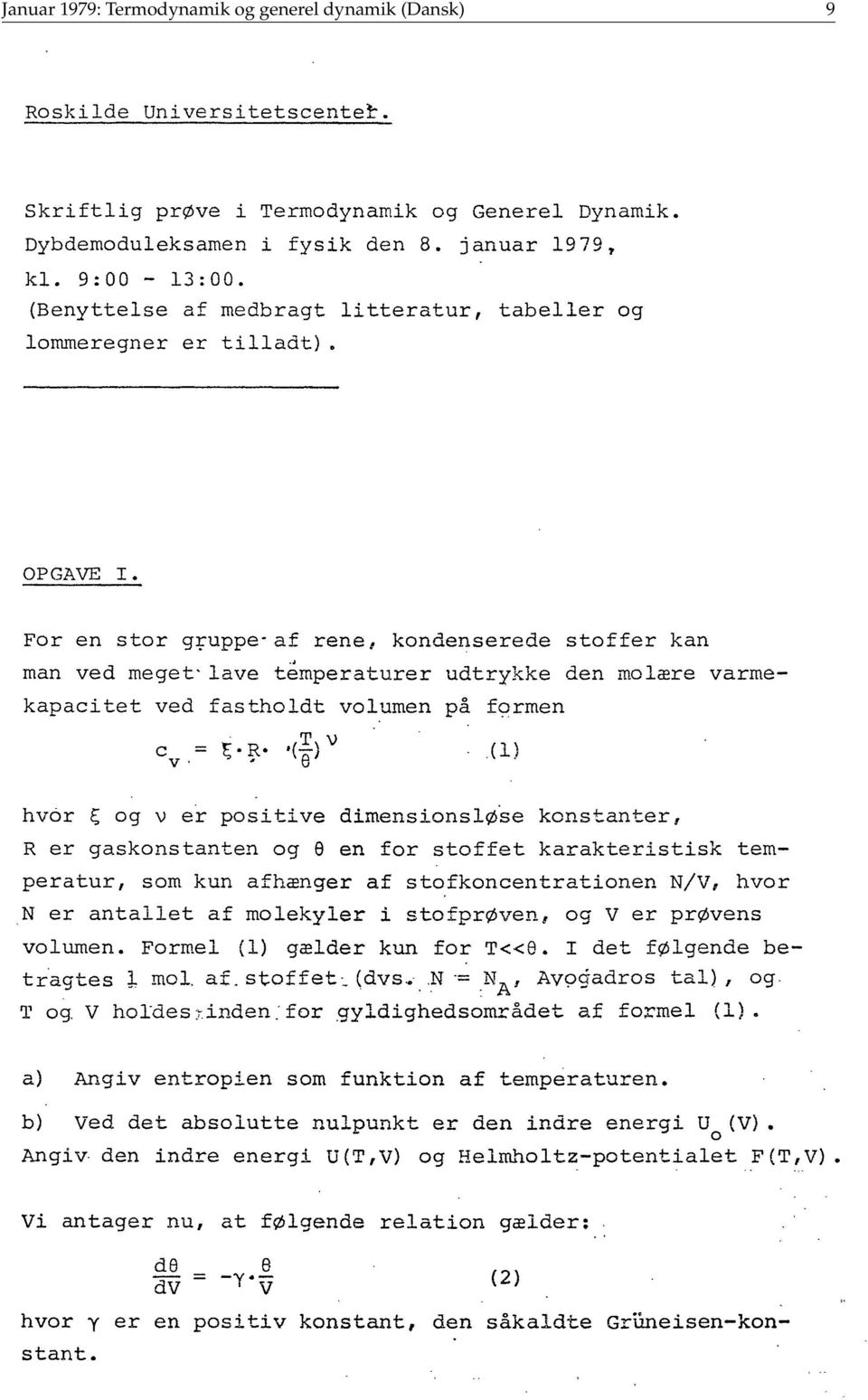
10 10 Januar 1979: Termodynamik og generel dynamik (Dansk)

11 Januar 1979: Termodynamik og generel dynamik (Dansk) 11

12 12 Januar 1979: Termodynamik og generel dynamik (Dansk)

13 Juni 1981: Termodynamik (Dansk) 13

14 14 Juni 1981: Termodynamik (Dansk)

15 Juni 1981: Termodynamik (Dansk) 15

16 16

17 Januar 1988: Termodynamik (Dansk) 17

18 18 Januar 1988: Termodynamik (Dansk)

19 Juni 1988: Termodynamik (Dansk) 19

20 20 Juni 1988: Termodynamik (Dansk)

21 Juni 1989: Statistisk mekanik (Dansk) 21
22 22 Juni 1989: Statistisk mekanik (Dansk)
23 Januar 1992: Termodynamik (Dansk) 23
24 24 Januar 1992: Termodynamik (Dansk)
25 Juni 1992: Termodynamik (Dansk) 25
26 26
27 Januar 1993: Termodynamik (Dansk) 27
28 28 Januar 1993: Termodynamik (Dansk)
29 January 1993: Thermodynamics (English translation) 29 Thermodynamics Tuesday January 12, 1993 Translated by Bo Jakobsen (Autumn 2010) The course was 9 ECTS points, and the exam an open book exam. The exam consists of 6 related problems. The molar entropy and energy is given by the following expression for an ideal gas: S = R ln(αvt µ ); u = RµT (1) where T is the absolute temperature, and v the molar volume. R is the gas constant, and α and µ are substance dependent constants. 1) State the value for µ of an mono-atomic ideal-gas. Furthermore, state for any value of µ the molar specific heat at constant pressure and volume. Two containers, both with volume V, are connected by a narrow tube through which a reversible working pump can transport gas from one container to the other. The volume of the tube can be neglected. 2) State the total entropy S and energy U, when container 1 contains n (1 + ɛ) mole and container 2 contains n (1 ɛ) mole of the ideal gas, and when both containers are in thermal equilibrium with a heat reservoir at temperature T. 3) Show that S is maximal for ɛ = 0, and state an approximated expression for S when ɛ 1, by Taylor expansion to 2. order in ɛ. 4) The system is isolated when it is in the state with temperature T and displacement parameter ɛ. The passage trough the tube is now opened, allowing the gas to flow freely from one container to the other. Give the temperature T, entropy S, and energy U for the new equilibrium state. 5) If one now uses the pressure difference for performing reversible work on the surroundings (instead of free flow as in 4) ), what is the temperature T, entropy S and energy U of the final state. 6) The pressure difference is now (like in problem 5) used for reversible work, but we let the containers have a heat conducting contact to a heat reservoir throughout the whole process, so that the temperature is fixed at T. Will the system under this process receive or give up heat to the heat reservoir? (Justify your answer). 1
30 30
31 Januar 1994: Termodynamik og statistisk mekanik (Dansk) 31
32 32
33 Juni 1994: Termodynamik og statistisk mekanik (Dansk) 33
34 34
35 Januar 1996: Termodynamik og statistisk mekanik (Dansk) 35
36 36 Januar 1996: Termodynamik og statistisk mekanik (Dansk)
37 Januar 1998: Termodynamik og statistisk mekanik (Dansk) 37
38 38 Januar 1998: Termodynamik og statistisk mekanik (Dansk)
39 Juni 1998: Termodynamik og statistisk mekanik (Dansk) 39
40 40 Juni 1998: Termodynamik og statistisk mekanik (Dansk)
41 Juni 1998: Termodynamik og statistisk mekanik (Dansk) 41
42 42
43 Januar 2000: Termodynamik og statistisk mekanik (Dansk) 43
44 44
45 Januar 2002: Termodynamik og statistisk mekanik (Dansk) 45
46 46 Januar 2002: Termodynamik og statistisk mekanik (Dansk)
47 Januar 2004: Termodynamik og statistisk mekanik (Dansk) 47
48 48 Januar 2004: Termodynamik og statistisk mekanik (Dansk)
49 January 2004: Thermodynamics and statistical mechanics (English translation) 49 Written 4 hour exam in Thermodynamics and statistical mechanics Thursday, January , at Translated by Bo Jakobsen (Autumn 2010) The course was 9 ECTS points. The exam consists of 2 problems. The weights of the problems are given. All usual helping aids are allowed. Problem 1 (50%) A system consists of three Ising spins σ 1, σ 2, and σ 3, which each can take the values +1 or 1. The system hence have 8 micro states. The energy of system is, in a given state, given by: E = J(σ 1 σ 2 + σ 1 σ 3 σ 2 σ 3 ) + m B B i σ i (1) with J a positive constant, m B is the Bohr magneton and B is an external magnetic field. In part a) to d) we have B = 0. a) Show that the system has 6 states with energy J, and 2 states with energy +3J. Preferably give a physical interpretation of the two types of states. b) Calculate the energy and specific heat of the system as function of temperature. c) Calculate the entropy of the system as function of temperature. d) Find the entropy in the limit T 0 and in the limit T, and give a physical interpretation of the results. e) Now let B > 0. State the entropy of the system in the limit T 0. 1
50 50 January 2004: Thermodynamics and statistical mechanics (English translation) Problem 2 (50%) We consider a mono-atomic ideal gas. a) Derive an expression for the isothermal compressibility, κ T. b) Show that the adiabatic compressibility is given by κ S = 3 5 P 1. We now consider a system consisting of two chambers, one of which can change its volume by use of a piston: Each chamber is filled with a mono-atomic ideal-gas, and the (fixed) partition between the chambers is a good thermal conductor. N 1 and N 2 are the numbers of particles in chamber 1 and 2 respectively. V 1 and V 2 are the volumes of chamber 1 and 2 respectively. V 1 is constant and V 2 can be changed by the piston. T 1 and T 2 are the temperatures in chamber 1 and 2 respectively. c) We now let the total system be in good thermal contact with the surroundings, and define a isothermal compressibility for chamber 2 (P 2 is the pressure in chamber 2): κ T,2 1 ( ) V2 (2) V 2 P 2 Calculate κ T,2 and compare it to κ T for the mono-atomic ideal-gas. d) The total system is now isolated from the surroundings, and we define a adiabatic compressibility for chamber 2: κ S,2 1 ( ) V2 (3) V 2 P 2 (Note that it is the total entropy that is kept constant). Derive an expression for κ S,2. e) Give κ S,2 in the limit of N 1 N 2 and in the limit N 1 N 2, and give a physical interpretations of the results. T S 2
51 Januar 2006: Termodynamik og statistisk mekanik (Dansk) 51 Ì ÊÅÇ Æ ÅÁÃÇ ËÌ ÌÁËÌÁËÃÅ Ã ÆÁÃ Ì Ö º¾  ÒÙ Ö¾¼¼ к½¼º¼¼¹½ º¼¼ ÊÇËÃÁÄ ÍÆÁÎ ÊËÁÌ ÌË ÆÌ Ê Ë Ö ØÐ ¹Ø Ñ Ö ÔÖ Ú ÐÐ Ú ÒÐ ÐÔ Ñ Ð ÖØ ÐРغ ÇÔ Ú ØØ Ø ØÖ ØÓÓÔ Ú ÖºÎ ØÒ Ò Ö Ò Ú ØÔÓÔ Ú ÖÒ º ØØ Ö Ñ ØØ Ö¹ÔÐ Ö Ö Ö ØÔÐ Ø Ð Ø ØÓÑÔ Ò ØØ Ö¹ÔÐ µ ÇÔ Ú ½ ¼±µ Î ØÖ Ø Ö ÒÑÓ Ð ÚÓÖ ÒØ ØÓÑ Ö Ò Ö Ø½¹ Ñ Ò ÓÒ ÐØ ÑÐ Ò Ö Ò Ø Ö Ø Ð Ø Ò Ö Ð ǫº Ð ÓÔ Ú Ò Ö ØØ Ò Ò Ø ØÝÔ Ú ÐÚ Ö Ò Ò ÑÓ ÐÐ Ò Ó Ò Ñ ǫø ÐØ Ð Ø Ò Ò ÑÐ Ò Ö ÚÓÖǫ Ö ÒÔÓ Ø Ú ÓÒ Ø ÒغÁ Ö Ø ÀÚ ØÓÒ ÓÔÐ Ö ØØ Ö Ø Ö Ø Ø ØÓÑ Ö Ö ØØ Ò Ö Ò ǫó ½Ø Ð Ø Ò Ñ Ò Ö Ò0ǫº Ö Òºµ Ö Ò Ý Ø Ñ Ø ÒØÖÓÔ Ø ÖÑ Ð Ú Ø ÓÑ ÙÒ Ø ÓÒ Ø ÑÔ Ö ¹ µ Ö ÒÑ Ð Ò Ö Ò Ø ÖÑ Ð Ú Ø ÓÑ ÙÒ Ø ÓÒ Ø ÑÔ Ö ØÙ¹ µî Ø Ý Ø Ñ Ø Ö Ø Ð Ø Ò Ñ Ò Ö Ò 2ǫ Ø Ð Ø Ò Ñ ØÙÖ Òº Ó Ú Ò Ý ÚÓÖδ Ö Ò ÓÒ Ø ÒØ ÓÖ ÐÐ Ö ÒÙкÁ Ø Ð ÓÔ Ú Ò Ö Ò Ö Ò ÓÖØÓÐ Ò Ò Ö ÙÐØ Ø ÖÒ º ÖÒ ÓØ Ð ÒÚ Ú Ö ØØ Ø Ö ÔδØ ÐØ Ð Ø Ò Ò ÑÐ Ò Ö ÁÑÓ ÐÐ ÒÑ Ø ÒÙ ØÓÑ ÖÒ ÒØ Ö Ø ÓÒÑ Ú Ò ÀÚ Ø ØÓÑ µ Ò ÒØÖÓÔ Ò ÖÒ ÒT 0Ó ÖÒ ÒT Ø Ð Ø Ò Ò Ø Ö ØÓÚ Ò ÓÖ Ð ǫ + µ Ò Ú ÒØÖÓÔ Ò Ý Ø Ñ Ø ÖÒ ÒT 0 ÓÖ Ò ÓÐ Ú δ>0 ½ Ó δ< 0º 2δº
52 52 Januar 2006: Termodynamik og statistisk mekanik (Dansk) Ó ÒØ Ò Ù Ú Ð Ó ÒØ ÒÓ Ò ÓØ ÖÑ ÓÑÔÖ Ð Ø Ø ÇÔ Ú ¾ ¼±µ µî Ø Ö Ò Ö ÐØ Ð Ö Ð Ò ÑÑ Ò Ò Ñ ÐÐ ÑØÖÝ Ø Ò Ò ¹ Ø Ý Ø ÑÑÓ ÐÐ Ö Ñ Ð Ò Ø Ð Ø Ò ÙÑ ÚÓÖX bó y ÖÔÓ ¹ ½µ Ø Ú ÓÒ Ø ÒØ Öµ ¾µ ÓÔ ÝÐ ÖÐ Ò Ò ½µº ] Ò Ö Ø ÖÑ Ð Ú Øº µ Ø Ñ Ý Ø Ñ Ø Ø Ð Ø Ò Ð Ò Ò Ó Ø ÖÚ ØØ Ð Ø Ò Ð Ò Ò Ò N Z T y 2 Ò 0 ÚÓÖE Ö Ý Ø Ñ Ø ÒØ ÖÒ µî Ø Ö ÓÖÑÓ ÐÐ Ò Ð Ö( E = T SÓÔ ÝÐ Ö Ò Ò Ö ÐÐ ÑÑ Ò¹ µ Ø ÑC PÓ C V µ Ø ÑÑÓ ÐÐ Ò Ø ÓÑÔÖ Ð Ø Ø κ S ÓÑ ÙÒ Ø ÓÒ P Ó Vº Ø ÖÚ Ø Ø ÙÒ Ò Ù ØÖÝ ÓÖκ Ø ÖÒ bó y µ Ú Ò Ý ÓÖØÓÐ Ò Ò ÑÓ ÐÐ ÒºÀÚ Ö ÓÖØÓÐ Ò Ò Ò ÓÒ Ø Ò¹ µ C P ( ) P T V = α P κ T [ (V Nb) = X N V ) T V αp 2 κs = κt ¾

53 January 2006: Thermodynamics and statistical mechanics (English translation) 53 Written 4-hour exam in: Thermodynamics and Statistical mechanics Tuesday January 24, 2006, at Translated by Bo Jakobsen The course was 9 ects points The exam consists of 2 problems. The weights of the problems are given. All usual helping aids are allowed. Problem 1 (50%) We consider a model where 3 identical atoms are in a one-dimensional lattice with 5 lattice-positions (there can only be one atom per lattice-position). If two neighbor places in the lattice both are occupied by an atom this contributes ɛ to the total energy of the state (ɛ is a positive constant). In the first part of the problem this is the only type of interaction in the model, and the total energy of the sketched state is therefore ɛ. a) Show that the system has 3 states with energy 2ɛ, 6 states with energy ɛ and one state with energy 0ɛ. b) Calculate the mean energy in thermal equilibrium as function of temperature. c) Calculate the entropy of the system in thermal equilibrium as function of temperature. d) Find the entropy in the limit T 0 and in the limit T, give an physical interpretation of the results. The interaction of the atoms with the wall are now included in the model; If an atom is neighbor to a wall this gives a contribution of δ to the total energy of the state (δ is a constant different from 0). The energy of the sketched states is therefore now ɛ + 2δ. e) State the entropy of the system in the limit T 0 for δ > 0 and δ < 0 respectively. 1
54 54 January 2006: Thermodynamics and statistical mechanics (English translation) Problem 2 (50%) a) Show that the following general relation between the pressure coefficient, the thermal expansion coefficient and the isothermal compressibility holds: ( ) P = α P (1) T κ T A system is modeled by the following partition function (where X, b and y are positive constants): Z = V [ ] N (V Nb) X T y/2 (2) N b) Determine the equation of state for this system, and show that the equation of state fulfills equation (1). c) Show that for this model ( ) E V = 0, where E is the internal energy of the T system in thermal equilibrium. d) Determine C P and C V e) For the model, determine the adiabatic compressibility, κ S, as function of P and V. Show that the found expression for κ S fulfills the general relation κ S = κ T T V α2 P C P (3) f) Give a physical interpretation of the model. What is the interpretation of the constants b and y? Added hints in the translation: You may use that: C P = C V + T V α2 P κ T (4) 2
55 Ì ÊÅÇ Æ ÅÁÃÇ ËÌ ÌÁËÌÁËÃÅ Ã ÆÁà ÊÇËÃÁÄ ÍÆÁÎ ÊËÁÌ ÌË ÆÌ Ê Ö º ÂÙÒ ¾¼¼ к½¼º¼¼¹½ º¼¼ Ë Ö ØÐ ¹Ø Ñ Ö ÔÖ Ú ÐÐ Ú ÒÐ ÐÔ Ñ Ð ÖØ ÐРغ ÇÔ Ú ØØ Ø ØÖ ØÓÓÔ Ú ÖºÎ ØÒ Ò Ö Ò Ú ØÔÓÔ Ú ÖÒ º ÚÓÖaÓ α ÖÔÓ Ø Ú ÓÒ Ø ÒØ Ö ÇÔ Ú ½ ¼±µ ØØ ÖÑÓ ÝÒ Ñ Ý Ø Ñ Ö Ö Ø Ö Ö ØÚ Ð Ò ÒØÖÓÔ ¹ ÙÒ Ø ÓÒ Ò ÓØ ÖÑ ÓÑÔÖ Ð Ø Ø Ö Ú Ú bó λ ÖÔÓ Ø Ú ÓÒ Ø ÒØ Öµ ½µ ¾µ S(T, V ) = at α V. µ Ø Ñ Ý Ø Ñ Ø Ø Ð Ø Ò Ð Ò Ò º )º pº º Ò Ú Ö Ú Ø ØØÖÝ Ø ÖÑÓ ÒÙÐ ÖÒ ÒT 0Ó V ÚÓÐÙÑ ÒÒ Ö Ò º µ Ò Ú ÑÑ Ò Ò ÒÑ ÐÐ ÑÌÓ ÎÚ ÒÖ Ú Ö Ð Ø µí Ð ØÙ ØÖÝ ÓÖ Ý Ø Ñ Ø Ó Ö Ù Ú Ð Ó ÒØ α pº Vº µ Ø Ñ Ý Ø Ñ Ø ÒØ ÖÒ Ò Ö E(T, V µ Ø Ñ Ý Ø Ñ Ø Ó ÓÖ Ú ÖÑ Ô Ø Ø C ÒÓÚ Ö º Ö ÖN ÒØ ØÓÑ Ö ÓÑ Ò ÓÖ Ö ÔM ÓÖ Ð¹ ÇÔ Ú ¾ ¼±µÎ ØÖ Ø Ö ÒÑÓ Ð ÓÖ ÓÖ Ø ÓÒ ØÓÑ ÖÔ µ Ø Ñ Ý Ø Ñ Ø Ó Ö Ú ÖÑ Ô Ø Ø C Ö Ø Ö Ö ØÚ Ò Ö Ò1ǫÓ ¼± ØÝÔ Ò Ö Ø Ö Ö ØÚ Ò Ö Ò ÔÙÒ Ø Ö ½± ØÝÔ Ò Ö Ø Ö Ö ØÚ Ò Ö Ò0ǫ ± ØÝÔ Ò ¹ 2ǫº µ Ò Ý Ø Ñ Ø Ø Ð Ø Ò ÙÑ ÒØ ÐÒÖÑ Ð ÖÙ ÒÝØØ Ö 1µº Ö Ö ØÝÔ Ö ÓÖ Ø ÓÒ ¹ Ð ÔÙÒ Ø ÖÔÓÚ Ö Ò M >> N >> µ Ò Ý Ø Ñ Ø Ò Ö Ø ÖÑ Ð Ú Ø Ó ÓÑÑ ÒØ Ö ÖÒ ÖÒ µ Ò Ú ÓÖ ÓÐ ØÑ ÐÐ Ñ ÒØ ÐÐ Ø ØÓÑ Ö ÓÖ Ö Ø ØÝÔ Ó 1 ÒÒ Ø ÐÒÖÑ Ð Ò ÒÚ Ò Ö Ø Ò ÓÔ Ú Òµº º º M >> N >> ÔÙÒ Ø ÖºÃÓÑÑ ÒØ Ö ÖÒ ÖÒ T 0Ó T ½ º ǫ T 0Ó T µàú ÖÚ ÖÑ Ô Ø Ø Ò ÖÒ ÒkT << µ Ò Ú Ý Ø Ñ Ø ÒØÖÓÔ ÖÒ ÒT Juni 2006: Termodynamik og statistisk mekanik (Dansk) 55 κ T = bv λ,
56 56
57 June 2006: Thermodynamics and statistical mechanics (English translation) 57 Written 4-hour exam in: Thermodynamics and Statistical mechanics Friday June 9, 2006, at Translated by Bo Jakobsen The course was 9 ects points The exam consists of 2 problems. The weights of the problems are given. All usual helping aids are allowed. Problem 1 (60%) A thermodynamical system is characterized by the following entropy function, where a and α are positive constants: S(T, V ) = at α V. The isothermal compressibility is given by (b and λ are positive constants): κ T = bv λ, Furthermore, it is known that the pressure goes to zero in the limit T 0 and V. a) Determine the equation of state for the system. b) Derive an expression for the isobaric expansion coefficient, α p. c) Determine the internal energy of the system, E(T, V ). d) Determine the isochoric specific heat of the system, C V. e) Determine the isobaric specific heat of the system, C p. f) State the connection between T and V in a reversible volume change. 1
58 58 June 2006: Thermodynamics and statistical mechanics (English translation) Problem 2 (40%) In the following we study a model for adsorption of atoms onto a surface. There are N identical atoms, which can be adsorbed at M different points on the surface (M N 1). There are three different kinds of absorptions points: 1% of type A characterized by an energy of 0ɛ, 9% of type B characterized by an energy of 1ɛ, and 90% of type C characterized by an energy of 2ɛ. a) Find the partition function for the system, in an approximation that utilizes M N 1 (this approximation can be used in the rest of the problem). b) State the ratio between the number of atoms adsorbed at type A and C points. Comment on the limits T 0 and T. c) Find the energy of the system when in thermal equilibrium, and comment on the limits T 0 and T. d) What is the specific heat in the limit k B T ɛ? e) State the entropy of the system in the limit T. 2
59 Januar 2008: Golden Sheet (Dansk) 59 Roskilde 17. januar 2008 Golden sheet, ver Termodynamik Termodynamikkens 1. lov: du = q + w = q pdv Termodynamikkens 2. lov (isoleret system): S 0, S = k ln Ω Termodynamikkens 3. lov: T 0 S 0, C x 0 Entropitilvækst ved tilført varme: ds q T ds = q (Quasistatisk, Reversibelt) T Ækvipartitionsprincippet: U = f Nk 2 BT, f = # frihedsgrader. Termodynamiske potentialer: Potentiale Dierentialform Maxwell relation U du = +T ds P dv + µdn ( T V H = U + P V dh = +T ds + V dp + µdn ( T P F = U T S df = SdT P dv + µdn ( S V G = U + P V T S = µn dg = SdT + V dp + µdn ( S P Linære responsefunktioner (dn=0): Varmekapacitet C v = ( ) U T Udvidelseskoecient α p = + 1 V Kompressibilitet κ T = 1 V Bulkmodul ) Trykkoecient = T ( ) S ( V T V ) ( T P V ) P T K T = V ( ) P = 1 V T κ T β V = ( P T V V ) = ( ) P ) S,N S = + ( ) V ) S,N S = + ( ) P ) T,N T = ( ) V T,N T C p = ( ) H = T ( ) S T ( P T α S = 1 V ) V ( T S κ S = 1 V ) V P S K S = V ( ) P = 1 V S κ S β S = ( ) P T dv = 0: Isochor; dp = 0: Isobar; dt = 0: Isoterm; ds = 0: Adiabat Z betragtes som en funktion af X og Y : ( Z X ) Y = [( X Z ) Y ] 1 = ( Z Q ) Y ( Q X ) Y Z = Z(X, Y ) dz = ( ) Z X Y dx + ( ) Z Y X ) dy / ( ) Y Z Z. ( ( Z ) ) ( Z ) X X Y X X = ( Y X S Y = ( Y P V,N P,N V,N P,N Y ) X.
60 60 Januar 2008: Golden Sheet (Dansk) Golden sheet, ver Side 2 af 2 2 Statistisk mekanik I termisk ligevægt med omgivelserne: p(s) = e βe(s) Z, β 1 k B T Tilstandssummen: Z = s e βe(s) ( s p(s) = 1) Middelværdi af variablen A: A = s A(s)p(s) = s Middelenergi: U = E = ln(z) β = 1 Z Z β A(s) e βe(s) Z Helmholtz fri energi: F = k B T ln(z) Skelnelige, uafhængige "partikler": Z = Z 1 Z 2 Z 3 Z 4... (E = E 1 + E 2 + E 3 + E ) Uskelnelige, uafhængige partikler: Z = Z N 1 /N! Gibb's statistik, KUN FOR 9 ECTS: I termisk og diusiv ligevægt med omgivelserne: p(s) = e β(e(s) µn(s)) /Z Gibbssummen: Z = s e β(e(s) µn(s)) ( s p(s) = 1) 3 Matematik Binomial-koecienten: ( ) N n = N! n!(n n)! Stirling: ln(n!) N ln(n) N (N >> 1) Taylor udvikling: f(x) = f(a) + f (a)(x a) + f (a) 2! (x a) 2 + f (a) 3! (x a) e x = 1 + x + x2 2! + x3 3! + x4 4! +... ln(1 + x) = x x2 2 + x3 3 x sin(x) = x x3 3! + x5 5!... cos(x) = 1 x2 2! + x4 4! x = 1 + x + x2 + x 3 + x ) = α(α 1)(α 2)...(α n+1) (1 + x) α = n=0 ( α n) x n, hvor ( α n 0 x n exp( ax 2 I(n,a) ) = I(n, a), a = I(n + 2, a) I(0, a) = 1 2 πa 1/2 I(2, a) = 1 4 πa 3/2 I(4, a) = 8 3 πa 5/2 I(1, a) = 1 2 a 1 I(3, a) = 1 2 a 2 I(5, a) = a 3 4 Ideal-gas pv = Nk B T = nrt, Z = 1 N! ( V Zint v Q ) N, vq = n! Adiabat: pv γ = const, γ = C P ( ) 3 h 2πmkT C V = f+2 f 5 Konstanter k B = J/K = ev/k R = J/(mol K) N A = h = J s = ev s 1 atm = bar = N/m 2 = Pa 1 ev = J 1 u = kg
61 Januar 2008: Termodynamik og statistisk mekanik (Dansk) 61 Skriftlig 4-timers prøve i TERMODYNAMIK OG STATISTISK MEKANIK Fredag d. 18 Januar 2008, kl Opgavesættet består af tre opgaver på to sider. Vægtning er angivet på opgaverne. Skriveredskaber og en simpel lommeregner tilladt. Golden Sheet vedlagt. Ingen øvrige hjælpemidler tilladt. 7.5 ECTS (Bachelorkurset) Opgave 1 (40%) Vi betragter et system bestående af N uafhængige magnetiske spin. Placeret i et magnetfelt af størrelsen B har hvert enkelt spin tre mulige tilstande med energierne henholdsvis +µ B B, 0 og µ B B, hvor µ B er Bohr s magneton. a) Opskriv tilstandsummen Z for det samlede system bestående af N uafhængige spin. b) Beregn Helmholtz fri energi F for systemet. c) Beregn systemets entropi som funktion af temperaturen. d) Find entropien i grænsen T 0 og i grænsen T, og giv en fysisk fortolkning af resultaterne. e) Vi betragter nu et system identisk med det ovenstående, bortset fra at energierne af de tre tilstande for de enkelte spin nu er givet ved henholdsvis +µ B B, µ B B og µ B B. Angiv entropien af systemet i grænsen T 0. Opgave 2 (20%) a) Bevis formlen:. b) Bevis formlen:. < E >= 1 Z Z β C v = < E2 > < E > 2 k B T 2 1
62 62 Januar 2008: Termodynamik og statistisk mekanik (Dansk) Opgave 3 (40%) a) Vis at der generelt gælder følgende sammenhæng mellem den adiabatiske udvidelseskoefficient, den isochore varmekapacitet og den isochore trykkoefficient: α S = C v. (1) T V β V Vi betragter nu en gas med følgende tilstandsligning, hvor a og b er positive konstanter: p = Nk ( ) BT N 2 V Nb a. (2) V Gassens indre energi er givet ved: U = f 2 Nk BT N a N V (3) b) Beregn gassens isochore trykstigningskoefficient β V. c) Beregn gassens adiabatiske udvidelseskoefficient α S. d) Gassen placeres i en beholder der er termisk isoleret fra omgivelserne. Vha. et stempel øges beholderens volumen nu langsomt med 5%. Opskriv et udtryk for den resulterende temperaturændring. e) Vi ser nu på samme proces som i spørgsmål d), men gassen er nu en diatomisk ideal-gas. Start-temperaturen er 30 C. Hvad er slut-temperaturen? 2
63 January 2008: Thermodynamics and statistical mechanics (English translation) 63 Written 4-hour exam in: Thermodynamics and Statistical mechanics Friday January 18, 2008, at Translated by Bo Jakobsen The exam consists of three problems on two pages. The weights of the problems are given. Writing aids and a simple calculator are allowed. The Golden sheet is included with this exam. No further helping aids are allowed. 7.5 ECTS (Bachelor course) Problem 1 (40%) Consider a system consisting of N independent magnetic spins. They are placed in a magnetic field of size B and each spin has three possible states with energy: +µ B B, 0, and µ B B respectively (µ B is the Bohr magneton). a) State the partition function, Z, for the total system consisting of N independent spins. b) Calculate the Helmholtz free energy, F, for the system. c) Calculate the entropy of the system as function of temperature. d) Find the entropy in the limit T 0 and in the limit T, give a physical interpretation of the results. e) We now consider a system identical to the one treated above, except for the energies of the three states of the individual spins, which now are given by +µ B B, µ B B, and µ B B respectively. State the entropy in the limit T 0. 1
64 64 January 2008: Thermodynamics and statistical mechanics (English translation) Problem 2 (20%) a) Prove the formula: E = 1 Z Z β. (1) b) Prove the formula: C V = E2 E 2 k B T 2. (2) Problem 3 (40%) a) Show that the following general relation holds between the adiabatic thermal expansion coefficient, the isochoric specific heat, and the isochoric pressure coefficient: α S = C V T V β V. (3) We now consider a gas with the following equation of state (a and b are positive constants): P = Nk ( ) 2 BT N V Nb a. (4) V The thermal energy of the gas is given by: U = f 2 Nk BT Na N V. (5) b) Calculate the isochoric pressure coefficient, β V, of the gas. c) Calculate the adiabatic thermal expansion coefficient, α S, of the gas. d) The gas is placed in a container which is thermally isolated from the surroundings. The volume of the container is now slowly increased by 5% utilizing a piston. Give an expression for the resulting temperature change. e) We now consider the same process as in question d), however the gas is now a diatomic ideal gas. Initial temperature is 30 C. What is the end temperature? 2
65 Januar 2009: Termodynamik og statistisk mekanik (Dansk) 65 Skriftlig 4-timers prøve i TERMODYNAMIK OG STATISTISK MEKANIK Onsdag d. 21 Januar 2009, kl Opgavesættet består af tre opgaver på to sider. Vægtning er angivet på opgaverne. Skriveredskaber og en simpel lommeregner tilladt. Golden Sheet vedlagt. Ingen øvrige hjælpemidler tilladt. Opgave 1 (30%) a) Vis at der generelt gælder følgende sammenhæng mellem den adiabatiske trykstigningskoefficient β S, den isobare varmekapacitet og den isobare udvidelseskoefficient: β S = C p. (1) T V α p b) Vi betragter nu en diatomisk idealgas. Udled et udtryk for β S som funktion af p og T. c) Den diatomiske idealgas placeres i en beholder der er termisk isoleret fra omgivelserne. Begyndelses-temperaturen er 30 C. Vha. et stempel øges trykket i beholderen nu langsomt med 7%. Hvad er den resulterende temperatur? Ville den resulterende temperatur være større hvis der var tale om en monoatomisk idealgas? Opgave 2 (30%) a) Bevis Maxwell relationen: ( ) S P T,N = ( ) V T P,N (2) b) Bevis formlen: p = k BT Z ( ) Z V T c) Opskriv Z for en monoatomisk idealgas (se golden sheet), og eftervis at denne opfylder ovenstående formel (3). (3) 1
66 66 Januar 2009: Termodynamik og statistisk mekanik (Dansk) Opgave 3 (40%) Vi betragter et system bestående af 2 identiske atomer der befinder sig i et to dimensionelt gitter med 9 pladser. Når de to atomer er nærmeste naboer (ikke diagonalt) bidrager dette med ɛ til tilstandens energi. Et atom der befinder sig på randen bidrager med δ til tilstandens energi. Der er ikke andre bidrag til systemets energi. ɛ er en positiv konstant. δ = 0 i opgave a), b) og c). a) Vis at systemet har 36 tilstande ialt. Vis at systemet (δ = 0) har 12 tilstande med energien ɛ. b) Beregn middelenergien i termisk ligevægt som funktion af temperaturen T. (δ = 0). c) Find middelenergien i grænserne T 0 og T, og giv en fysisk fortolkning af resultaterne. (δ = 0). d) Angiv entropien i grænserne T 0 og T for δ = 0. Angiv entropien i grænsen T 0 for henholdsvis δ > 0 og δ < 0. 2
67 January 2009: Thermodynamics and statistical mechanics (English translation) 67 Written 4-hour exam in: Thermodynamics and Statistical mechanics Friday January 21, 2009, at Translated by Bo Jakobsen The course was 7.5 ECTS. The exam consists of three problems on two pages. The weights of the problems are given. Writing aids and a simple calculator are allowed. The Golden sheet is included with this exam. No further helping aids are allowed. Problem 1 (30%) a) Show that the following relation is true in general: β S = C P T V α P (1) with β S the adiabatic (isentropic) pressure coefficient, C P the isobaric specific heat and α P the isobaric thermal expansion coefficient. b) Consider now a diatomic ideal gas. Derive an expression for β S as function of P and T for this gas. c) The diatomic ideal gas is placed in a container which is thermally isolated from the surroundings. The initial temperature is 30 C. The pressure in the container is now raised slowly by 7%, using a piston. What is the resulting temperature? Would the resulting temperature be greater if it was a mono-atomic ideal gas? Problem 2 (30%) a) Prove the Maxwell relation: ( ) S P T,N ( ) V = T P,N (2) b) Prove the formula: P = k BT Z ( ) Z V T (3) 1
68 68 January 2009: Thermodynamics and statistical mechanics (English translation) (c) The partition function, Z, is for an ideal gas given by: Z = 1 ( ) N ( ) 3 V Zint h, v Q = (4) N! 2πmkT v Q show that it satisfies the above equation (3). Problem 3 (40%) Consider a system consisting of two identical atoms in a two dimensional lattice with 9 places. When the two atoms are nearest neighbors (not on a diagonal) they contribute ɛ to the energy of the state. An atom on the edge contributes δ to the energy of the state. No other energy contributions exist. ɛ is a positive constant. In part a), b), and c) we have δ = 0 a) Show that the system has 36 states altogether. Show that the system (δ = 0) has 12 states with energy ɛ. b) Calculate the mean energy in thermal equilibrium as function of temperature T (δ = 0). c) Find the mean energy in the limit T 0 and T, and give a physical interpretation of the result (δ = 0). d) Find the entropy in the limits T 0 and T for δ = 0. Find the entropy in the limit T 0 for δ > 0 and δ < 0 respectively. 2
69 Efterår 2009: Golden Sheet (Dansk) 69 Golden sheet E2009, ver Termodynamik Termodynamikkens 1. lov: du = q + w = q pdv Termodynamikkens 2. lov (isoleret system): S 0, S = k ln Ω Termodynamikkens 3. lov: T 0 S 0, C x 0 Entropitilvækst ved tilført varme: ds q T ds = q T (Quasistatisk, Reversibelt) Ækvipartitionsprincippet: U = f 2 Nk BT, f = # frihedsgrader. Termodynamiske potentialer: Potentiale Differentialform Maxwell relation U du = +T ds P dv + µdn ( ) T V S,N = ( ) P S H = U + P V dh = +T ds + V dp + µdn ( ) T P S,N = + ( ) V S F = U T S df = SdT P dv + µdn ( ) S V T,N = + ( ) P T G = U + P V T S = µn dg = SdT + V dp + µdn ( ) S P T,N = ( ) V T Linære responsefunktioner (dn=0): Varmekapacitet C V = ( ) U T V = T ( ) S T Udvidelseskoefficient α P = + 1 ( V ) V T P Kompressibilitet κ T = 1 ( V ) V P T Bulkmodul K T = V ( ) P V T = 1 κ T Trykkoefficient β V = ( ) P T V V C P = ( ) H T P = T ( ) S T α S = 1 ( V ) V T S κ S = 1 ( V ) V P S K S = V ( ) P V S = 1 κ S β S = ( ) P T dv = 0: Isochor; dp = 0: Isobar; dt = 0: Isoterm; ds = 0: Adiabat S P V,N P,N V,N P,N 2 Statistisk mekanik I termisk ligevægt med omgivelserne: p(s) = e βe(s) Z, β 1 k B T Tilstandssummen: Z = s e βe(s) ( s p(s) = 1) Middelværdi af variablen A: A = s A(s)p(s) = e βe(s) s A(s) Z Middelenergi: U = E = ln(z) β = 1 Z Z β Helmholtz fri energi: F = k B T ln(z) Skelnelige, uafhængige partikler : Z = Z 1 Z 2 Z 3 Z 4... (E = E 1 + E 2 + E 3 + E ) Uskelnelige, uafhængige partikler : Z = Z1 N/N! 3 Ideal-gas Tilstandsligning: pv = Nk B T = nrt Adiabat: pv γ = const, γ = C P C V = f+2 f Isoterm kompression: W = NkT ln V f V i
70 70 Efterår 2009: Golden Sheet (Dansk) 2 4 Matematik Binomial-koefficienten: ( N n ) = N! n!(n n)! Stirling: ln(n!) N ln(n) N (N >> 1) Taylor udvikling: f(x) = f(a) + f (a)(x a) + f (a) 2! (x a) 2 + f (a) 3! (x a) e x = 1 + x + x2 2! + x3 3! + x4 4! +... ln(1 + x) = x x2 2 + x3 3 x sin(x) = x x3 3! + x5 5!... cos(x) = 1 x2 2! + x4 4! x = 1 + x + x2 + x 3 + x (1 + x) α = ( α ) n=0 n x n, hvor ( ) α n = α(α 1)(α 2)...(α n+1) n! 0 x n exp( ax 2 ) = I(n, a), I(n,a) a = I(n + 2, a) I(0, a) = 1 2 πa 1/2 I(2, a) = 1 4 πa 3/2 I(4, a) = 3 8 πa 5/2 I(1, a) = 1 2 a 1 I(3, a) = 1 2 a 2 I(5, a) = a 3 Z betragtes som en funktion af X og Y (Z = Z(X, Y )): ( ) ( ) Z Z dz = dx + dy [Total differential] X Y Y X ( ) [( ) ] Z X 1 = [Den inverse af den afledte] X Y Z Y ( ) ( ) ( ) Z Z Q = [Kædereglen] X Y Q Y X Y ( ) ( ) ( ) Z X Y 1 = [ Den falske kæderegel ] X Y Y Z Z X ( ( ) ) ( ( ) ) Z Z = [Ombytning af diff. rækkefølge] X Y X Y Y X Y X 5 Konstanter k B = J/K = ev/k R = J/(mol K) N A = h = J s = ev s 1 atm = bar = N/m 2 = Pa 1 ev = J 1 u = kg
71 Januar 2010: Termodynamik og statistisk mekanik (Dansk) 71 Skriftlig 4-timers prøve i TERMODYNAMIK OG STATISTISK MEKANIK Mandag 18/1-2010, kl Opgavesættet består af tre opgaver på ialt to sider. Vægtning er angivet på opgaverne, hvert underspørgsmål indenfor en opgave har sammen vægt. Skriveredskaber og en simpel lommeregner (dvs. en, som ikke kan lave grafer eller symbolsk manipulation) er tilladt. Golden Sheet (3 sider) er vedlagt. Ingen øvrige hjælpemidler er tilladt. Opgave 1 (35%) a) Vis at total-differentialer for entropien, kan skrives ved den isobare varmekapacitet og den isobare udvidelseskoefficient på følgende måde: ds = C P T dt V α P dp. Betragt nu en isoterm reversibel trykændring fra P i til P f. b) Vis at den tilførte varme er givet ved den isobare udvidelseskoefficient som: Q = T Pf P i V α P dp, c) Vis at det udførte arbejde er givet ved den isoterme kompressibilitet som: W = Pf P i V P κ T dp. I det følgende antages α P og κ T at være trykuafhængige (dette er en god antagelse for væsker). Betragt nu en væske med følgende karakteristika: T = 300K, V = m 3, α P = K 1 og κ T = Pa 1 Trykket ændres isotermt og reversibelt fra atmosfærisk tryk til 1000atm. d) Beregn den tilførte varme og det udførte arbejde ved tryk ændringen. Kommenter på det fundne resultat. (Hint: Da volumen-ændringen er meget lille pga. den lille isoterme kompressibilitet, kan volumen antages at være konstant i evalueringen af integralerne.) Opgave 2 (30%) a) Vis at der generelt gælder følgende sammenhæng mellem den adiabatiske trykkoefficient, den isochore trykkoefficient, den isochore varmekapacitet og den isoterme kompressibilitet: C V β S = β V + T V β V κ T (Hint: Du kan evt. udnytte følgende sammenhæng: C P = C V + T V α P β V ) b) Beregn β S for en diatomisk ideal-gas. 1
72 72 Januar 2010: Termodynamik og statistisk mekanik (Dansk) Opgave 3 (35%) Betragt et model-system som har N pladser og n identiske partikler (der kan maximalt være én partikkel på en given plads). Energien af systemet afhænger kun af antallet af partikler. Hver partikkel tilføre ǫ > 0 energi til systemet. Nedenstående figur illustrerer 3 eksempler. N = 9, n = 2 N = 9, n = 4 N = 9, n = 4 E = 2ǫ E = 4ǫ E = 4ǫ a) Vis at tilstandssummen generelt for et givet N og n kan skrives som: ( ) N Z n = e βǫn n b) Find et generelt udtryk for Helmholtz fri energi for et givet N og n. Vi betragter nu modellen for fastholdt størrelse (N) og temperatur, men lader antallet af partikler (n) variere. (Du kan f.eks. tænke på det, som om modellen er i kontakt med et partikel reservoir, hvor der frit kan flyde partikler mellem reservoiret og modellen eller at partiklerne repræsenterer objekter der kan opstå og forsvinde, f.eks. fejlsteder i en krystal). c) Vis at i termisk ligevægt er antallet af partikler givet ved: n = N e βǫ + 1 og beregn n for T 0 og T. N (Hint: Du må antage at N 1, n 1 og (N n) 1.) d) Giv en fysisk forklaring på hvorfor der i termisk ligevægt generelt er partikler i modellen, selvom den tomme model (n = 0) ved enhver temperatur har den laveste energi (nemlig E n=0 = 0). Kommenter desuden på de fundne grænseværdier for n N. Slut på opgavesættet 2
73 January 2010: Thermodynamics and statistical mechanics (English translation) 73 Exam originally in Danish, translated by Bo Jakobsen Written 4-hour exam in Thermodynamics and Statistical Mechanics Monday 18/1-2010, The exam consists of three problems on two pages altogether. The weight of the problems are given, and within a problem sub-questions have the same weight. Writing aids and a simple calculator (that is one which can not do graphs or symbolic manipulations) are allowed. The Golden sheet (3 pages) are included with this exam. No further helping aids are allowed. Problem 1 (35%) a) Show that the total differential for the entropy can be written in terms of the isobaric specific heat and the isobaric thermal expansion coefficient, in the following way: ds = C P T dt V α P dp. We now consider an isothermal reversible (quasistatic) pressure change from P i to P f. b) Show that the supplied heat is given by the isobaric thermal expansion coefficient as: Q = T Pf P i V α P dp, c) Show that the work done is given by the isothermal compressibility as: W = Pf P i V P κ T dp. In the following it is assumed that α P and κ T are pressure independent (this is a good approximation for liquids). Consider a liquid with the following characteristics: T = 300K, V = m 3, α P = K 1 og κ T = Pa 1 The pressure is changed isothermal and reversible from atmospheric pressure to 1000atm. d) Calculate the supplied heat and the work done during the pressure change. Comment on the result. (Hint: The volume can be assumed constant in the evaluation of the integrals, as the volume change is very small (due to the small isothermal compressibility)). Problem 2 (30%) a) Show that the following relation holds in general, between the adiabatic pressure coefficient, the isochoric specific heat and the isothermal compressibility : β S = β V + T V β V κ T (Hint: You may potentially use the following relation: C P = C V + T V α P β V ) b) Calculate β S for a diatomic ideal-gas. 1 C V
74 74 January 2010: Thermodynamics and statistical mechanics (English translation) Problem 3 (35%) Consider a model-system with N positions and n identical particles (each position can hold at most one particle). The energy of the system depends only on the number of particles. Each particle contributes ɛ > 0 energy to the system. The figure below illustrates three examples. N = 9, n = 2 N = 9, n = 4 N = 9, n = 4 E = 2ǫ E = 4ǫ E = 4ǫ a) Show that the partition function (for any given N and n) in general can be written as: ( ) N Z n = e βɛn n b) Find a general expression for the Helmholtz free energy for a given N and n. We now consider the model for fixed size (N) and temperature, but allows the number of particles (n) to vary. (You may e.g. think of the this in terms of the model being in contact with a particle reservoir, with free exchange of particles between the model and the reservoir or think of it in terms of particles representing objects that can emerge and disappear, e.g. point defects in a crystal). c) Show that in thermal equilibrium the number of particles is given by: n = N e βɛ + 1 and calculate n for T 0 og T. N (Hint: you may assume that N 1, n 1 and (N n) 1.) d) Give a physical explanation of why the model in general will contain particles in thermal equilibrium, even though the empty model (n = 0) at any temperature has the lowest energy (that is E n=0 = 0). Furthermore, comment on the limits found for n N. 2
75 Autumn 2010: Golden Sheet (English) 75 Golden sheet E2010, ver Thermodynamics 1. law of thermodynamics: du = q + w = q pdv 2. law of thermodynamics (isolated system): S 0, S = k B ln Ω 3. law of thermodynamics: T 0 S 0, C x 0 Entropy growth by delivering heat: ds q T ds = q T (Quasistatic, Reversible) Equipartition theorem: U = f 2 Nk BT, f = # degrees of freedom Thermodynamic potentials: Potential Differential form Maxwell relation U du = +T ds P dv + µdn ( ) T V S,N = ( ) P S H = U + P V dh = +T ds + V dp + µdn ( ) T P S,N = + ( ) V S F = U T S df = SdT P dv + µdn ( ) S V T,N = + ( ) P T G = U + P V T S = µn dg = SdT + V dp + µdn ( ) S P T,N = ( ) V T Linear response functions (dn=0): Specific heat C V = ( ) U T V = T ( ) S T Thermal expansion coefficient α P = + 1 ( V ) V T P Compressibility κ T = 1 ( V ) V P T Bulk modulus K T = V ( ) P V T = 1 κ T Pressure coefficient β V = ( ) P T dv = 0: Isochoric; dp = 0: Isobaric; dt = 0: Isothermal; Q = 0: Adiabatic; ds = 0: Isentropic (Adiabatic + Quasistatic) V V V,N P,N V,N P,N C P = ( ) H T P = T ( ) S T α S = 1 ( V ) V T S κ S = 1 ( V ) V P S K S = V ( ) P V S = 1 κ S β S = ( ) P T S P 2 Statistical mechanics In thermal equilibrium with the surroundings: p(s) = e βe(s) Z, β 1 k B T Partition function: Z = s e βe(s) ( s p(s) = 1) Average value of variable A: A = s A(s)p(s) = e βe(s) s A(s) Z Mean energy: U = E = ln(z) β = 1 Z Z β Helmholtz free energy: F = k B T ln(z) Distinguishable, independent particles : Z = Z 1 Z 2 Z 3 Z 4... (E = E 1 + E 2 + E 3 + E ) Indistinguishable, independent particles : Z = Z1 N/N! 3 Ideal-gas Equation of state: P V = Nk B T = nrt Adiabat: P V γ = const, γ = C P C V = f+2 f Isothermal compression: W = Nk B T ln V f V i
76 76 Autumn 2010: Golden Sheet (English) 2 4 Math Binomial-coefficient: ( N n ) = N! n!(n n)! Stirling s approximation: ln(n!) N ln(n) N (N >> 1) Taylor expansion: f(x) = f(a) + f (a)(x a) + f (a) 2! (x a) 2 + f (a) 3! (x a) e x = 1 + x + x2 2! + x3 3! + x4 4! +... ln(1 + x) = x x2 2 + x3 3 x sin(x) = x x3 3! + x5 5!... cos(x) = 1 x2 2! + x4 4! x = 1 + x + x2 + x 3 + x (1 + x) α = ( α ) n=0 n x n, hvor ( ) α n = α(α 1)(α 2)...(α n+1) n! 0 x n exp( ax 2 )dx = I(n, a), I(n,a) a = I(n + 2, a) I(0, a) = 1 2 πa 1/2 I(2, a) = 1 4 πa 3/2 I(4, a) = 3 8 πa 5/2 I(1, a) = 1 2 a 1 I(3, a) = 1 2 a 2 I(5, a) = a 3 Z is a function of X og Y (Z = Z(X, Y )): ( ) ( ) Z Z dz = dx + dy [Total differential] X Y Y X ( ) [( ) ] Z X 1 = [The inverse of the derivative] X Y Z Y ( ) ( ) ( ) Z Z Q = [The chain rule] X Y Q Y X Y ( ) ( ) ( ) Z X Y 1 = [ The fake chain rule ] X Y Y Z Z X ( ( ) ) ( ( ) ) Z Z = [Exchange of order of differentiation] X Y X Y Y X Y X 5 Constants k B = J/K = ev/k R = J/(mol K) N A = h = J s = ev s 1 atm = bar = N/m 2 = Pa 1 ev = J 1 u = kg
77 Januar 2011: Termodynamik og statistisk mekanik (Dansk) 77 Skriftlig 4-timers prøve i TERMODYNAMIK OG STATISTISK MEKANIK Mandag 31/1-2011, kl Opgavesættet består af tre opgaver på ialt to sider. Vægtning er angivet på opgaverne, hvert underspørgsmål indenfor en opgave har sammen vægt. Skriveredskaber og en simpel lommeregner (dvs. en, som ikke kan lave grafer eller symbolsk manipulation) er tilladt. Golden Sheet (3 sider) er vedlagt. Ingen øvrige hjælpemidler er tilladt. Problem 1 (30 %) a) Vis at total differentialet af entropien kan skrives som: T ds = V T α S dp + C P V α P dv. (1) Betragt nu en kvasistatisk volumen ændring (fra V 1 til V 2 ) ved konstant tryk. b) Vis at den tilførte varme er givet som: Q = V2 og evaluer dette integral for en diatomisk idealgas. V 1 C P V α P dv (2) c) Beregn arbejdet udført på denne idealgas, og ændringen i termisk energi af idealgassen. Problem 2 (30 %) Betragt et system med flere faser (så som væske og gas faserne). Figuren viser et eksempel på et fasediagram for et sådant system, som funktion af temperatur og tryk. Pressure solid phase supercritical fluid liquid phase critical point triple point gaseous phase vapour Temperature Eksempel på at (T,P) fasediagram. Diagrammet viser hvilke fase som er den stabile for en givet temperatur og tryk. Linerne som separerer faserne kaldes faseseparationslinjer. a) Hvilken fysisk størrelse bestemmer hvilken fase som er den stabile fase ved et given punkt i fasediagrammet, og hvad er kriteriet for faseseparationslinjerne? 1
78 78 Januar 2011: Termodynamik og statistisk mekanik (Dansk) b) Vis at hældningen af faseseparationslinjen kan findes som: dp dt = L total af faseseparationslinjen T V. (3) Hvor L total er den totale latente varme associeret med transformationen af en given mængde af stoffet og V er ændringen i volumen associeret med transformationen af samme mængde stof. Betragt nu vand, som har en specifik latent varme på L specifik = 2260J/g og en molar masse på 18g/mol. c) Beregn et groft estimat for kogepunktet for vand på toppen af Mount Everest, hvor trykket er 1/3 af trykket ved havniveau (som er Pa). Når du evaluere højresiden af ligning (3) må du bruge havniveau værdierne for L total, T og V. (Hint: Du må betragte vanddamp som en idealgas.) Problem 3 (40 %) Betragt et to tilstands paramagnetisk system som består af N uafhængige dipoler. Hver dipol kan være i èn af to tilstande; en med energi 0 (som kaldes ned tilstanden ) og en med energi ǫ > 0 (som kaldes op tilstanden ). Betragt systemet som værende i termisk kontakt med et varmebad med temperatur T. a) Find Helmholtz fri energi som funktion af T. b) Find ligevægts entropien som funktion af temperaturen. c) Beregn T = 0 og T = grænserne af entropien, diskuter resultaterne i relation til hvad man forventer i disse grænser. Betragt nu et system som består af to sådanne dipol systemer som er svagt koblede men ellers isolerede fra omgivelserne. Hvert af de to dipol systemer har et totalt antal dipoler på henholdsvis N 1 og N 2, og et antal dipoler i op tilstanden på henholdsvis n op,1 og n op,2. Den total energi i systemet er E = ǫ(n op,1 + n op,2 ), og du må antage at N 0, n op 0 og n ned 0 for begge dipol systemer. d) Vis at entropi af delsystem 1 er givet som: S 1 = k B [N 1 ln(n 1 ) n op,1 ln(n op,1 ) (N 1 n op,1 ) ln(n 1 n op,1 )] (4) e) Diskuter kriteriet for at være i ligevægt, og vis ved en eksplicit beregning at følgende holder i ligevægt: (hint: vis først at nop,2 n op,1 = 1) n op,1 n op,2 = N 1 N 2. (5) 2 Eksamenssættet er slut.
79 January 2011: Thermodynamics and statistical mechanics (English) 79 Written 4-hour exam in Thermodynamics and Statistical Mechanics Monday 31/01-11, The exam consists of three problems on two pages altogether. The weight of the problems are given, and within a problem sub-questions have the same weight. Writing aids and a simple calculator (that is one which can not do graphs or symbolic manipulations) are allowed. The Golden sheet (3 pages) are included with this exam. No further helping aids are allowed. Problem 1 (30 %) a) Show that the total differential of the entropy can be written as: T ds = V T α S dp + C P V α P dv. (1) Consider now a quasistatic volume change (from V 1 to V 2 ) at constant pressure. b) Show that the applied heat is given as: Q = V2 and evaluate this integral for a diatomic ideal gas. V 1 C P V α P dv (2) c) Calculate the work done on the ideal gas, and the change in thermal energy of the ideal gas. Problem 2 (30 %) Consider a system with multiple phases (such as the liquid and gas phases). The figure shows an example of a phase diagram for such an system, as function of temperature and pressure. Pressure solid phase supercritical fluid liquid phase critical point triple point gaseous phase vapour Temperature Example of a (T,P) phase diagram. The diagram shows for a given temperature and pressure which phase is the stable one. The lines which separate the phases are called phase boundary lines. a) Which physical quantity determine which phase is the stable one at a given point in the phase diagram, and what is the criterion for the phase boundary lines? 1
80 80 January 2011: Thermodynamics and statistical mechanics (English) b) Show that the slope of the phase boundary lines can be found as: dp = L total dt of phase boundary T V. (3) Where L total is the total latent heat associated with the transformation of a given amount of substance and V the change in volume associated with the transformation of the same amount of substance. Now consider water, which has a specific latent heat of L specific = 2260J/g, and a molar mass of 18g/mol. c) Calculate a rough estimate of the boiling point of water at the top of Mount Everest, at which the pressure is 1/3 the pressure at sea level (which is Pa). You may use the sea level values of L total, T, and V when evaluating the right hand side of eq. (3). (Hint: you may consider water vapor as an ideal gas.) Problem 3 (40 %) Consider a two state paramagnetic system consisting of N independent dipoles. Each dipole can be in one of two states; one with energy 0 (called the down state ) and one with energy ǫ > 0 (called the up state ). Consider the system to be in thermal contact with a heat bath with temperature T. a) Find the Helmholtz free energy as function of T. b) Find the equilibrium entropy as function of temperature. c) Calculate the T = 0 and T = limits of the entropy, and discuss the results in relation to what is expected in these limits. Consider now a system consisting of two such dipole systems which are weakly coupled but otherwise isolated from the surroundings. Each of the two dipole systems has a total number of dipoles N 1 and N 2 respectively, and a number of dipoles in the up state n up,1 and n up,2 respectively. The total energy in the system is E = ǫ(n up,1 + n up,2 ), and you may assume that N 0, n up 0 and n down 0 for both dipole systems. d) Show that the entropy of sub-system 1 is given as: S 1 = k B [N 1 ln(n 1 ) n up,1 ln(n up,1 ) (N 1 n up,1 ) ln(n 1 n up,1 )] (4) e) Discuss the criterion for being in equilibrium, and show by explicit calculation that the following holds in equilibrium: (hint: show first that nup,2 n up,1 = 1) n up,1 n up,2 = N 1 N 2. (5) 2 End of the exam
81 Juni 2011: Termodynamik og statistisk mekanik (Dansk) 81 Skriftlig 4-timers prøve i TERMODYNAMIK OG STATISTISK MEKANIK Tirsdag 28/6-2011, kl Opgavesættet består af 3 opgaver på ialt to sider. Vægtning er angivet på opgaverne, hvert underspørgsmål indenfor en opgave har samme vægt. Skriveredskaber og en simpel lommeregner (dvs. en, som ikke kan lave grafer eller symbolsk manipulation) er tilladt. Golden Sheet (3 sider) er vedlagt. Ingen øvrige hjælpemidler er tilladt. Problem 1 (35 %) I de følgende 3 delspørgsmål betragtes gas hvor entropien er givet ved: ( ) ] V S = Nk B [ln + 5/2 NV Q (1) N er antallet af atomer, V volumen og V Q er kvante volumenet som udelukkende er en funktion af temperaturen. Energien af gasser er givet ved E = 3/2Nk B T. I alle delspørgsmål betragtes gassen som værende i en ydre isolerende kasse, som er delt op på forskellige måder i de tre delspørgsmål. Figur 1 illustrerer de betragtede situationer. V 1 N V 2 N N V 1 V 2 V V N 1 (a) (b) (c) Figure 1. De 3 situationer som betragtes i spørgsmål a c Betragt først en situation hvor en mængde gas N er i volumen V 1 adskilt fra et tomt volumen V 2 (som skitseret på figur 1a.) Gassen tillades nu at ekspandere ind i det tomme volumen så den til sidst fylder det hele. N 2 a) Angiv ændringen i energi og temperatur af gassen, og beregn ændringen i entropi ved ekspansionen. Kommenter på sammenhængen mellem varme og entropi i denne proces. Antag nu at gassen består af to forskellige typer af atomer som man kan kende forskel på. Der er N atomer af hver slags. Det samlede volumen kan opdeles i to lige store dele med en varmeledende væg. Betragt nu en situation hvor vi først har de to typer atomer adskilt af væggen, og derefter en situation hvor der ikke er nogen væg. b) Beregn entropien af det samlede system i situationen hvor der er en væg (som skitseret på figur 1b) og i situationen hvor væggen er fjernet. Kommenter på hvor entropiforskelen kommer fra. 1
82 82 Juni 2011: Termodynamik og statistisk mekanik (Dansk) Betragt til sidst en situation hvor gassen er delt op af en væg der kan flytte sig let og er varmeledende. Volumen af de to dele kaldes hhv. V 1 og V 2 og antallet af partikler er hhv. N 1 og N 2. Situationen er skitseret på figur 1c. c) Beregn forholdet mellem V 1 og V 2 i termodynamisk ligevægt. Problem 2 (30 %) a) Vis at ( ) ( ) ( ) ( ) V V V T = + P S P T T P P S (HINT: Betragt først V(P,T) og dernæst T(S,P)) (2) b) Vis at der generelt gælder følgende sammenhæng mellem den adiabatiske kompressibilitet (κ S ), den isoterme kompressibilitet (κ T ), den isobare udvidelseskoefficient (α P ) og den isobare varmekapacitet (C P ): c) Beregn κ S for en diatomisk ideal-gas. κ T κ S = V T α2 P C P. (3) Problem 3 (35 %) Betragt et system bestående af N uafhængige atomer i et gitter. Hvert atom kan være i 6 tilstande: 2 med energi 0ǫ, 1 med energi 1ǫ og 3 med energi 3ǫ, hvor ǫ er en positiv konstant (ǫ > 0). a) Find Helmholtz fri energi som funktion af T. b) Find ligevægtsentropien som funktion af temperaturen. c) Beregn T = 0 og T = grænserne af entropien, diskuter resultaterne i relation til hvad man forventer i disse grænser. Betragt nu et system bestående af et enkelt atom N = 1. Til hver mikrotilstand hører nu et spin (B) sådan at til tilstandene med energi 0ǫ er B = 1, til tilstandene med energi 1ǫ er B = 0 og til tilstandene med energi 3ǫ er B = 1. d) Beregn middelværdien af B i termisk ligevægt og angiv værdien i grænserne T = 0 og T =. Kommenter på grænserne. Antag nu at det samlede spin af et system med N atomer findes som summen af spinnet for de enkelte atomer, e) Angiv det samlede middelspin for N atomer som funktion af temperaturen. 2 Eksamenssættet er slut.
83 June 2011: Thermodynamics and statistical mechanics (English translation) 83 Exam originally in Danish, translated by Bo Jakobsen 2011 Written 4-hour exam in Thermodynamics and Statistical Mechanics Tuesday 28/6-2011, kl The exam consists of three problems on two pages altogether. The weight of the problems are given, and within a problem sub-questions have the same weight. Writing aids and a simple calculator (that is one which can not do graphs or symbolic manipulations) are allowed. The Golden sheet (3 pages) are included with this exam. No further helping aids are allowed. Problem 1 (35 %) In the following 3 sub-questions a gas is considered where the entropy is given as: ( ) ] V S = Nk B [ln + 5/2 NV Q (1) N is the number of atoms, V the volume, and V Q is the quantum volume which is only a function of temperature. The energy of the gas is given as E = 3/2Nk B T. The gas is in all sub-questions considered as being in an outer isolated box, the box is partitioned in different ways in the three sub-questions. Figure 1 illustrates the considered situations. V 1 N V 2 N N V 1 V 2 V V N 1 (a) (b) (c) Figure 1. The 3 situations considered in sub-question a c Consider firstly a situation where an amount of gas N is in volume V 1 separated from an empty volume V 2 (as sketched on figure 1a.) The gas is now allowed to expand into the empty volume, so that it in the end fills everything. N 2 a) State the change in energy and temperature of the gas, and calculated the change in entropy by the expansion. Comment on the connection between heat and entropy in the process. Now assume that the gas consists of two different types of atoms, which can be distinguished. There are N atoms of each kind. The total volume can be separated in two equal sized parts by a heat conducting wall. Consider now a situation where we firstly have the two types of atoms separated by the wall, and thereafter a situation where no wall is inserted. b) Calculated the total entropy in the situation with a wall (as sketched on figure 1b) and in the situation where the wall is removed. Comment on the course of the entropy difference. 1
84 84 June 2011: Thermodynamics and statistical mechanics (English translation) Finally, consider a situation where the gas is separated by a wall which can move easily and is heat conducting. The volume of the two pars are called V 1 and V 2 respectively and the number of particles N 1 and N 2 respectively. The situation is sketched on figure 1c. c) Calculated the ratio between V 1 and V 2 in thermodynamical equilibrium. Problem 2 (30 %) a) Show that ( ) ( ) ( ) ( ) V V V T = + P S P T T P P S (HINT: consider firstly V(P,T) and then T(S,P)) (2) b) Show that the following relation between the adiabatic compressibility (κ S ), the isothermal compressibility (κ T ), the isobaric expansion coefficient (α P ), and the isobaric specific heat (C P ) holds in general: c) Calculate κ S for a diatomic ideal-gas. κ T κ S = V T α2 P C P. (3) Problem 3 (35 %) Consider a system consisting of N independent atoms on a grid. Each atom can be in 6 states: 2 with energy 0ǫ, 1 with energy 1ǫ and 3 with energy 3ǫ, where ǫ is a positive constant (ǫ > 0). a) Find Helmholtz free energy as function of T. b) Find the equilibrium entropy as function of temperature. c) Calculate the T = 0 and T = limits of the entropy, and discuss the results in relation to what is expected in these limits. Consider now a system consisting of a single atom N = 1. A spin B is now assigned to each micro state, such that to the states with energy 0ǫ we have B = 1, to the states with energy 1ǫ we have B = 0 and to the states with energy 3ǫ we have B = 1. d) Calculate the mean value of B in thermal equilibrium and state the vallues in the T = 0 and T = limits. Comment on the limits. Now assume that the total spin of a system with N atoms can be found as the sum of the spin from the individual atoms, e) Give the total average spin for N atoms as function of temperature. 2
85 Autumn 2011: Golden Sheet (English) 85 Golden sheet Autumn 2011, ver Thermodynamics 1. law of thermodynamics: du = q + w QS = q pdv 2. law of thermodynamics (isolated system): S 0, S = k B ln Ω 3. law of thermodynamics: T 0 S 0, C x 0 Entropy growth by delivering heat: ds q T ds = q T (Quasistatic) Equipartition theorem: U = f 2 Nk BT, f = # degrees of freedom Thermodynamic potentials: Potential Differential form Maxwell relation U du = +T ds P dv + µdn ( ) T V S,N = ( ) P S H = U + P V dh = +T ds + V dp + µdn ( ) T P S,N = + ( ) V S F = U T S df = SdT P dv + µdn ( ) S V T,N = + ( ) P T G = U + P V T S = µn dg = SdT + V dp + µdn ( ) S P T,N = ( ) V T Linear response functions (dn=0): Specific heat C V = ( ) U T V = T ( ) S T Thermal expansion coefficient α P = + 1 ( V ) V T P Compressibility κ T = 1 ( V ) V P T Bulk modulus K T = V ( ) P V T = 1 κ T Pressure coefficient β V = ( ) P T dv = 0: Isochoric; dp = 0: Isobaric; dt = 0: Isothermal; Q = 0: Adiabatic; ds = 0: Isentropic (Adiabatic + Quasistatic) V V V,N P,N V,N P,N C P = ( ) H T P = T ( ) S T α S = 1 ( V ) V T S κ S = 1 ( V ) V P S K S = V ( ) P V S = 1 κ S β S = ( ) P T S P 2 Statistical mechanics In thermal equilibrium with the surroundings: p(s) = e βe(s) Z, β 1 k B T Partition function: Z = s e βe(s) ( s p(s) = 1) Average value of variable A: A = s A(s)p(s) = e βe(s) s A(s) Z Mean energy: U = E = ln(z) β = 1 Z Z β Helmholtz free energy: F = k B T ln(z) Distinguishable, independent particles : Z = Z 1 Z 2 Z 3 Z 4... (E = E 1 + E 2 + E 3 + E ) Indistinguishable, independent particles : Z = Z1 N/N! 3 Ideal-gas Equation of state: P V = Nk B T = nrt Thermal energy: Only quadratic degrees of freedom; U = f/2nk B T.
86 86 Autumn 2011: Golden Sheet (English) 2 4 Math Binomial-coefficient: ( N n ) = N! n!(n n)! Stirling s approximation: ln(n!) N ln(n) N (N >> 1) Taylor expansion: f(x) = f(a) + f (a)(x a) + f (a) 2! (x a) 2 + f (a) 3! (x a) e x = 1 + x + x2 2! + x3 3! + x4 4! +... ln(1 + x) = x x2 2 + x3 3 x sin(x) = x x3 3! + x5 5!... cos(x) = 1 x2 2! + x4 4! x = 1 + x + x2 + x 3 + x (1 + x) α = ( α ) n=0 n x n, hvor ( ) α n = α(α 1)(α 2)...(α n+1) n! 0 x n exp( ax 2 )dx = I(n, a), I(n,a) a = I(n + 2, a) I(0, a) = 1 2 πa 1/2 I(2, a) = 1 4 πa 3/2 I(4, a) = 3 8 πa 5/2 I(1, a) = 1 2 a 1 I(3, a) = 1 2 a 2 I(5, a) = a 3 Z is a function of X and Y (Z = Z(X, Y )), Y is a function of X and Q (Y = Y (X, Q)): ( ) ( ) Z Z dz = dx + dy [Total differential] X Y Y X ( ) [( ) ] Z X 1 = [The inverse of the derivative] X Y Z Y ( ) ( ) ( ) Z Z Q = [The chain rule] X Y Q Y X Y ( ) ( ) ( ) Z X Y 1 = [ The fake chain rule ] X Y Y Z Z X ( ( ) ) ( ( ) ) Z Z = [Exchange of order of differentiation] X Y X Y Y X Y X ( ) ( ) ( ) ( ) Z Z Z Y = + [Exchange of fixed variable] X Q X Y Y X X Q 5 Constants k B = J/K = ev/k R = J/(mol K) N A = h = J s = ev s 1 atm = bar = N/m 2 = Pa 1 ev = J 1 u = kg
87 Januar 2012: Termodynamik og statistisk mekanik (Dansk) 87 Skriftlig 4-timers prøve i TERMODYNAMIK OG STATISTISK MEKANIK Torsdag 12/1-2012, kl Opgavesættet består af to opgaver på ialt to sider. Vægtning er angivet på opgaverne, hvert underspørgsmål indenfor en opgave har sammen vægt. Skriveredskaber og en simpel lommeregner (dvs. en, som ikke kan lave grafer eller symbolsk manipulation) er tilladt. Golden Sheet (3 sider) er vedlagt. Ingen øvrige hjælpemidler er tilladt. Opgave 1 (40 %) Betragt et system med k + 1 diskrete energiniveauer E n, n = 0... k og lad Ω n være degeneretheden af hvert energiniveau (dvs. antallet af mikrotilstande som har den energi). Den venstre figur viser et eksempel på et sådan system. I det følgende er systemet i kontakt med et varmebad med en given temperatur og er i termisk ligevægt. E E E 2 E 1 E 0 Ω 2 = 2 Ω 1 = 1 Ω 0 = 3 Ẽ 2 = E 2 + c Ẽ 1 = E 1 + c Ẽ 0 = E 0 + c Ω 2 = 2 Ω 1 = 1 Ω 0 = 3 Venstre: Et eksempel på et system, i dette tilfælde er k = 2 da der er 3 energiniveauer. Antallet af mikrotilstande for hvert energiniveau er angivet. Højre: Et system med skiftet energi-skala, men ellers med den sammen struktur i energiniveauerne. a) Vis at sandsynligheden for at finde systemet i et givet energiniveau er: P(E n ) = Ω n e Enβ k m=0 Ω me Emβ (1) Vi betragter nu yderligere et system hvor energi-skalaen er blevet ændret (skiftet) således at Ẽn = E n + c, hvor c er en konstant (sammenlign den venstre og højre figur). I det følgende referere variable med en (en tilde) til systemet med den skiftede energi-skala, og variable uden en tilde til det originale system. b) Vis at sandsynlighederne er uændrede ved sådan en ændring i energi-skala, det vil sige: P(Ẽn) = P(E n ) (2) c) Vis at middelenergien af de to systemer er relateret ved: Ẽ = E + c (3) 1
88 88 Januar 2012: Termodynamik og statistisk mekanik (Dansk) d) Vis at den fri energi af de to systemer er relateret ved: F = F + c (4) e) Vis at entropien af de to systemer er relateret ved: S = S (5) og angiv et udtryk for entropien som funktion af temperaturen. f) Beregn T 0 og T grænserne af sandsynligheden for at finde det originale system med en given energi (det vil sige, find grænserne af P(E n ) for alle n). Kommenter på fortolkningen af resultatet. (Hint: Brug resultaterne fra de forgående spørgsmål og vælg c fornuftigt inden du forsøger at evaluere grænserne.) g) Beregn T 0 og T grænserne af entropien for det originale system. Kommenter på fortolkningen af resultatet. (Hint: Brug resultaterne fra de forgående spørgsmål og vælg c fornuftigt inden du forsøger at evaluere grænserne.) Opgave 2 (60 %) I det følgende betragter vi en kvasistatisk samt adiabatisk volumen ændring, primært med fokus på en monoatomar idealgas. a) Vis at den følgende relation holder for volumen og temperatur af en monoatomar idealgas under kvasistatisk adiabatisk volumen ændring: V T 3/2 = Konstant. (6) b) Betragt en kvasistatisk adiabatisk process hvor volumen af en monoatomar idealgas reduceres til 1/3 af det oprindelige volumen. Beregn slut temperaturen (T f ) og slut trykket (P f ) som funktion af start temperaturen (T i ) og start trykket (P i ). Beregn yderligere slut trykket hvis temperaturen bagefter reduceres til den oprindelige start temperatur mens volumen holdes konstant. c) Vis at den følgende relation gælder generelt mellem den adiabatiske termiske udvidelses koefficient (α S ), den isochore varmefylde (C V ), den isoterme kompressibilitet (κ T ) og den isobare termiske udvidelseskoefficient (α P ): α S = C V κ T V T α P. (7) d) Vis eksplicit at ligning 7 holder for en monoatomar idealgas ved at evaluere venstre og højre siden af ligningen for en sådan gas. Entropien af en monoatomar idealgas er givet ved: ( ) ] ( ) 3 V h S = Nk B [ln + 5/2, with V Q = (8) NV Q 2πmkB T hvor m er massen af atomet. e) Vis eksplicit at entropien som givet i ligning 8 faktisk er konstant under en kvasistatisk adiabatisk volumen ændring af en monoatomar idealgas (det vil sige en process hvor ligning 6 holder). 2 Eksamenssættet er slut.
89 January 2012: Thermodynamics and statistical mechanics (English) 89 Written 4-hour exam in Thermodynamics and Statistical Mechanics Thursday 12/01-12, The exam consists of 2 problems on 2 pages altogether. The weights of the problems are given, and within a problem sub-questions have the same weight. Writing aids and a simple calculator (that is one which can not do graphs or symbolic manipulations) are allowed. The Golden sheet (3 pages) are included with this exam. No further helping aids are allowed. Problem 1 (40 %) Consider a system with k + 1 discrete energy levels E n, n = 0... k, and let Ω n be the degeneracy of each energy level (that is the number of micro-states with that energy). (The left figure gives an example of such a system). In the following the system is in contact with a heat-bath of a certain temperature and in thermal equilibrium. E E E 2 E 1 E 0 Ω 2 = 2 Ω 1 = 1 Ω 0 = 3 Ẽ 2 = E 2 + c Ẽ 1 = E 1 + c Ẽ 0 = E 0 + c Ω 2 = 2 Ω 1 = 1 Ω 0 = 3 Left: Example of system, in this case k = 2 as there are 3 energy levels. The number of micro-states for each energy-level is indicated. Right: System with shifted energy scale, but otherwise same structure of the energy levels. a) Show that the probability for finding the system at a given energy level is: P(E n ) = Ω n e Enβ k m=0 Ω me Emβ (1) We now additionally consider a system where the energy scale has been changed (shifted) so that Ẽ n = E n + c, where c is some constant (compare left and right figure). In the following variables with a (a tilde) refer to the system with the shifted energy scale, and variables without the tilde to the original system. b) Show that the probabilities are unchanged by such a change in energy scale, that is: P(Ẽn) = P(E n ) (2) c) Show that the mean energies of the two systems are related by: Ẽ = E + c (3) 1
90 90 January 2012: Thermodynamics and statistical mechanics (English) d) Show that the free energies of the two systems are related by: F = F + c (4) e) Show that the entropies of the two systems are related by: S = S (5) and give an expression for the entropy as function of temperature. f) Calculate the T 0 and T limits of the probability for finding the original system at a given energy (that is find the limits of P(E n ) for all n s). Comment on the interpretation of the result. (Hint: Use the results from the previous questions and choose c wisely before trying to evaluate the limits.) g) Calculate the T 0 and T limits of the entropy for the original system. Comment on the interpretation of the result. (Hint: Use the results from the previous questions and choose c wisely before trying to evaluate the limits.) Problem 2 (60 %) In the following we consider a quasistatic adiabatic volume change, mainly with focus on a monoatomic ideal-gas. a) Show that the following relation holds for volume and temperature of a mono-atomic ideal-gas during a quasistatic adiabatic volume change: V T 3/2 = Constant. (6) b) Consider a quasistatic adiabatic process in which the volume of an mono-atomic ideal-gas is reduced to 1/3 of the initial volume. Calculate the final temperature (T f ) and pressure (P f ) in terms of the initial temperature (T i ) and initial pressure (P i ). Furthermore, calculate the final pressure if the temperature is afterwards reduced to the initial temperature, while holding the volume constant. c) Show that the following relation between the adiabatic thermal expansion coefficient (α S ), the isochoric specific heat (C V ), the isothermal compressibility (κ T ), and the isobaric thermal expansion coefficient (α P ) holds in general: α S = C V κ T V T α P. (7) d) Show explicitly that equation 7 holds for a mono-atomic ideal-gas by evaluating the left and right hand side for such a gas. The entropy of a mono-atomic ideal-gas is given by: ( ) ] ( ) 3 V h S = Nk B [ln + 5/2, with V Q = (8) NV Q 2πmkB T where m is the mass of the atom. e) Show explicitly that the entropy as given in equation 8 is in fact constant during a quasistatic adiabatic volume change of a mono-atomic ideal-gas (that is a process where equation 6 holds). 2 End of the exam
91 Juni 2012: Termodynamik og statistisk mekanik (Dansk) 91 Skriftlig 4-timers prøve i TERMODYNAMIK OG STATISTISK MEKANIK Mandag 25/6-2012, kl Opgavesættet består af 3 opgaver med hver 4 underspørgsmål på ialt 2 sider (+ denne forside). Hvert underspørgsmål har sammen vægt. Skriveredskaber og en simpel lommeregner (dvs. en, som ikke kan lave grafer eller symbolsk manipulation) er tilladt. Golden Sheet (3 sider) er vedlagt. Ingen øvrige hjælpemidler er tilladt. 1
92 92 Juni 2012: Termodynamik og statistisk mekanik (Dansk) Opgave 1 Betragt et system som består af tre magnetiske spin, som enten kan være i tilstanden op eller tilstanden ned. Hvis to nabo spin har samme orienteringe biddrager det ǫ til energien, mens to nabo spin med forskellig orientering biddrager med 0ǫ, hvor ǫ er en positiv konstant. Systemet antages at være i ligevægt, og i kontakt med et varmebad med en given temperatur. a) Vis at der er 2 tilstande med energi 2ǫ, 4 tilstande med energi 1ǫ og 2 tilstande med energi 0ǫ. Opskriv desuden tilstandssummen for systemet. b) Find sandsynligheden for at være i makrotilstanden med højest energi som funktion af temperaturen og tilsvarende sansynelighed for at være i lavest energi. c) Find høj- og lavtemperatur grænserne af de i b) fundne sandsynligheder. Kommenter på den fysiske fortolkning og specielt på forskelle og ligheder mellem sandsynlighederne for makrotilstanden med højest og lavest energi. d) Beregn entropien som funktion af temperatur. Find desuden høj- og lavtemperatur grænserne af denne, og kommenter på disse. Opgave 2 a) Bevis følgende generelle sammenhæng mellem tryk, temperatur, volumen og tilstandssum: P = k ( ) BT Z. Z V b) Bevis følgende generelle sammenhæng: T C P = C V + V T β2 V K T (1) I det følgende betragtes en van der Waals gas. Den har tilstandssummen: Z = 1 ( ) N ( ) 3 V Nb e N2 a V k B T h ; V Q = N! 2πmkB T hvor a, b er positive konstanter, og m er partiklens masse. c) Vis at tilstandsligningen for en van der Waals gas er givet ved: V Q En van der Waals gas har middelenergien givet ved: P = Nk BT V Nb an 2 V 2 < E > = 3 2 Nk BT an 2 V d) Beregn C P for en van der Waals gas (forsøg ikke at reducere udtrykket). 2
93 Juni 2012: Termodynamik og statistisk mekanik (Dansk) 93 Opgave 3 For et isoleret system med en indre frihedsgrad (som f.eks. illustret på figur 3a) ved vi at entropien i ligevægt er maximal, det vil sige at: ( ) S V 1 U (V 1,eq ) = 0 Hvis man derimod har et system med fast entropi, kan man vise at energien er minimal i ligevægt, dvs. ( ) U (V 1,eq ) = 0 (2) V 1 a) Bevis ligning 2 S Betragt nu et system som på figur 3b hvor et isoleret system er opdelt af en isolerende væg. De to dele er fyldt med monoatomar idealgas (N 1, og N 2 molekyler). b) Benyt kriteriet for ligevægt fra a) til at vise at P 1 = P 2 i ligevægt. I det følgende får du brug for entropien af en monoatomar idealgas, som er: ( ) ] ( V h S = Nk B [ln + 5/2 ; V Q = NV Q 2πmkB T hvor m er massen af atomerne. Figur 3c viser et eksempel på en proces som er entropi drevet. Vægen som først separere de to dele fjernes pludselig, og efter noget tid fylder idealgassen hele det samlede volumen. c) Forklar hvorfor denne proces er entropi drevet. Beregn desuden forskellen i entropi mellem start og slut. Figur 3d viser et eksempel på en proces som er Energi drevet, gassen udvides langsomt ved at et stempel (med en isolerende væg) langsomt bevæges. d) Forklar hvorfor denne proces er Energi drevet. Beregn desuden ændringen i temperatur og energi mellem start og slut, samt det udførte arbejde. a b c d ) 3 V 1 V 2 N 1, V 1 N 2, V 2 N, V1 N, V 1 N, V final N, V final Figur 3a til 3d Eksamenssættet er slut. 3
94 94
95 June 2012: Thermodynamics and statistical mechanics (English translation) 95 Exam originally in Danish, translated by Bo Jakobsen 2012 Written 4-hour exam in Thermodynamics and Statistical Mechanics Monday 25/6-2012, kl The exam consists of three problems with each 4 sub-questions on two pages altogether (+ this front page). Each sub-question have the same weight. Writing aids and a simple calculator (that is one which can not do graphs or symbolic manipulations) are allowed. The Golden sheet (3 pages) are included with this exam. No further helping aids are allowed. 1
96 96 June 2012: Thermodynamics and statistical mechanics (English translation) Problem 1 Consider a system consisting of three magnetic spin, each either in state up or state down. If two neighbor spins have the same orientation it contributes ǫ to the total energy, while two neighbor spins with opposite orientation contributes 0ǫ, ǫ being a positive constant. The system is in equilibrium, and in contact with a heath bath at a given temperature. a) Show that the system has 2 states with energy 2ǫ, 4 states with energy 1ǫ and 2 states with energy 0ǫ. Give the partition function for the system b) Find the probability as function of temperature, for being in the macro state with the highest energy, and similar the probability for being in the lowest energy state. c) Find the high- and low-temperature limits of the in b) found probabilities. Comment on the physical interpretation and especially on the difference and similarities between the probability for the macro-states with highest and lowest energy. d) Calculate the entropy as function of temperature. Furthermore, find the high- and low-temperature limits of this. Comment on the limits. Problem 2 a) Proof the following general relation between pressure, temperature, volume, and partition function: P = k ( ) BT Z. Z V T b) Proof the following general relation: C P = C V + V T β2 V K T (1) In the following a van der Waals is considered. It has the partition function given by: Z = 1 ( ) N ( ) 3 V Nb e N2 a V k B T h ; V Q = N! 2πmkB T where a, b are positive constants, and m the mass of the particle. V Q c) Show that the equation of state for a van der Waals gas is given as: A van der Waals gas has mean energy given as: P = Nk BT V Nb an 2 V 2 < E > = 3 2 Nk BT an 2 V d) Calculate C P for a van der Waals gas (Do not try to reduce the expression). 2
97 June 2012: Thermodynamics and statistical mechanics (English translation) 97 Problem 3 For an isolated system with a inner degree of freedom (as e.g. illustrated on figure 3a) we know that the entropy is maximal in equilibrium, that is: ( ) S V 1 U (V 1,eq ) = 0 On the other hand, if you have a system with constant entropy, it is possible to show that the energy is minimal in equilibrium, that is: ( ) U (V 1,eq ) = 0 (2) V 1 a) Proof equation 2 S Now consider a system as on figure 3b, where an isolated system is partitioned by an isolated wall. The two parts are filled with mono-atomic ideal-gas (N 1, and N 2 molecules). b) Use the criterion for equilibrium from a) to show that P 1 = P 2 in equilibrium. In the following you will need the entropy of a mono-atomic ideal-gas, which is:: ( ) ] ( ) 3 V h S = Nk B [ln + 5/2 ; V Q = NV Q 2πmkB T where m is the mass of the atoms. Figure 3c shows an example of a process which is entropy driven. The wall which separates the two parts is suddenly removed, and after some time the idea-gas fill up the full volume. c) Explain why this process is entropy driven. Calculate the difference in entropy between start and end. Figure 3d shows an example of a process which is Energy driven, the gas is slowly expanded by moving a pistol (with isolated wall). d) Explain why this process is energy driven. Calculate the change in temperature and energy between start and end. Furthermore calculate the work done. a b c d V 1 V 2 N, V1 N 1, V 1 N 2, V 2 N, V 1 N, V final N, V final Figure 3a to 3d End of exam. 3
98 98
99 Autumn 2012: Golden Sheet (English) 99 Golden sheet Autumn 2012, ver Thermodynamics 1. law of thermodynamics: du = q + w QS = q P dv 2. law of thermodynamics (isolated system): S 0, S = k B ln Ω 3. law of thermodynamics: T 0 S 0, C x 0 Entropy growth by delivering heat: ds q T ds = q T (Quasistatic) Equipartition theorem: U = f 2 Nk BT, f = # degrees of freedom Thermodynamic potentials: Potential Differential form Maxwell relation U du = +T ds P dv + µdn ( ) T V S,N = ( ) P S H = U + P V dh = +T ds + V dp + µdn ( ) T P S,N = + ( ) V S F = U T S df = SdT P dv + µdn ( ) S V T,N = + ( ) P T G = U + P V T S = µn dg = SdT + V dp + µdn ( ) S P T,N = ( ) V T Linear response functions (dn=0): Specific heat C V = ( ) U T V = T ( ) S T Thermal expansion coefficient α P = + 1 ( V ) V T P Compressibility κ T = 1 ( V ) V P T Bulk modulus K T = V ( ) P V T = 1 κ T Pressure coefficient β V = ( ) P T dv = 0: Isochoric; dp = 0: Isobaric; dt = 0: Isothermal; Q = 0: Adiabatic; ds = 0: Isentropic (Adiabatic + Quasistatic) V V V,N P,N V,N P,N C P = ( ) H T P = T ( ) S T α S = 1 ( V ) V T S κ S = 1 ( V ) V P S K S = V ( ) P V S = 1 κ S β S = ( ) P T S P 2 Statistical mechanics In thermal equilibrium with the surroundings: p(s) = e βe(s) Z, β 1 k B T Partition function: Z = s e βe(s) ( s p(s) = 1) Average value of variable A: A = s A(s)p(s) = e βe(s) s A(s) Z Mean energy: U = E = ln(z) β = 1 Z Z β Helmholtz free energy: F = k B T ln(z) Distinguishable, independent particles : Z = Z 1 Z 2 Z 3 Z 4... (E = E 1 + E 2 + E 3 + E ) Indistinguishable, independent particles : Z = Z1 N/N! 3 Ideal-gas Equation of state: P V = Nk B T = nrt Thermal energy: Only quadratic degrees of freedom; U = f/2nk B T.
100 100 Autumn 2012: Golden Sheet (English) 2 4 Math Binomial-coefficient: ( N n ) = N! n!(n n)! Stirling s approximation: ln(n!) N ln(n) N (N >> 1) Taylor expansion: f(x) = f(a) + f (a)(x a) + f (a) 2! (x a) 2 + f (a) 3! (x a) e x = 1 + x + x2 2! + x3 3! + x4 4! +... ln(1 + x) = x x2 2 + x3 3 x sin(x) = x x3 3! + x5 5!... cos(x) = 1 x2 2! + x4 4! x = 1 + x + x2 + x 3 + x (1 + x) α = ( α ) n=0 n x n, hvor ( ) α n = α(α 1)(α 2)...(α n+1) n! 0 x n exp( ax 2 )dx = I(n, a), I(n,a) a = I(n + 2, a) I(0, a) = 1 2 πa 1/2 I(2, a) = 1 4 πa 3/2 I(4, a) = 3 8 πa 5/2 I(1, a) = 1 2 a 1 I(3, a) = 1 2 a 2 I(5, a) = a 3 Z is a function of X and Y (Z = Z(X, Y )), Y is a function of X and Q (Y = Y (X, Q)): ( ) ( ) Z Z dz = dx + dy [Total differential] X Y Y X ( ) [( ) ] Z X 1 = [The inverse of the derivative] X Y Z Y ( ) ( ) ( ) Z Z Q = [The chain rule] X Y Q Y X Y ( ) ( ) ( ) Z X Y 1 = [ The fake chain rule ] X Y Y Z Z X ( ( ) ) ( ( ) ) Z Z = [Exchange of order of differentiation] X Y X Y Y X Y X ( ) ( ) ( ) ( ) Z Z Z Y = + [Exchange of fixed variable] X Q X Y Y X X Q 5 Constants k B = J/K = ev/k R = J/(mol K) N A = h = J s = ev s 1 atm = bar = N/m 2 = Pa 1 ev = J 1 u = kg
101 Januar 2013: Termodynamik og statistisk mekanik (Dansk) 101 Skriftlig 4-timers prøve i TERMODYNAMIK OG STATISTISK MEKANIK Torsdag 10/1-2013, kl Opgavesættet består af tre opgaver på ialt to sider (+ denne forside). Vægtning er angivet på opgaverne, hvert underspørgsmål indenfor en opgave har sammen vægt. Skriveredskaber og en simpel lommeregner (dvs. en, som ikke kan lave grafer eller symbolsk manipulation) er tilladt. Golden Sheet (3 sider) er vedlagt. Ingen øvrige hjælpemidler er tilladt. 1
102 102 Januar 2013: Termodynamik og statistisk mekanik (Dansk) Opgave 1 (40 %) I det følgende betragtes et system med 6 pladser og 2 partikler (der kan maximalt være en partikkel på hver plads). Energien af systemet afhænger af hvilke pladser som er optaget, på følgende måde: Der er 1 plads som bidrager 0ǫ hvis den er optaget, 2 pladser som hver bidrager 1ǫ hvis den er optaget og 3 pladser som hver bidrager 2ǫ hvis den er optaget (ǫ > 0). På figur 1 ses tre eksempler på konfigurationer med tilhørende total energi. Systemet antages at være i ligevægt og i god termisk kontakt med et varmebad af en given temperature, T. 2ǫ 1ǫ 0ǫ 2ǫ 1ǫ 0ǫ 2ǫ 1ǫ 0ǫ E = 4ǫ E = 1ǫ E = 1ǫ Figure 1: Tre eksempel på konfigurationer med tilhørende energi. De 6 ringe angiver de mulige pladser, og de udfyldte cirkler angiver de to partikler. a) Opskriv tilstandssummen for systemet, og vis desuden at der i alt er 15 konfigurationer. b) Beregn middelenergien for systemet som funktion af temperaturen, og beregn desuden høj- og lavtemperaturgrænsen af middelenergien. c) Beregn entropien af systemet som funktion af temperaturen, og beregne desuden høj- og lav temperaturgrænsen af denne. Systemet ændres nu så der er 2 pladser som hver bidrager med 0ǫ hvis den er optaget, 3 pladser som hver bidrager 1ǫ hvis den er optaget og 4 pladser som hver bidrager med 2ǫ hvis den er optaget (9 pladser i alt). d) Angiv for det ændrede system (uden eksplicit beregning) høj- og lavtemperaturgrænserne af entropien, samt lavtemperaturgrænsen af middelenergien. Opgave 2 (40 %) a) Vis at følgende generelle sammenhæng gælder Betragt i det følgende en monoatomar idealgas. b) Beregn κ S og κ T for en monoatomar idealgas. κ S = κ T T V α2 P C P. (1) Betragt nu et system som skitseret på figur 2. Systemet består af en ydre isoleret kasse, med et isoleret stempel. Kassen er opdelt af en indre væg som er en god varmeleder. Kassen er fyldt med monoatomar idealgas. Systemet antages at være i termisk ligevægt. 3
103 Januar 2013: Termodynamik og statistisk mekanik (Dansk) 103 V 2, N 2 V 1, N 1 P 2, T 2 P 1, T 1 S 2 S 1 Figure 2: Illustration af systemet til Opgave 2. Vi definere nu den udefra sete (altså i volumen 1) adiabatiske kompresibilitet som (hvor det andet lighedstegn følger af den falske kæderegel): hvor S total = S 1 + S 2. κ S,1 = 1 ( ) V1 = 1 V 1 P 1 S total V 1 ( ) S total P 1 V 1 ( S total ) (2) V 1 P 1 I det følgende udnyttes at entropien af en monoatomar idealgas kan skrives som: [ ] S = Nk B ln V (k BT ) 3/2 + 5/2. (3) N c) Beregn κ S,1. Hint: Vis først at den samlede entropi af systemet kan skrives som: ( S total = N 1 k B ln V ( ) ( 3/2 1 P1 V 1 + 5/2) + N 2 k B ln V ( ) 3/2 2 P1 V 1 + 5/2). (4) N 1 N 1 N 2 N 1 d) Beregn κ S,1 i grænserne N 1 N 2 og N 1 N 2. Sammenlign resultaterne med resultaterne fra spørgsmål b). Opgave 3 (20 %) Betragt et system som består af en isolerer beholder som er opdelt i to dele (med volumen V 1 og V 2 ) af en varmeledende væg. Beholderens to dele er fyldt med monoatomar idealgas (N 1 og N 2 partikler). For monoatomar idealgas vides at entropien kan skrives som: [ ] S = Nk B ln V (k BT ) 3/2 + 5/2. (5) N a) Diskuter det fundamentale kriterie for ligevægt, og vis eksplicit at T 1 = T 2 i ligevægt. Volumen 2 betragtes nu som et varmebad og de to dele antages at have samme temperatur. b) Vis at ændringen i total entropi for det samlede system, som stammer fra ændring af en indre frihedsgrad i del-volumen 1 kan findes som ds total = 1 T df 1 (6) hvor F 1 er Helmholts fri energi for del-volumen 1. Eksamenssættet er slut. 4
104 104
105 January 2013: Thermodynamics and statistical mechanics (English) 105 Written 4-hour exam in Thermodynamics and Statistical Mechanics Thursday 10/01-12, The exam consists of three problems on two pages altogether (+ this front page). The weights of the problems are given, and within a problem sub-questions have the same weight. Writing aids and a simple calculator (that is one which can not do graphs or symbolic manipulations) are allowed. The Golden sheet (3 pages) are included with this exam. No further helping aids are allowed. 1
106 106 January 2013: Thermodynamics and statistical mechanics (English) Problem 1 (40 %) In the following we consider a system with 6 places and 2 particles (each place can maximal be occupied by one particle). The energy of the system depends on which places are occupied, in the following way: 1 place exists which contributes 0ǫ if occupied, 2 places exists which contributes 1ǫ if occupied, and 3 places exists which contributes 2ǫ if occupied (ǫ > 0). Figure 1 shows three examples of configurations and the corresponding total energy. The system is assumed to be in equilibrium, and in good thermal contact with a heat bath at a given temperature, T. 2ǫ 1ǫ 0ǫ 2ǫ 1ǫ 0ǫ 2ǫ 1ǫ 0ǫ E = 4ǫ E = 1ǫ E = 1ǫ Figure 1: Three examples of configurations with corresponding energy. The 6 rings illustrates the possible places and the filled circles the two particles. a) State the partition function for the system, furthermore show that there are 15 configurations in total. b) Calculate the mean energy for the system as function of temperature. Furthermore, calculate the high and low temperature limits of the mean energy. c) Calculate the entropy of the system as function of temperature. Furthermore, calculate the high and low temperature limits of the entropy. The system is now changed in such a way that 2 places exists which each contributes with 0ǫ if occupied, 3 places exists which each contributes 1ǫ if occupied, and 4 places exists which each contributes 2ǫ if occupied (total of 9 places). d) For the changed system, state (without explicit calculation) the high and low temperature limit of the entropy, and low temperature limit of the mean energy. Problem 2 (40 %) a) Show that the following general relation holds In the following a mono atomic ideal gas is considered. b) Calculate κ S and κ T for a mono-atomic ideal gas. κ S = κ T T V α2 P C P. (1) Consider a system as sketched on figure 2. The system consists of an outer isolating box, with an isolating piston. The box is partitioned by an inner wall which is a good heat conductor. The box is filled with mono-atomic ideal gas. The system is considered to be in thermal equilibrium. 3
107 January 2013: Thermodynamics and statistical mechanics (English) 107 V 2, N 2 V 1, N 1 P 2, T 2 P 1, T 1 S 2 S 1 Figure 2: Illustration of the system for problem 2. We now define the externally seen (that is in volume 1) adiabatic compressibility as (where the second equality sign follows from the fake chain rule ): where S total = S 1 + S 2. κ S,1 = 1 ( ) V1 = 1 V 1 P 1 S total V 1 ( ) S total P 1 V 1 ( S total ) (2) V 1 P 1 In the following it is used that the entropy of an mono-atomic ideal gas can be written as: [ ] S = Nk B ln V (k BT ) 3/2 + 5/2. (3) N c) Calculate κ S,1. Hint: First show that the total entropy of the system can be written as: ( S total = N 1 k B ln V ( ) ( 3/2 1 P1 V 1 + 5/2) + N 2 k B ln V ( ) 3/2 2 P1 V 1 + 5/2). (4) N 1 N 1 N 2 N 1 d) Calculate κ S,1 in the limits N 1 N 2 and N 1 N 2. Compare the results with the results from sub-question b). Opgave 3 (20 %) Consider a system consisting of an isolated container which is separated into two compartments (each with volume V 1 and V 2 ) by a heat conducting wall. The two compartments are filled with mono-atomic ideal gas (N 1 and N 2 particles). For an mono-atomic ideal gas, entropy can be written as: [ ] S = Nk B ln V (k BT ) 3/2 + 5/2. (5) N a) Discuss the fundamental criterion for equilibrium, and show explicitly that T 1 = T 2 in equilibrium. Volume 2 is now considered as a heat bath, and the two compartments are assumed to have the same tempe-rature. b) Show that the change in total entropy, for the total system, coming from a change in an inner degree of freedom in sub-volume 1, can be found as: ds total = 1 T df 1 (6) where F 1 is Helmholts free energy of sub-volume 1. End of the exam. 4
108 108
Skriftlig Eksamen Kombinatorik, Sandsynlighed og Randomiserede Algoritmer (DM528)
 Skriftlig Eksamen Kombinatorik, Sandsynlighed og Randomiserede Algoritmer (DM58) Institut for Matematik og Datalogi Syddansk Universitet, Odense Torsdag den 1. januar 01 kl. 9 13 Alle sædvanlige hjælpemidler
Vina Nguyen HSSP July 13, 2008
 Vina Nguyen HSSP July 13, 2008 1 What does it mean if sets A, B, C are a partition of set D? 2 How do you calculate P(A B) using the formula for conditional probability? 3 What is the difference between
Skriftlig Eksamen Diskret matematik med anvendelser (DM72)
 Skriftlig Eksamen Diskret matematik med anvendelser (DM72) Institut for Matematik & Datalogi Syddansk Universitet, Odense Onsdag den 18. januar 2006 Alle sædvanlige hjælpemidler (lærebøger, notater etc.),
Linear Programming ١ C H A P T E R 2
 Linear Programming ١ C H A P T E R 2 Problem Formulation Problem formulation or modeling is the process of translating a verbal statement of a problem into a mathematical statement. The Guidelines of formulation
Basic statistics for experimental medical researchers
 Basic statistics for experimental medical researchers Sample size calculations September 15th 2016 Christian Pipper Department of public health (IFSV) Faculty of Health and Medicinal Science (SUND) E-mail:
Skriftlig Eksamen Beregnelighed (DM517)
 Skriftlig Eksamen Beregnelighed (DM517) Institut for Matematik & Datalogi Syddansk Universitet Mandag den 31 Oktober 2011, kl. 9 13 Alle sædvanlige hjælpemidler (lærebøger, notater etc.) samt brug af lommeregner
Benyttede bøger: Statistisk fysik 1, uredigerede noter, Per Hedegård, 2007.
 Formelsamling Noter til Fysik 3 You can know the name of a bird in all the languages of the world, but when you re finished, you ll know absolutely nothing whatever about the bird... So let s look at the
Første og anden hovedsætning kombineret
 Statistisk mekanik 3 Side 1 af 12 Første og anden hovedsætning kombineret I dette afsnit udledes ved kombination af I og II en række udtryk, som senere skal vise sig nyttige. Ved at kombinere udtryk (2.27)
Skriftlig Eksamen Beregnelighed (DM517)
 Skriftlig Eksamen Beregnelighed (DM517) Institut for Matematik & Datalogi Syddansk Universitet Mandag den 7 Januar 2008, kl. 9 13 Alle sædvanlige hjælpemidler (lærebøger, notater etc.) samt brug af lommeregner
Help / Hjælp
 Home page Lisa & Petur www.lisapetur.dk Help / Hjælp Help / Hjælp General The purpose of our Homepage is to allow external access to pictures and videos taken/made by the Gunnarsson family. The Association
Termodynamikkens første hovedsætning
 Statistisk mekanik 2 Side 1 af 13 Termodynamikkens første hovedsætning Inden for termodynamikken kan energi overføres på to måder: I form af varme Q: Overførsel af atomar/molekylær bevægelsesenergi på
Engelsk. Niveau D. De Merkantile Erhvervsuddannelser September Casebaseret eksamen. og
 052431_EngelskD 08/09/05 13:29 Side 1 De Merkantile Erhvervsuddannelser September 2005 Side 1 af 4 sider Casebaseret eksamen Engelsk Niveau D www.jysk.dk og www.jysk.com Indhold: Opgave 1 Presentation
The X Factor. Målgruppe. Læringsmål. Introduktion til læreren klasse & ungdomsuddannelser Engelskundervisningen
 The X Factor Målgruppe 7-10 klasse & ungdomsuddannelser Engelskundervisningen Læringsmål Eleven kan give sammenhængende fremstillinger på basis af indhentede informationer Eleven har viden om at søge og
Trolling Master Bornholm 2012
 Trolling Master Bornholm 1 (English version further down) Tak for denne gang Det var en fornøjelse især jo også fordi vejret var med os. Så heldig har vi aldrig været før. Vi skal evaluere 1, og I må meget
Aktivering af Survey funktionalitet
 Surveys i REDCap REDCap gør det muligt at eksponere ét eller flere instrumenter som et survey (spørgeskema) som derefter kan udfyldes direkte af patienten eller forsøgspersonen over internettet. Dette
Det er muligt at chekce følgende opg. i CodeJudge: og
 Det er muligt at chekce følgende opg. i CodeJudge:.1.7 og.1.14 Exercise 1: Skriv en forløkke, som producerer følgende output: 1 4 9 16 5 36 Bonusopgave: Modificer dit program, så det ikke benytter multiplikation.
Vores mange brugere på musskema.dk er rigtig gode til at komme med kvalificerede ønsker og behov.
 På dansk/in Danish: Aarhus d. 10. januar 2013/ the 10 th of January 2013 Kære alle Chefer i MUS-regi! Vores mange brugere på musskema.dk er rigtig gode til at komme med kvalificerede ønsker og behov. Og
Engelsk. Niveau C. De Merkantile Erhvervsuddannelser September 2005. Casebaseret eksamen. www.jysk.dk og www.jysk.com.
 052430_EngelskC 08/09/05 13:29 Side 1 De Merkantile Erhvervsuddannelser September 2005 Side 1 af 4 sider Casebaseret eksamen Engelsk Niveau C www.jysk.dk og www.jysk.com Indhold: Opgave 1 Presentation
PARALLELIZATION OF ATTILA SIMULATOR WITH OPENMP MIGUEL ÁNGEL MARTÍNEZ DEL AMOR MINIPROJECT OF TDT24 NTNU
 PARALLELIZATION OF ATTILA SIMULATOR WITH OPENMP MIGUEL ÁNGEL MARTÍNEZ DEL AMOR MINIPROJECT OF TDT24 NTNU OUTLINE INEFFICIENCY OF ATTILA WAYS TO PARALLELIZE LOW COMPATIBILITY IN THE COMPILATION A SOLUTION
Unitel EDI MT940 June 2010. Based on: SWIFT Standards - Category 9 MT940 Customer Statement Message (January 2004)
 Unitel EDI MT940 June 2010 Based on: SWIFT Standards - Category 9 MT940 Customer Statement Message (January 2004) Contents 1. Introduction...3 2. General...3 3. Description of the MT940 message...3 3.1.
To the reader: Information regarding this document
 To the reader: Information regarding this document All text to be shown to respondents in this study is going to be in Danish. The Danish version of the text (the one, respondents are going to see) appears
Generalized Probit Model in Design of Dose Finding Experiments. Yuehui Wu Valerii V. Fedorov RSU, GlaxoSmithKline, US
 Generalized Probit Model in Design of Dose Finding Experiments Yuehui Wu Valerii V. Fedorov RSU, GlaxoSmithKline, US Outline Motivation Generalized probit model Utility function Locally optimal designs
Brug sømbrættet til at lave sjove figurer. Lav fx: Få de andre til at gætte, hvad du har lavet. Use the nail board to make funny shapes.
 Brug sømbrættet til at lave sjove figurer. Lav f: Et dannebrogsflag Et hus med tag, vinduer og dør En fugl En bil En blomst Få de andre til at gætte, hvad du har lavet. Use the nail board to make funn
Skriftlig Eksamen Automatteori og Beregnelighed (DM17)
 Skriftlig Eksamen Automatteori og Beregnelighed (DM17) Institut for Matematik & Datalogi Syddansk Universitet Odense Campus Lørdag, den 15. Januar 2005 Alle sædvanlige hjælpemidler (lærebøger, notater
User Manual for LTC IGNOU
 User Manual for LTC IGNOU 1 LTC (Leave Travel Concession) Navigation: Portal Launch HCM Application Self Service LTC Self Service 1. LTC Advance/Intimation Navigation: Launch HCM Application Self Service
 ÁÒØÖÓ Ù Ø ÓÒØ Ð Ö Ó Ø Ò ÐÐÙ ØÖ Ø ÓÒ ÖÑ Å Ø ÈÓ Ø ÓÖ Ö Ã¹ÌÍ ÅÓÖØ ÒÀ Ö ½¾º ÔÖ Ð¾¼¼¼ ½ ÀÚ ÖÅ Ø ÈÓ Ø Å Ø ÈÓ Ø Ö ØÔÖÓ Ö ÑÑ Ö Ò ÔÖÓ ¹ Ö ØÔÅ Ø ÓÒغ ØÅ Ø ÈÓ Ø¹ÔÖÓ Ö Ñ Ö ÒÓÔ Ö ØØ Ð Ø Ò Ö Ö Ò ÐÐ Ö Ö ÙÖ Öº Å Ø ÈÓ
Termodynamik. Esben Mølgaard. 5. april N! (N t)!t! Når to systemer sættes sammen bliver fordelingsfunktionen for det samlede system
 Termodynamik Esben Mølgaard 5. april 2006 1 Statistik Hvis man har N elementer hvoraf t er defekte, eller N elementer i to grupper hvor forskydningen fra 50/50 (spin excess) er 2s, vil antallet af mulige
Trolling Master Bornholm 2014
 Trolling Master Bornholm 2014 (English version further down) Den ny havn i Tejn Havn Bornholms Regionskommune er gået i gang med at udvide Tejn Havn, og det er med til at gøre det muligt, at vi kan være
Nyhedsmail, december 2013 (scroll down for English version)
 Nyhedsmail, december 2013 (scroll down for English version) Kære Omdeler Julen venter rundt om hjørnet. Og netop julen er årsagen til, at NORDJYSKE Distributions mange omdelere har ekstra travlt med at
Statistisk mekanik 2 Side 1 af 10 Entropi, Helmholtz- og Gibbs-funktionen og enthalpi. Entropi
 Statistisk mekanik 2 Side 1 af 10 Entropi Entropi er en tilstandsvariabel 1, der løst formuleret udtrykker graden af uorden. Entropien er det centrale begreb i termodynamikkens anden hovedsætning (TII):
Statistisk mekanik 2 Side 1 af 10 Entropi, Helmholtz- og Gibbs-funktionen og enthalpi. Entropi
 Statistisk mekanik 2 Side 1 af 10 Entropi Entropi er en tilstandsvariabel 1, der løst formuleret udtrykker graden af uorden i et system. Da der er mange flere uordnede (tilfældigt ordnede) mikrotilstande
Trolling Master Bornholm 2015
 Trolling Master Bornholm 2015 (English version further down) Panorama billede fra starten den første dag i 2014 Michael Koldtoft fra Trolling Centrum har brugt lidt tid på at arbejde med billederne fra
X M Y. What is mediation? Mediation analysis an introduction. Definition
 What is mediation? an introduction Ulla Hvidtfeldt Section of Social Medicine - Investigate underlying mechanisms of an association Opening the black box - Strengthen/support the main effect hypothesis
Skriftlig eksamen Science statistik- ST501
 SYDDANSK UNIVERSITET INSTITUT FOR MATEMATIK OG DATALOGI Skriftlig eksamen Science statistik- ST501 Torsdag den 11. juni Opgavesættet består af 4 opgaver, med i alt 13 delspørgsmål, som vægtes ligeligt.
Boligsøgning / Search for accommodation!
 Boligsøgning / Search for accommodation! For at guide dig frem til den rigtige vejledning, skal du lige svare på et par spørgsmål: To make sure you are using the correct guide for applying you must answer
deta = A = deta = a 11 deta 11 a 12 det A 12 + a 13 deta 13 deta = deta = 1(0 2) 5(0 0) + 0( 4 0) = 2 deta = a i,j deta i,j
 Ä Ò Ò ØÖ Ø ÓÖ Ñ Ò ÓÔ Ú Ö Ä Ú Ø ÓÖÑ Ð Ø Ö Ó Ì ÓÑ Â Ò Ò ÓÒØ ÒØ ½ Ø ÖÑ Ò ÒØ Ö ½º½ Í Ú Ð Ò º º º º º º º º º º º º º º º º º º º º º º º º º º º º º º º º º º º º º º º º º º º º º ½º½º½ ÑÔ Ð Í Ú Ð Ò Ø ÓÖ
Project Step 7. Behavioral modeling of a dual ported register set. 1/8/ L11 Project Step 5 Copyright Joanne DeGroat, ECE, OSU 1
 Project Step 7 Behavioral modeling of a dual ported register set. Copyright 2006 - Joanne DeGroat, ECE, OSU 1 The register set Register set specifications 16 dual ported registers each with 16- bit words
DK - Quick Text Translation. HEYYER Net Promoter System Magento extension
 DK - Quick Text Translation HEYYER Net Promoter System Magento extension Version 1.0 15-11-2013 HEYYER / Email Templates Invitation Email Template Invitation Email English Dansk Title Invitation Email
E-PAD Bluetooth hængelås E-PAD Bluetooth padlock E-PAD Bluetooth Vorhängeschloss
 E-PAD Bluetooth hængelås E-PAD Bluetooth padlock E-PAD Bluetooth Vorhängeschloss Brugervejledning (side 2-6) Userguide (page 7-11) Bedienungsanleitung 1 - Hvordan forbinder du din E-PAD hængelås med din
Statistik for MPH: 7
 Statistik for MPH: 7 3. november 2011 www.biostat.ku.dk/~pka/mph11 Attributable risk, bestemmelse af stikprøvestørrelse (Silva: 333-365, 381-383) Per Kragh Andersen 1 Fra den 6. uges statistikundervisning:
Trolling Master Bornholm 2014
 Trolling Master Bornholm 2014 (English version further down) Ny præmie Trolling Master Bornholm fylder 10 år næste gang. Det betyder, at vi har fundet på en ny og ganske anderledes præmie. Den fisker,
Aalborg Universitet. Skriftlig eksamen i Grundlæggende Mekanik og Termodynamik. Fredag d. 2. juni 2017 kl
 Aalborg Universitet Skriftlig eksamen i Grundlæggende Mekanik og Termodynamik Fredag d. 2. juni 2017 kl. 9 00-13 00 Ved bedømmelsen vil der blive lagt vægt på argumentationen (som bør være kort og præcis),
Bookingmuligheder for professionelle brugere i Dansehallerne 2015-16
 Bookingmuligheder for professionelle brugere i Dansehallerne 2015-16 Modtager man økonomisk støtte til et danseprojekt, har en premieredato og er professionel bruger af Dansehallerne har man mulighed for
how to save excel as pdf
 1 how to save excel as pdf This guide will show you how to save your Excel workbook as PDF files. Before you do so, you may want to copy several sheets from several documents into one document. To do so,
Nanotermodynamik formelsamling
 Nanotermodynamik formelsamling Af Asmus Ougaard Dohn & Sune Klamer Jørgensen 2. november 2005 ndhold 1 Kombinatorik 2 2 Termodynamik 3 3 deal gasser: 5 4 Entropi og temp.: 7 5 Kemisk potential: 7 6 Gibbs
Trolling Master Bornholm 2016 Nyhedsbrev nr. 8
 Trolling Master Bornholm 2016 Nyhedsbrev nr. 8 English version further down Der bliver landet fisk men ikke mange Her er det Johnny Nielsen, Søløven, fra Tejn, som i denne uge fangede 13,0 kg nord for
Gusset Plate Connections in Tension
 Gusset Plate Connections in Tension Jakob Schmidt Olsen BSc Thesis Department of Civil Engineering 2014 DTU Civil Engineering June 2014 i Preface This project is a BSc project credited 20 ECTS points written
Slot diffusers. Slot diffusers LD-17, LD-18
 LD-17, LD-18 Application LD-17 and LD-18 are designed for supply of cold or warm air in rooms with a height between. m and 4 m. They allow easy setting of air deflectors for different modes of operation
IBM Network Station Manager. esuite 1.5 / NSM Integration. IBM Network Computer Division. tdc - 02/08/99 lotusnsm.prz Page 1
 IBM Network Station Manager esuite 1.5 / NSM Integration IBM Network Computer Division tdc - 02/08/99 lotusnsm.prz Page 1 New esuite Settings in NSM The Lotus esuite Workplace administration option is
Trolling Master Bornholm 2016 Nyhedsbrev nr. 5
 Trolling Master Bornholm 2016 Nyhedsbrev nr. 5 English version further down Kim Finne med 11 kg laks Laksen blev fanget i denne uge øst for Bornholm ud for Nexø. Et andet eksempel er her to laks taget
DM559/DM545 Linear and integer programming
 Department of Mathematics and Computer Science University of Southern Denmark, Odense June 10, 2017 Marco Chiarandini DM559/DM545 Linear and integer programming Sheet 12, Spring 2017 [pdf format] The following
Trolling Master Bornholm 2016 Nyhedsbrev nr. 3
 Trolling Master Bornholm 2016 Nyhedsbrev nr. 3 English version further down Den første dag i Bornholmerlaks konkurrencen Formanden for Bornholms Trollingklub, Anders Schou Jensen (og meddomer i TMB) fik
Bachelorprojekt. Forår 2013 DMD10
 + Bachelorprojekt Forår 2013 DMD10 +! 1. Om at skrive bachelorprojekt! 2. Typer af bachelorprojekter! 3. To eksempler på DMD-projekter! 4. Overvejelser over samarbejdsformer, proces, sprog! 5. ITUs generelle
Danish Language Course for International University Students Copenhagen, 12 July 1 August Application form
 Danish Language Course for International University Students Copenhagen, 12 July 1 August 2017 Application form Must be completed on the computer in Danish or English All fields are mandatory PERSONLIGE
Danish Language Course for Foreign University Students Copenhagen, 13 July 2 August 2016 Advanced, medium and beginner s level.
 Danish Language Course for Foreign University Students Copenhagen, 13 July 2 August 2016 Advanced, medium and beginner s level Application form Must be completed on the computer in Danish or English All
Reexam questions in Statistics and Evidence-based medicine, august sem. Medis/Medicin, Modul 2.4.
 Reexam questions in Statistics and Evidence-based medicine, august 2013 2. sem. Medis/Medicin, Modul 2.4. Statistics : ESSAY-TYPE QUESTION 1. Intelligence tests are constructed such that the average score
1 s01 - Jeg har generelt været tilfreds med praktikopholdet
 Praktikevaluering Studerende (Internship evaluation Student) Husk at trykke "Send (Submit)" nederst (Remember to click "Send (Submit)" below - The questions are translated into English below each of the
Fejlbeskeder i SMDB. Business Rules Fejlbesked Kommentar. Validate Business Rules. Request- ValidateRequestRegist ration (Rules :1)
 Fejlbeskeder i SMDB Validate Business Rules Request- ValidateRequestRegist ration (Rules :1) Business Rules Fejlbesked Kommentar the municipality must have no more than one Kontaktforløb at a time Fejl
Observation Processes:
 Observation Processes: Preparing for lesson observations, Observing lessons Providing formative feedback Gerry Davies Faculty of Education Preparing for Observation: Task 1 How can we help student-teachers
Danmarks Tekniske Universitet
 Danmarks Tekniske Universitet Side 1 af 11 Skriftlig prøve, torsdag den 8 maj, 009, kl 9:00-13:00 Kursus navn: Fysik 1 Kursus nr 100 Tilladte hjælpemidler: Alle hjælpemidler er tilladt "Vægtning": Besvarelsen
BANGKOK FASE 2 - VALGFAG INFORMATION, VEJLEDNING OG DOKUMENTER
 Find vejen frem VIA University College BANGKOK FASE 2 - VALGFAG INFORMATION, VEJLEDNING OG DOKUMENTER Find vejen frem VIA University College FASE 2 Information, vejledning og dokumenter Information, vejledning
Trolling Master Bornholm 2016 Nyhedsbrev nr. 6
 Trolling Master Bornholm 2016 Nyhedsbrev nr. 6 English version further down Johnny Nielsen med 8,6 kg laks Laksen blev fanget seks sømil ud for Tejn. Det var faktisk dobbelthug, så et kig ned i køletasken
The River Underground, Additional Work
 39 (104) The River Underground, Additional Work The River Underground Crosswords Across 1 Another word for "hard to cope with", "unendurable", "insufferable" (10) 5 Another word for "think", "believe",
Nyhedsmail, november 2013 (scroll down for English version)
 Nyhedsmail, november 2013 (scroll down for English version) Kære Omdeler Uret er stillet til vintertid, og antallet af lyse timer i døgnet er fortsat faldende. Vintermørket er kort sagt over os, og det